
The average American residential electric bill hit $189 per month in 2025 — the highest figure J.D. Power has ever recorded. In Q4, it climbed to $206. Monthly gas bills averaged $122. Water bills reached $101.
Meanwhile, residential customer satisfaction with electric utilities dropped to 499 on a 1,000-point scale — the lowest score in the history of J.D. Power’s utility tracking. Twenty-two percent of customers said they couldn’t pay their full bill or had an outstanding balance. At the same time, 55% of customers experienced a power outage in 2025, nearly half of which were caused by extreme weather. U.S. electricity customers averaged 11 hours of outages in 2024 — almost double the prior decade’s average.
Here’s the question utility executives need to sit with: in this environment — where bills are at record highs, satisfaction is at record lows, and outages are becoming a fact of life — what exactly are your utility CX outsourcing services doing about it?
If the answer is “answering calls,” you have a problem. Because utility CX outsourcing services that only answer calls are actively widening the trust deficit.
What the utility sector needs is an AI-First CX approach — one where artificial intelligence isn’t an add-on bolted to a legacy call center model, but the foundational layer that powers every customer interaction. AI-First means every agent is augmented with real-time data, every quality score is computed automatically, every outage communication is proactive, and every affordability conversation is informed by predictive analytics. That’s the model Fusion CX was built around — and it’s why we call ourselves an AI-First CX company, not a call center with AI features.
The Trust Equation Utilities Can’t Afford to Ignore
Utilities occupy a unique position in the customer experience landscape. Unlike telecom or retail — where customers can switch providers when they’re unhappy — most utility customers are captive. In regulated markets, there is no alternative. In the 17 deregulated states plus D.C. that offer electricity choice, residential switching participation has plateaued at roughly 26%.
This creates a dangerous illusion: that customer experience doesn’t matter because customers can’t leave. But the J.D. Power 2025 U.S. Electric Utility Residential Customer Satisfaction Study tells a different story.
It’s the wrong conclusion. What captive customers do instead of switching is disengage, distrust, and escalate. They call their public utility commission, flood social media during outages, oppose rate cases, and resist participation in demand-response and energy-efficiency programs that utilities desperately need to adopt. When utilities score high on brand appeal, 37% of customers trust them to set fair rates. When brand appeal is low, that trust collapses.
The call center is where brand appeal is built or destroyed — one interaction at a time. And that makes choosing the right utility call center services partner one of the highest-stakes decisions a utility can make.
Five Shifts That Separate Strategic Utility Outsourcing from Expensive Ticket-Taking
1. From Outage Response to Outage Communication Intelligence
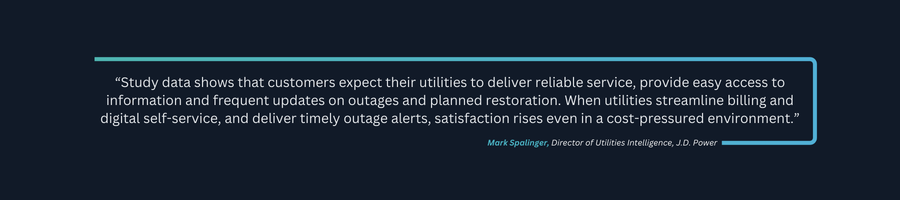
Research consistently shows that over 70% of utility customers rate proactive communication during outages as the top driver of satisfaction. Yet many utilities still rely on overloaded call centers and generic web notices when the grid goes down.
J.D. Power’s 2025 data is striking: business customers who received five or more proactive contacts during an outage scored 699 in safety and reliability satisfaction — a full 210 points higher than those who received no outage information. That’s not a marginal difference. That’s the gap between a customer who trusts you and one who’s filing a PUC complaint.
The best utility CX outsourcing services are now designed around this reality. At Fusion CX, our utility operations don’t wait for customers to call during an outage. We deploy:
- Proactive outbound notification campaigns via voice, SMS, and email — with estimated restoration times updated in real-time
- Inbound surge staffing models that flex within hours based on weather forecasts and grid alerts
- Arya-powered agent dashboards that surface outage maps, affected zones, and ETR data so agents can answer confidently, not read from scripts
- Real-time sentiment tracking through AI QMS — scoring 100% of interactions (not a 2% sample) to ensure tone and accuracy hold under pressure
2. From Billing Support to Affordability Counseling
With bills at record highs and 22% of electric customers unable to pay in full, billing calls aren’t just operational transactions. There are affordability crises in real time. The utility that treats a billing inquiry as a chance to explain charges, offer payment arrangements, guide customers to assistance programs, and proactively suggest rate plan optimization will build trust. The utility that treats it as a 4-minute AHT target will deepen resentment.
J.D. Power reports that 53% of commercial customers selected a new rate plan in 2025, up from 43% in 2024. Specialty, interruptible, and time-based plans have seen the sharpest growth in interest. Customers are actively looking for help — and the call center is where they’re looking.
Fusion CX’s utility CX outsourcing services are built around affordability as a CX competency, not a compliance checkbox. Our agents are trained to navigate assistance programs (LIHEAP, utility hardship funds, budget billing), surface rate plan eligibility mid-call through Arya’s contextual prompts, and treat every billing conversation as a trust-building moment. Our dedicated utility billing services team handles end-to-end billing support — from e-billing enrollment to dispute resolution — so that affordability guidance is seamless, not siloed.
3. From Siloed Channels to True Omnichannel CX
The 2026 J.D. Power U.S. Utility Digital Experience Study found that overall digital satisfaction for utilities is just 616 on a 1,000-point scale — far below wealth management (734), insurance (699), and retirement plans (690). Mobile apps score highest at 654, but 28% of profiled utilities still don’t offer one. A 100-point gap separates the top-performing utility from the bottom.
This digital gap creates a specific outsourcing challenge. When digital self-service fails or doesn’t exist, every unresolved digital interaction becomes a phone call. And when phone agents have no visibility into what the customer already tried online, the experience restarts from zero.
How Fusion CX Connects Utility Channels
Modern utility CX outsourcing services must integrate voice, digital, and proactive outreach so that every interaction shares a single customer context.
The key is that these channels share a single customer view. An agent answering a phone call can see that the customer already submitted a service request via chat two hours ago, checked the outage map on the app, and has a payment arrangement expiring next week. That context turns a repeat-contact frustration into a resolution.
4. From Compliance-Driven to Intelligence-Driven Operations
Utility contact centers operate under regulatory scrutiny that most industries don’t face. Disconnection rules, data privacy requirements, PUC reporting obligations, and service-level mandates create a compliance burden that shapes every interaction. Most outsourcing providers treat this as a risk management exercise: train agents on what not to say, audit a sample of calls, and hope nothing goes wrong.
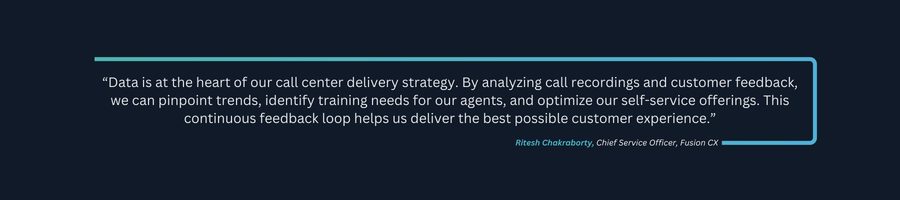
That’s necessary but insufficient. The utilities gaining ground are using utility CX outsourcing services as an intelligence asset — not just a compliance record. An AI-First CX approach makes this possible by embedding intelligence into every layer of the operation, from real-time quality scoring with AI QMS to predictive analytics that flag emerging risks before they become regulatory issues.
Fusion CX’s AI Stack for Utility Intelligence
The intelligence output from this stack doesn’t stay in the call center. It feeds back to the utility’s operations: revealing which tariff structures confuse customers, which outage communication gaps generate repeat contacts, which service territories have emerging satisfaction risks, and where disconnection-related complaints are concentrating before they become PUC inquiries.
5. From Cost-Per-Call to Cost-Per-Outcome
Here’s the metric trap most utility customer care outsourcing services fall into. The utility measures cost per call and average handle time. The outsourcing partner optimizes for both. Calls get shorter. Cost goes down. But first-call resolution doesn’t improve. Payment arrangement enrollment doesn’t increase. Outage-related repeat contacts don’t decrease. PUC complaints don’t drop.
The utilities seeing real business impact from outsourcing have reframed their metrics around outcomes:
- Trust metrics: Did satisfaction hold or improve during a rate increase period?
- Affordability metrics: What percentage of at-risk customers were enrolled in assistance programs or payment plans?
- Digital adoption: How many callers were successfully guided to self-service for their next interaction?
- Regulatory health: Did PUC complaint volume decline relative to customer base growth?
- Revenue protection: What was the collection effectiveness index? Did days’ sales outstanding improve?
This intelligence-led approach delivered measurable results for a utility collections engagement: DSO reduced by 20%, CEI at 88%, and CSAT at 85% — with full TRAI and DPDP compliance.
The Wildcard Utilities Aren’t Preparing For: The Data Center Backlash
Here’s a trend most utility outsourcing discussions are ignoring. Data centers accounted for roughly 4% of U.S. electricity demand in 2025 — and that figure is rising rapidly as AI workloads scale. Sixteen percent of surveyed electric customers already believe data centers and AI contributed to their higher bills.
This is a narrative problem waiting to become a call center crisis. As rate cases increasingly cite infrastructure upgrades needed for data center load growth, customer-facing teams will need to explain why bills are rising without fueling resentment. That requires agents who understand load dynamics, rate case mechanics, and how to translate complex infrastructure economics into clear, empathetic language.
Generic outsourcing partners won’t be ready for this. Fusion CX’s utility domain specialization — built over 33 years of serving energy, gas, and water utilities — means our teams can handle these emerging conversations with the depth and nuance they demand.
Why Outsourcing Strategy Must Differ for Regulated and Deregulated Markets
Most utility outsourcing conversations treat the sector as monolithic. It isn’t. The CX imperatives differ fundamentally between regulated and deregulated markets, and your outsourcing partner should reflect that.
The structure of utility CX outsourcing services must also adapt depending on whether the utility operates in a regulated or deregulated market.
Fusion CX serves both market types across our 40+ delivery centers in 15 countries. For regulated utilities, our utility customer care outsourcing services emphasize trust-building, affordability guidance, and regulatory protection. For deregulated retailers and REPs, we deploy competitive retention models, save-desk operations, and renewal campaigns that directly impact customer lifetime value.
What We’d Tell Every Utility CXO Heading into 2026
Your customers are paying more than ever and trusting you less than ever. That gap between cost and confidence is becoming one of the defining challenges for utilities.
The call center sits at the center of that challenge. If it only answers calls, it amplifies frustration. If it communicates clearly, supports affordability conversations, and explains outages transparently, it becomes a powerful trust-building tool.
That’s why utility CX outsourcing services should be measured by outcomes, not just handle time or cost per contact. The real question is whether your customer experience operation is helping customers understand their bills, navigate outages, and regain confidence in your service.
At Fusion CX, our AI-First CX approach combines domain expertise with platforms like Arya, AI QMS, Accent Harmonizer, and Sayin.AI to deliver smarter, more proactive customer engagement.
If your current utility CX outsourcing services partner cannot show how they are improving trust, affordability, and regulatory health — not just operational costs — it may be time for a different conversation.

Sumanta Ghorai
Sumanta Ghorai is a CX and BPO marketing professional specializing in go-to-market strategy, thought leadership, and presales storytelling for global enterprises. At Fusion CX, he works closely with business and delivery leaders to translate complex CX and AI-driven capabilities into clear, outcome-focused narratives across telecom, utilities, and technology-led industries.


