
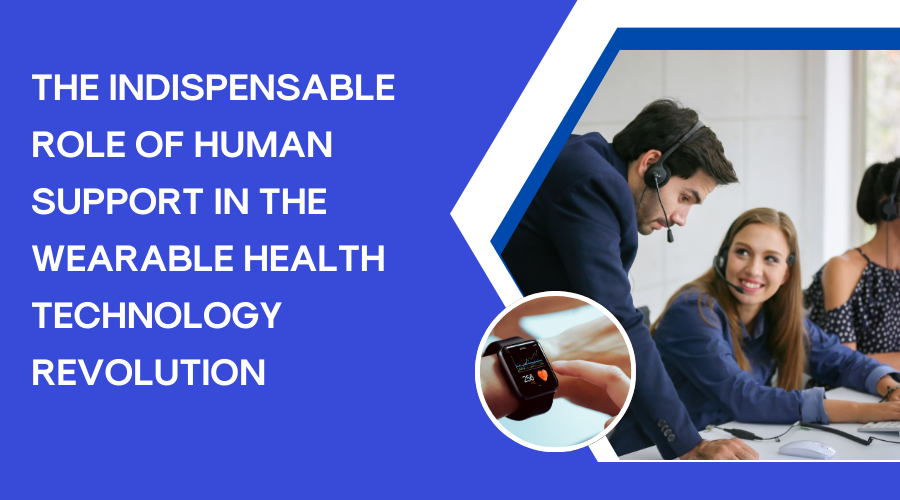
Wearable health technology has matured significantly. Clinical-grade devices that monitor cardiac rhythm, blood glucose, oxygen saturation, blood pressure, sleep quality, and activity patterns are deployed across thousands of health systems and managed care programs. The devices work. The data is clinically valid. The evidence for outcome improvement — when programs are run well — is real.
The variable that separates programs that produce clinical outcomes from programs that generate unused devices and incomplete data streams is not device quality. It is human support. The patients who actually wear the device, transmit data consistently, respond to alerts, and engage with their care team based on what the device reveals are the patients who drive the clinical outcomes that justify the program investment.
This article covers why human support for wearable health technology is not optional, what that support requires at each stage of the patient journey, and what healthcare organizations deploying wearable programs need to build — or outsource — to make those programs work.
The Wearable Adoption Problem — Why Technology Alone Isn’t Enough
Every wearable health technology program faces the same fundamental challenge. Patients receive devices with good intentions. Some set them up immediately and wear them consistently for months. Others set them up, wear them for two weeks, and stop. A significant minority never activates the device at all.
The Adoption Reality
Studies of clinical wearable programs consistently show that 20–40% of enrolled patients either never activate their device or abandon it within 30 days. Among patients who do engage initially, consistent wear compliance at 90 days drops to 55–70% without active engagement programs. The clinical benefit of a wearable device worn 40% of the time is not 40% of the benefit of a device worn every day. For conditions like cardiac arrhythmia or heart failure decompensation, intermittent monitoring misses the events that matter most.
The adoption gap isn’t explained by patient indifference. Research identifies specific, addressable barriers at each stage of the patient journey. Patients don’t activate devices because setup is confusing. They stop wearing devices because of discomfort, connectivity problems, or because nobody noticed or responded when they stopped. They disengage from clinical alerts because alert response feels disconnected from their actual care.
Each of these barriers is a human support problem. None of them are technology problems. Better device design doesn’t solve confusing setup instructions. AI-powered alert systems don’t replace a care coordinator who calls a patient who stopped transmitting and asks why.
Human Support Across the Four Stages of Wearable Patient Engagement
Stage 1 — Enrollment and Onboarding
The first 72 hours after a patient receives a wearable device determine whether the program succeeds. Patients who complete device setup and achieve a first successful transmission within 72 hours have significantly higher 90-day retention rates than those who don’t. The window to capture enrollment momentum is narrow.
Effective wearable onboarding support requires an outbound contact within 24–48 hours of device delivery — before the patient has had time to lose the setup guide, set the box aside, or decide the process is too complicated. The support agent’s job at this stage is:
- Confirm the patient received the device and has it in hand
- Walk through device setup step-by-step — Bluetooth pairing, app installation, account creation — in real time
- Confirm first successful data transmission before ending the call
- Explain what the monitoring program does and what clinical response the patient can expect when alerts occur
- Set expectations for ongoing engagement — how often to wear the device, what transmission cadence looks like, and how the care team will use the data
This call is the most important human touchpoint in the entire wearable program. Patients who complete it with a functioning device and clear expectations engage at 2–3× the rate of patients who received a box with an instruction sheet and no follow-up contact.
Stage 2 — Active Monitoring and Transmission Support
Once a patient is wearing and transmitting, the support requirement shifts to maintaining that behavior. Transmission gaps are the primary failure mode in this stage. Patients stop transmitting for identifiable reasons — device battery failure, Bluetooth connectivity loss, app updates that broke the connection, or gradual disengagement that begins with one skipped day and becomes a week.
Proactive non-transmitter outreach — contacting patients within 48 hours of a transmission gap — is the intervention that restores transmission and prevents episodic dropout from becoming permanent disengagement. The contact serves two functions simultaneously: it resolves the technical barrier that may be causing the gap, and it communicates to the patient that someone is watching and that their data matters.
That second function is more clinically powerful than it sounds. Patients who know their transmissions are monitored and that gaps are noticed wear their devices more consistently than those who feel their data is going into a void. The act of following up on transmission gaps — independent of whether a technical problem exists — sustains engagement through the visibility it creates.
Stage 3 — Alert Response and Clinical Escalation
When a wearable device generates a clinical alert — a blood pressure spike, a weight-gain threshold breach, an oxygen saturation decline, or a cardiac rhythm irregularity — someone must act. The clinical value of the entire monitoring program rests on this single moment. An alert that fires but doesn’t trigger a response is worse than no alert at all. It creates a documented record that a warning signal was identified and ignored.
The Alert Response Standard
Urgent alerts — oxygen saturation below threshold, significant weight gain, cardiac rhythm abnormality — require contact within 4 hours. Standard out-of-range alerts require contact within 24 hours. These are not aspirational targets. They are the clinical response windows within which intervention prevents the deterioration that the alert was designed to detect. Programs that don’t meet these windows are monitoring without responding.
Human support at the alert response stage requires agents who understand the clinical context of the alert — not just the technical fact that a threshold was breached. An agent calling a heart failure patient about a 3-pound weight gain needs to know what that means clinically, what questions to ask, when to escalate to a nurse or physician, and what documentation to create. Generic call center agents without clinical training cannot execute this function safely.
The human support team at this stage acts as a clinical triage layer — distinguishing alerts that require immediate clinical escalation from those that require a care management follow-up from those that result from device error or patient activity. This triage function is what makes alert management scalable for large enrolled populations. Without it, every alert goes directly to a clinician — which is neither sustainable nor appropriately tiered.
Stage 4 — Long-Term Engagement Maintenance
Wearable engagement degrades over time without active maintenance. A patient who wore their device daily in month one wears it every few days by month four and sporadically by month seven. This is not a character failure — it is normal human behavior in the absence of engagement reinforcement. The initial novelty wears off. The sense of urgency that accompanied enrollment fades. And the device becomes background equipment rather than active care management.
Structured engagement check-ins at 30, 60, and 90 days — brief calls that reinforce the clinical purpose of the monitoring, address any accumulated barriers, and update the patient on how their data is being used — significantly extend program engagement. These calls don’t need to be long. A 5-minute check-in that confirms the patient is wearing the device, addresses any concerns, and reinforces that the care team is reviewing their data is sufficient to reset engagement momentum.
The 90-day check-in is particularly important. Programs that proactively reach every enrolled patient at 90 days and offer to address any barriers or answer any questions retain significantly more patients through the critical 6-month mark than programs that contact patients only when alerts fire or transmission gaps appear.
Wearable programs deliver outcomes when patients wear devices, transmit consistently, and respond to clinical alerts. That requires human support infrastructure — not just device technology.
Fusion CX provides dedicated wearable patient support programs — device onboarding, transmission monitoring, alert response coordination, and engagement maintenance. HIPAA-compliant. Multilingual in 28+ languages. Available 24/7.
What Human Support Agents Need to Know for Wearable Programs
Wearable health technology support is a specialized skill set. Standard technical support training produces agents who can troubleshoot Bluetooth connectivity. It doesn’t produce agents who can explain what a CGM reading means for a newly diagnosed diabetes patient, or recognize that a cardiac monitoring patient describing fatigue and shortness of breath needs immediate clinical escalation rather than a scheduled callback.
Device-Specific Technical Knowledge
Every wearable device has specific setup requirements, connectivity challenges, wear guidelines, and calibration processes. Agents supporting a cardiac patch program need different technical knowledge than agents supporting a CGM program. Training must be device-specific — not a generic introduction to wearable technology.
Common technical support scenarios agents must be able to handle include: Bluetooth pairing failures, app connectivity loss after software updates, sensor placement questions, data gap identification and resolution, battery management, and replacement device processes. Each requires documented resolution protocols, not improvisation.
Clinical Context Awareness
Agents in wearable support programs don’t provide clinical advice. However, they must understand the clinical context of the program well enough to:
- Explain — in plain language — why daily monitoring matters for the patient’s specific condition
- Recognize alert language and patient-reported symptoms that require immediate clinical escalation
- Distinguish between a technical data anomaly and a clinical data signal when reviewing transmission records
- Answer patient questions about what their readings mean in general terms while staying within scope
This level of clinical context awareness requires condition-specific training. An agent supporting a heart failure monitoring program needs to understand what fluid retention means clinically, why daily weight measurement matters, and what symptoms suggest decompensation. An agent supporting a CGM program needs to understand the difference between hyperglycemia and hypoglycemia and recognize when a patient’s description of symptoms suggests the latter requires immediate escalation.
Empathy for Chronic Illness
Patients enrolled in wearable monitoring programs are managing serious chronic conditions. Many have lived with their conditions for years. Some are frightened by the monitoring data they’re seeing. Others are frustrated by devices that feel intrusive or uncomfortable. A few are monitoring because they recently had a cardiac event or hospitalization that fundamentally changed how they think about their health.
Agents who approach these patients with the same transactional tone appropriate for a software support line create negative experiences that reduce engagement. Agents who demonstrate a genuine understanding of what it means to manage a serious chronic condition — who hear the anxiety in a patient’s voice when a heart rate alert fires and respond — create the trust that sustains long-term program engagement.
Empathy training for clinical wearable support is not a soft skill add-on. It is a clinical engagement driver with measurable impact on retention and compliance rates.
Population-Specific Human Support Challenges
Older Adults and Digital Literacy
Many clinical wearable programs target older adult populations — heart failure patients, Medicare members with chronic conditions, post-surgical patients requiring remote recovery monitoring. These populations often have lower digital literacy and greater difficulty navigating device setup, app interfaces, and Bluetooth connectivity than younger patients.
Support programs for older adult wearable users must account for this. Setup support calls need to move at the patient’s pace, with agents trained in patience and plain-language technical instruction. Device interfaces that assume smartphone fluency create barriers for patients who use basic cell phones or have limited app experience. And technical support for older adults requires more time per contact — which must be reflected in staffing models.
This connects to the broader digital equity challenge in wearable healthcare programs — the same patients who most need continuous monitoring are sometimes the patients least equipped to navigate the technology without active support. The remote patient monitoring healthcare guide covers the health equity dimension of connected care programs in detail.
Patients With Language Barriers
Clinical wearable programs serving linguistically diverse patient populations — which is increasingly the case in most US markets — require native-language support capabilities. A Spanish-speaking heart failure patient whose device generates a weight gain alert at 6am on a Sunday needs to reach a support agent who speaks Spanish — not an interpreter service that requires a three-party connection and adds friction to a potentially urgent clinical moment.
The language coverage requirement for wearable support isn’t limited to setup calls. It applies to every stage of the patient journey — onboarding, transmission monitoring, alert response, and engagement maintenance. Multilingual support infrastructure for wearable programs is a clinical equity requirement, not a feature enhancement.
Patients With Complex Comorbidities
Many patients in clinical wearable programs carry multiple chronic conditions. A heart failure patient may also manage diabetes, hypertension, and chronic kidney disease. Each condition adds complexity to the monitoring picture and the support conversation. An alert that looks simple in isolation may be more clinically significant in the context of the patient’s full condition burden.
Support agents working with patients with complex comorbidities need access to relevant clinical context — not full medical records, but the key conditions and monitoring parameters that inform the alert-response conversation. They also need lower thresholds for clinical escalation — because the same alert that warrants a standard follow-up call in a generally healthy patient may warrant immediate escalation in a patient with a significant comorbidity burden.
Getting the Technology-Human Balance Right
Wearable health technology programs operate in a constant tension between automation and human touch. AI-assisted alert triage, automated transmission monitoring, and intelligent engagement prompts reduce the per-patient support burden and make programs scalable. But automation that replaces human contact at the wrong moments creates clinical risk and engagement failure.
| Program Function | Automation Appropriate | Human Required |
|---|---|---|
| Transmission monitoring | Automated gap detection and flagging | Human outreach to non-transmitting patients |
| Alert triage | AI categorization and priority scoring | Human response to every flagged alert |
| Appointment reminders | Automated SMS or voice reminder | Human follow-up when the reminder not acknowledged |
| Device setup guidance | Written or video guides for common steps | Live support call for first setup; technical failures |
| Engagement check-ins | Automated engagement prompts and nudges | Human calls at 30/60/90 days for enrolled patients |
| Clinical escalation | Automated notification to the on-call clinician | Humans call the patient for every urgent alert |
The principle is consistent across every program function: automate the detection and routing; keep humans on the response. Algorithms that identify non-transmitters are more efficient than manual review. Phone calls that address why a patient stopped transmitting are more effective than automated text messages.
Building vs. Outsourcing Wearable Patient Support
Healthcare organizations deploying clinical wearable programs face the same build-versus-outsource decision they face across all patient support functions — with the added complexity of condition-specific training requirements and 24/7 coverage needs that most in-house teams cannot sustain.
The argument for outsourcing wearable patient support is particularly strong for programs that:
- Enroll patients with serious conditions requiring 24/7 alert response coverage, which few health systems can maintain in-house at a reasonable cost
- Serve linguistically diverse patient populations requiring native-language support across multiple languages
- Span multiple device types or monitoring programs that require separate condition-specific training curricula
- Experience variable enrollment volume — seasonal programs, post-launch ramp, or AEP-driven Medicare enrollment surges — that make fixed in-house staffing inefficient
The argument for in-house management is strongest for programs with tight EHR integration requirements, where external agents cannot access clinical context, or for programs where the monitoring program is deeply embedded in a specific clinical workflow that requires staff who understand the broader care context.
Many organizations find a hybrid model — outsourcing device onboarding, transmission monitoring, and after-hours alert response while keeping daytime clinical escalation and care coordination in-house — balances both considerations. This model provides 24/7 coverage without 24/7 in-house staffing costs, while keeping complex clinical interactions with the team that has full EHR access.
For the broader framework on wearable programs in specific disease areas — particularly autoimmune conditions and cardiac monitoring — the companion guides on wearable technology in autoimmune care and RPM for chronic disease cover program design and clinical outcome measurement in depth.
Measuring Human Support Effectiveness in Wearable Programs
| Metric | What It Measures | Target |
|---|---|---|
| 72-hour device activation rate | % of enrolled patients with first transmission within 72h of delivery | >85% with proactive onboarding call |
| 90-day wear compliance | % of enrolled days with valid wear data at 90 days | >70% with active engagement program |
| Non-transmitter contact rate | % of 48-hour gaps receiving human outreach | 100% within protocol window |
| Alert response time | Time from alert to first human patient contact attempt | <4h urgent; <24h standard |
| Escalation accuracy | % of clinical escalation triggers correctly identified and routed | >99% — missed escalations are clinical incidents |
| Patient satisfaction with support | CSAT on device support and engagement quality | >4.3/5.0 |
| Program retention at 6 months | % of enrolled patients still actively transmitting at 180 days | >60% with 30/60/90 engagement check-in program |
Track device activation rate and 90-day compliance together — a high activation rate with poor 90-day compliance indicates the onboarding call is working but the ongoing engagement program is failing. A low activation rate with high compliance among activators indicates the onboarding call is missing patients who would have been strong engagers if they’d been reached. The combination tells you where the support program needs investment.
The DME and device support services framework covers how these support programs operate within the broader device delivery and coordination infrastructure — including prior authorization, insurance verification, and patient communication across the full device lifecycle.
Deploying a clinical wearable program and losing patients to device abandonment, transmission gaps, and unanswered alerts?
Fusion CX provides HIPAA-compliant human support for wearable health technology programs — device onboarding, transmission monitoring, non-transmitter outreach, alert response coordination, and 30/60/90-day engagement maintenance. Agents trained in chronic disease context. Multilingual support in 28+ languages. Available 24/7.