
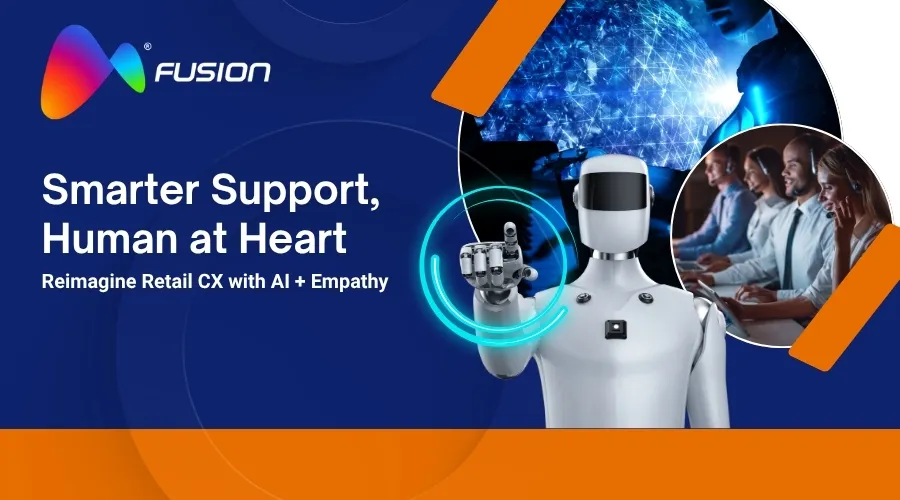
Retail customer care is no longer just about resolving issues — it’s about orchestrating intelligent, consistent, and humanized experiences across every touchpoint. AI-powered retail customer support has emerged as the defining force behind this shift, enabling brands to handle scale, speed, and personalization without sacrificing the empathy today’s consumers demand.
As retail call center outsourcing gains momentum, the brands pulling ahead are those that treat customer support not as a cost center, but as a competitive advantage — one powered by intelligent automation and human judgment working in tandem.
What Is AI-Powered Retail Customer Support?
AI-powered retail customer support refers to the use of artificial intelligence — including chatbots, virtual assistants, sentiment analysis engines, and machine learning platforms — to automate, augment, and personalize customer interactions across the full retail journey. Unlike traditional rule-based systems, modern retail customer service automation learns from every interaction, continuously improving accuracy, tone, and resolution speed.
The scope is broad. AI handles everything from answering FAQs and tracking orders to routing complex complaints to the right agent with full context already loaded. For retailers operating at scale — across time zones, channels, and product categories — this isn’t a luxury. It’s the foundation of a sustainable CX operation.
At Fusion CX, AI-powered retail customer support is never a replacement for human agents. It’s the infrastructure that frees them to do what they do best: build relationships, resolve emotionally charged situations, and represent your brand with empathy.
Why Human Touch Still Matters in Retail Call Centers
Even with AI chatbots and digital self-service channels, there’s no replacing a compassionate voice during a frustrating situation. Whether it’s appliance customer service or handling a delayed fashion order, emotions run high — and empathy matters. This balance is the core of the digital-human nexus driving retail transformation — ensuring efficiency never comes at the cost of connection.
Top reasons human agents remain irreplaceable:
- Building trust in high-stakes moments like damaged electronics or missed deliveries
- Handling sensitive issues like returns and refunds, or navigating product recalls with care
- Reading tone and context — AI can detect emotion, but humans respond to it best
- Handling escalations where a customer needs to feel genuinely heard, not processed
AI tools like Accent Harmonizer support these moments by reducing communication friction, harmonizing accents, and enhancing clarity across every channel — so human agents can focus entirely on the conversation, not the mechanics of it.
How AI Assistants Are Transforming Retail Customer Service
AI assistants have moved well beyond the scripted chatbot era. Today’s AI customer service for retail is context-aware, channel-agnostic, and capable of handling nuanced queries that would have required a live agent just a few years ago.
Across the retail customer service landscape, AI assistants are driving real operational change:
- Conversational AI chatbots resolving order status, delivery updates, and return eligibility — 24/7, with no wait time
- Intelligent routing engines that analyze query intent and customer history before assigning the right agent, reducing handle time and repeat contacts
- AI voice assistants on inbound retail call lines triaging queries before a human even picks up
- Real-time agent assist tools like Arya, which coach agents mid-conversation with next-best-action prompts, relevant knowledge base snippets, and tone guidance
- Proactive outreach bots via Engage that trigger loyalty nudges, abandoned cart reminders, and shipping alerts — turning support moments into revenue opportunities
The result: retail service desks are resolving 70%+ of tier-1 queries through automation, freeing human teams to handle the conversations that genuinely require judgment and empathy. Chatbots are also converting web visitors into buyers during peak sales events — turning cost centers into growth levers.
Automated Retail Technical Support: What AI Handles Best
Technical support is one of the highest-volume, highest-cost areas in retail CX — and one of the best candidates for intelligent automation. Customers reaching out about product setup, connectivity issues, warranty claims, or device compatibility expect fast, accurate answers. Waiting on hold is not an option they’ll tolerate.
Automated retail technical support powered by AI can triage and resolve a wide range of tier-1 technical queries without human intervention:
- Product setup and onboarding — step-by-step AI-guided walkthroughs for consumer electronics, appliances, and connected devices
- Troubleshooting flows — dynamic decision-tree bots that diagnose issues and suggest fixes, escalating only when the problem exceeds automation’s scope
- Warranty and replacement queries — AI instantly checking purchase records and warranty status, then routing to a human agent if a claim needs to be opened
- Driver and firmware support — automated links to the correct downloads based on device model and region
At Fusion CX, tools like MindVoice handle the triage layer on voice channels — identifying query type from the first few words and routing accordingly — while human agents are reserved for the high-empathy moments: a damaged product on a gift for a loved one, a recalled device in a home with young children, or a warranty dispute that needs real advocacy.
This is what smart consumer electronics customer service looks like in practice: fast where speed matters, human where it counts.
Balancing Automation with Empathy: Best Practices for Retail Contact Centers
The brands that get AI-powered retail customer support right are the ones that design for the handoff — not just for the automation. Knowing when to hand a conversation from a bot to a human, and doing so seamlessly, is the difference between a great CX and a frustrating one.
Here’s how leading retail contact center operations balance the two:
- Defined escalation triggers — emotion-flagging, repeat contact detection, and query complexity thresholds that route automatically to a human agent
- Sentiment analysis in real time — AI QMS scoring conversations continuously for frustration signals, not just accuracy metrics
- AI-assisted agent support via Arya — surfacing next-best actions, suggested responses, and relevant policies mid-call so agents never have to put a customer on hold to search a knowledge base
- Empathy training integrated into QA — AI QMS scores conversations not just on resolution rate and handle time, but on empathy markers: tone acknowledgment, active listening indicators, and resolution ownership
- Post-interaction AI analysis — identifying patterns across thousands of conversations to continuously refine bot scripts, escalation rules, and agent coaching priorities
This approach isn’t just more efficient — it produces measurably better customer outcomes. When agents are freed from repetitive queries, coached in real time, and scored on empathy as much as speed, the experience customers receive is genuinely more human.
The Omnichannel Retail CX Experience: AI Across Every Channel
In today’s retail environment, a customer might discover a product on Instagram, add it to cart on mobile, ask a question via live chat, and call in to resolve a delivery issue three days later. If your support operation treats each of those as separate interactions, you’ve already lost the thread.
A seamless omnichannel customer experience in retail means the customer never has to repeat themselves — and your agents never have to guess at context. Intelligent automation in a retail contact center powers this continuity by:
- Giving agents a unified view of all past interactions, purchase history, and open issues — regardless of which channel the customer used
- Enabling voice bots, chatbots, and email AI to hand off conversations with full context preserved
- Personalizing support in real time — AI recognizing a returning VIP customer and adjusting tone, priority, and resolution authority accordingly
- Syncing support data across omnichannel platforms so that every touchpoint informs the next
This isn’t just operationally elegant — it’s commercially significant. Customers who receive consistent, connected support across channels have higher lifetime value, lower churn rates, and are measurably more likely to recommend the brand. Intelligent automation doesn’t just reduce friction. It builds loyalty.
Fashion or Electronics — AI-Powered Retail Customer Support Isn’t One-Size-Fits-All
Retail isn’t a monolith, and neither are the customers in it. What a fashion shopper needs is wildly different from what a customer buying a washing machine expects — and your AI-powered retail customer support strategy has to reflect that.
In fashion and apparel, returns are high. Fit, color, style, delivery delays — the reasons are varied and often emotional. That’s why brands need agents trained in fashion and apparel customer service, supported by AI that handles the logistics so humans can focus on the relationship. Engage automates loyalty nudges, abandoned cart reminders, and proactive delivery updates — so customers feel seen throughout the journey, not just when something goes wrong.
“Fashion may fade, but great service never goes out of style.”
Fusion CX
In consumer electronics and appliances, the support profile is entirely different. Customers reach out for setup assistance, warranty help, or troubleshooting — and they expect precise, fast answers. MindVoice steps in on the triage layer, identifying query type and routing intelligently, while human agents handle the high-stakes moments. It’s support that’s fast, accurate, and scalable without losing the human edge where it matters.
The same principle extends across cosmetics and beauty, consumer packaged goods, and nutritional supplements — each sub-vertical has its own support profile, escalation patterns, and customer expectations. Fusion CX designs AI-powered retail CX programs that are purpose-built for each category, not repurposed from a generic template.
Why Outsourcing Retail Customer Service Is a Smart Move
For many retail brands, building and maintaining an in-house AI-powered support operation is neither practical nor cost-effective. Retail helpdesk outsourcing to a specialist partner like Fusion CX gives brands immediate access to enterprise-grade AI tools, trained agents, and scalable infrastructure — without the overhead of building it from scratch.
Here’s what makes retail customer service outsourcing the smarter path:
- 24/7 multilingual support across voice, email, live chat, and social — covering customers in every time zone and language
- AI tools already deployed and optimized — Arya, MindVoice, MindSpeech, AI QMS, and Engage are live and proven, not on a roadmap
- Real-time dashboards and performance analytics giving retail brands full visibility into CSAT, resolution rates, handle time, and sentiment trends
- Right-shoring flexibility via Fusion CX’s right-shoring model — placing the right support function in the right geography for the right cost and quality balance
- Scalability on demand — surge capacity for peak retail events like Black Friday, holiday season, and major product launches without the risk of overstaffing year-round
Outsourcing isn’t about replacing your team. It’s about extending your brand’s ability to deliver great experiences at a scale you couldn’t build alone.
What Should I Look for in a Retail Customer Service Platform?
For retail brands evaluating a retail customer service platform, the key question isn’t “what does the technology do?” — it’s “does this platform make my agents better and my customers happier?” Here’s what to evaluate:
- Omnichannel coverage — does it unify voice, chat, email, and social into a single agent view?
- AI that augments, not just automates — real-time agent assist, sentiment scoring, and smart routing built in
- Vertical-specific configuration — retail CX has unique patterns (returns, peak demand, product complexity) that generic platforms handle poorly
- Quality management with empathy scoring — not just AHT and CSAT, but conversation-level empathy measurement
- Proven integration with your commerce stack — order management, CRM, loyalty platforms, and inventory systems
Fusion CX’s retail CX platform combines all of the above — with AI tools purpose-built for retail and a delivery model that scales with your business.
Frequently Asked Questions
How do AI assistants improve customer service in retail?
AI assistants in retail handle high-volume, repetitive queries — order tracking, return eligibility, FAQs — instantly and at any hour. They free human agents to focus on complex, emotionally sensitive interactions. More importantly, AI assistants like Arya work alongside human agents in real time, surfacing the right information at the right moment so every conversation is smarter and faster.
What is intelligent automation in a retail contact center?
Intelligent automation in a retail contact center goes beyond basic bots. It combines AI routing, sentiment analysis, real-time agent coaching, and post-interaction analytics into a connected system that improves continuously. The goal isn’t to eliminate human agents — it’s to make every human interaction more effective by handling everything that doesn’t need one.
Can AI fully automate retail customer service?
Not entirely — and it shouldn’t. AI excels at speed, scale, and consistency. Humans excel at empathy, judgment, and building trust in high-stakes moments. The most effective retail customer support operations use AI to handle the volume and humans to handle the value. The optimal split depends on your product category, customer profile, and the complexity of your support queries.
When should a retail brand use a chatbot versus a human agent?
Chatbots are ideal for: FAQs about store policy and product availability, order status and tracking, return procedure guidance, and first-contact triage. Human agents should own: escalated complaints, emotionally sensitive situations, high-value customer interactions, complex troubleshooting, and anything involving judgment calls about exceptions or policy. A well-designed AI-powered retail customer support program defines these boundaries clearly — and makes the handoff between the two invisible to the customer.
Final Thoughts: Keep the Heart, Add the Intelligence
Today’s retail customers want speed, personalization, and empathy — and they want all three simultaneously. AI-powered retail customer support delivers that trifecta when it’s designed with intention: AI handling the volume, humans owning the relationship, and both operating from the same connected platform.
Brands that master this balance aren’t just resolving tickets faster — they’re building loyalty, reducing churn, and turning every support interaction into a brand-defining moment.
Whether you’re a fashion retailer managing high return volumes, an electronics brand handling complex technical queries, or a CPG company navigating product recalls, Fusion CX helps you fuse human care with intelligent automation — at the scale your business demands.