

In today’s hyper-competitive landscape, delivering exceptional customer experience (CX) is no longer a nice-to-have—it’s a business imperative. Customer journey mapping is one of the most powerful tools for achieving this, enabling brands to visualize, understand, and optimize every interaction a customer has with their company. At Fusion CX, we’ve helped numerous clients across industries transform fragmented experiences into seamless, personalized journeys that drive loyalty and growth. This comprehensive guide explores best practices, top tools, and proven strategies for mastering customer journey mapping in 2025 and beyond.
What Is Customer Journey Mapping?
A customer journey map is a visual representation of the complete path a customer takes—from initial awareness to post-purchase advocacy. It captures touchpoints, emotions, pain points, and opportunities across channels, providing a holistic view of the customer experience.
Effective mapping goes beyond simple timelines. In 2025, leading maps will incorporate real-time data, AI-driven insights, emotional metrics, and cross-channel orchestration to create dynamic, actionable blueprints for enhanced CX.
Why Customer Journey Mapping Matters in 2025
According to Salesforce’s 2024 State of the Connected Customer report, 80% of consumers say the experience a brand provides is as important as its products or services. Companies excelling in end-to-end journey management see 20–30% higher customer lifetime value (McKinsey).
Mapping helps identify friction, align teams, prioritize improvements, and deliver personalized experiences at scale. In an era of AI and omnichannel expectations, it’s the foundation for proactive, customer-centric strategies.
Best Practices for Effective Customer Journey Mapping
Follow these proven practices to create impactful maps:
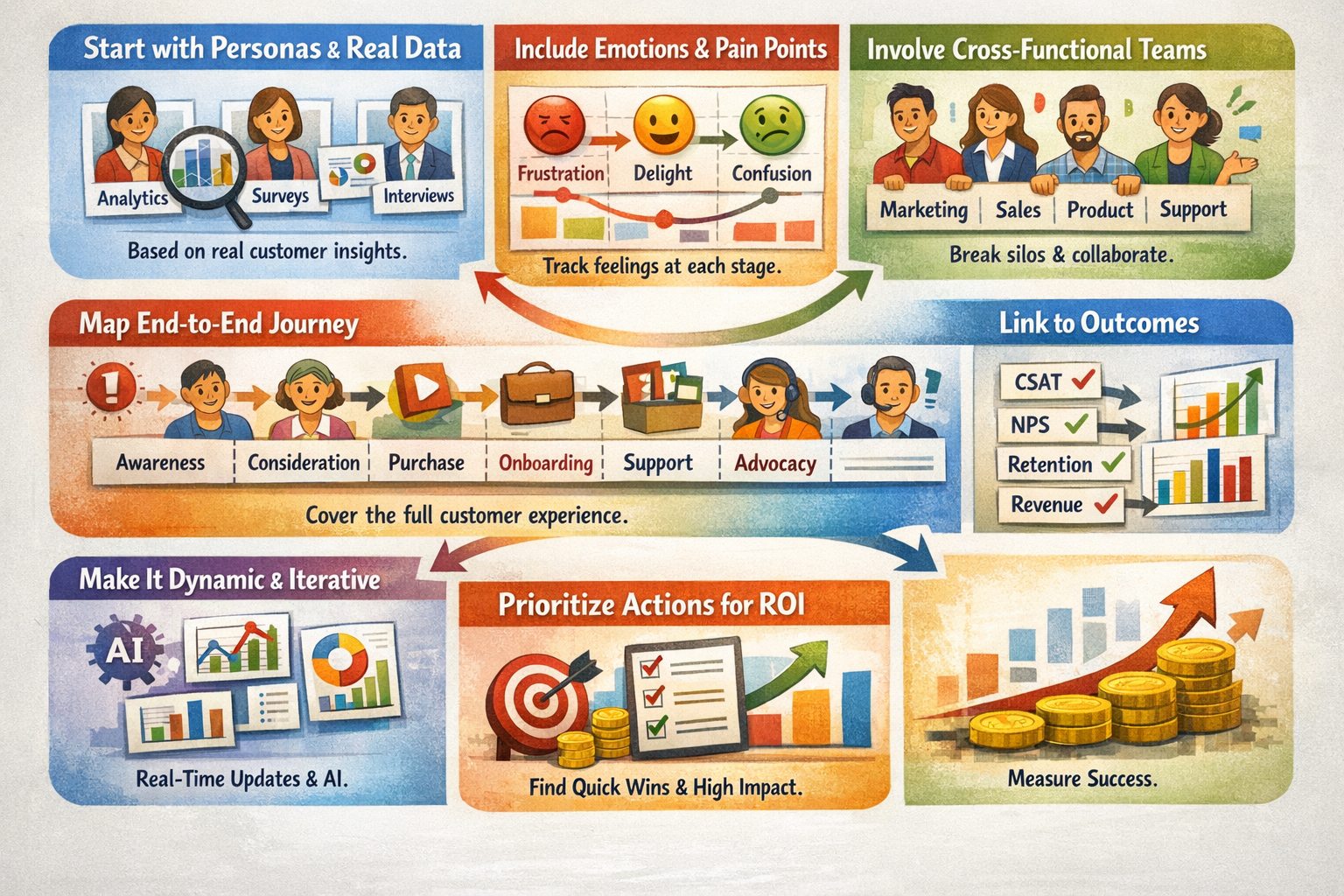
- Start with Personas and Real Data: Base maps on detailed customer personas and actual feedback (surveys, analytics, interviews) rather than assumptions.
- Include Emotions and Pain Points: Track how customers feel at each stage—frustration, delight, confusion—to uncover hidden opportunities.
- Map End-to-End: Cover awareness, consideration, purchase, onboarding, support, and advocacy. Don’t stop at the sale.
- Involve Cross-Functional Teams: Include marketing, sales, support, and product teams to break silos and ensure buy-in.
- Make It Dynamic and Iterative: Use real-time data and AI to update maps regularly as behaviors evolve.
- Link touchpoints to measurable outcomes such as CSAT, NPS, retention, and revenue.
- Prioritize Actions: Identify quick wins and high-impact improvements to drive ROI.
Top Customer Journey Mapping Tools in 2025
Choosing the right tool depends on collaboration needs, data integration, and AI capabilities. Here are some of the leading options:
- Miro: Best for collaborative, visual mapping with AI-assisted insights and templates.
- Lucidchart: Excellent for integrations and real-time team collaboration.
- UXPressia: Persona-driven with advanced customization and impact analysis.
- Smaply: Strong for metrics tracking and persona-focused journeys.
- TheyDo: Ideal for journey management, automation, and linking to tools like Jira.
- FigJam (Figma): Great for design teams needing intuitive, creative mapping.
At Fusion CX, we complement these tools with our omnichannel expertise and analytics platforms to turn maps into orchestrated experiences.
Step-by-Step Strategies to Build and Optimize Your Customer Journey
1. Define Goals and Personas
Align on business objectives and create data-backed personas representing key segments.
2. Gather Insights
Collect quantitative data (analytics, CRM) and qualitative feedback (surveys, interviews).
3. Map Current-State Journey
Plot stages, touchpoints, channels, emotions, and pain points.
4. Identify Gaps and Opportunities
Highlight friction and moments of delight; prioritize using effort-impact matrices.
5. Design Future-State Journey
Create an idealized map with personalized, seamless interactions.
6. Implement and Orchestrate
Integrate omnichannel support, AI personalization, and proactive service—as outlined in Fusion CX’s omnichannel guide.
7. Measure and Iterate
Track KPIs and refine based on ongoing feedback.
The Impact of Strong Customer Journey Mapping
Organizations that master journey mapping report higher satisfaction, reduced churn, and stronger advocacy. At Fusion CX, we’ve seen clients achieve significant CSAT lifts and retention gains by mapping journeys and delivering consistent, empathetic support across channels.
Take Action: Elevate Your CX with Fusion CX
Ready to map and optimize your customer journeys? Fusion CX partners with brands to deliver end-to-end CX solutions, from journey insights to omnichannel orchestration and outsourced support.
Contact Fusion CX today for a customized assessment and start building journeys that turn customers into lifelong advocates.

Alicia Johnson
Alicia Johnson is a CX professional focused on helping organizations deliver consistent, customer-first experiences at scale. At Fusion CX, she works closely with cross-functional teams to support growth through operational excellence, thoughtful CX design, and measurable business outcomes.


