
Businesses face growing challenges in ensuring customer identity today. They must comply with stringent regulatory requirements in a digital world. Therefore, Customer Identity Verification (KYC) Support in Banking plays a critical role. This service verifies customer identities effectively to prevent fraud. Furthermore, it protects sensitive data and ensures legal compliance. KYC processes are now essential for banking, finance, insurance, and telecom sectors. In these industries, knowing your customer is a strict regulatory requirement.
This comprehensive guide explores Customer Identity Verification (KYC) Support in BPO. We look at different types of KYC processes and their operational benefits. Additionally, outsourcing these services can streamline your complex business operations. We also include an informative FAQ section for better understanding.
What is Customer Identity Verification (KYC) Support in Banking?
Customer Identity Verification (KYC) is a crucial process. It verifies individuals’ identities before they access specific services. Consequently, it helps businesses mitigate risks related to fraud and money laundering. It also effectively stops other illegal activities.
In this context, Customer Identity Verification (KYC) Support involves outsourcing these tasks. Businesses hand over the process to specialized third-party service providers. These providers handle tasks efficiently, securely, and in full compliance with global regulations. KYC support processes include verifying identities and documents. It also involves advanced facial recognition and secure authentication techniques. Thus, outsourcing KYC tasks reduces operational costs. It improves efficiency and ensures compliance with required legal standards.
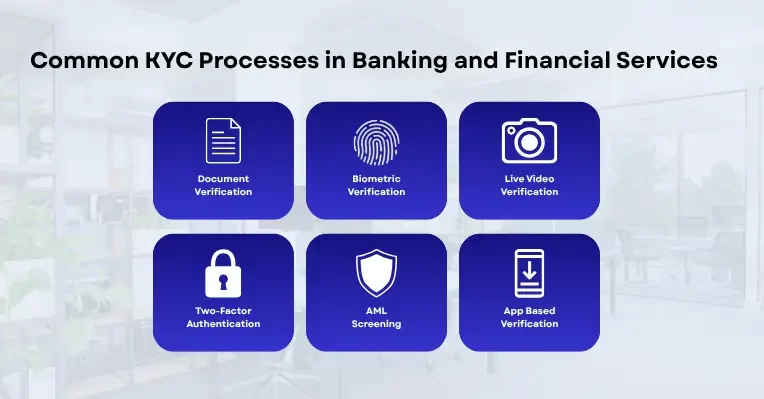
Types of Customer Identity Verification (KYC) Support in Banking
Document Verification
Document verification is a primary method used in modern verification. Customers submit government-issued identification documents. These include passports, driver’s licenses, or national identity cards. Then, BPO service providers check these documents for authenticity. Providers utilize AI-powered tools and human agents for cross-checking. They compare documents against official records to ensure validity.
Biometric Verification
Biometric verification is an essential tool for secure identity checks. This process utilizes biometric data like fingerprints, iris scans, or facial recognition. In modern BPO setups, facial recognition is the most common biometric method. Customers must take a selfie or a video while holding their identification document. After that, the BPO service provider compares facial features with the document photo. This ensures the identity is completely genuine.
Live Video Verification
Live video verification involves a real-time video call. This call occurs between the customer and a verification agent. During the call, the customer shows their identification documents. They also answer security questions and perform specific actions. This process is typically used in high-risk scenarios. Financial services use it because they require enhanced security. This method allows for direct interaction and immediate feedback. Therefore, it serves as a highly reliable verification method.
Two-Factor Authentication (2FA)
Two-factor authentication adds an extra layer of security. It requires customers to provide two distinct forms of verification. First, they provide something they know, like a password. Second, they provide something they have, like a mobile code. This process is common for online banking, e-commerce, and financial services. Within BPO, providers integrate 2FA to ensure secure customer identification. This effectively prevents unauthorized access.
AML Screening (Anti-Money Laundering)
Anti-money laundering (AML) screening is a critical part of KYC. This is especially true in the financial and banking sectors. The process involves screening customers against watchlists and databases. Consequently, it ensures they are not involved in money laundering or financial crimes. AML screening includes checking for politically exposed persons (PEPs). It also checks sanction lists and adverse media reports. BPO service providers offer AML screening as part of a comprehensive solution.
Customer Verification via Mobile Apps
Many businesses turn to mobile apps for KYC verification due to mobile usage. These apps allow customers to easily upload their identification documents. They can also take selfies and complete identity checks directly. In BPO, mobile-based verification is becoming highly popular. It offers a seamless and convenient experience for customers. This is beneficial for individuals in remote or hard-to-reach locations.
Benefits of Specialized Customer Identity Verification (KYC) Support Teams
Improved Security and Fraud Prevention
Enhanced security is a major benefit of outsourcing verification support. Providers verify customer identities using advanced techniques. These include biometric verification, document authentication, and AML screening. As a result, businesses significantly reduce fraud risks. They prevent identity theft and financial crimes. This support ensures only legitimate customers access services, protecting your organization.
Regulatory Compliance
KYC is a strict legal requirement in many industries. Failing to comply with KYC regulations results in hefty fines. It also causes severe reputational damage. BPO providers are proven experts in regulatory compliance. Outsourcing ensures that businesses adhere to relevant laws and guidelines. Therefore, organizations maintain their legal standing and avoid costly penalties.
Cost Efficiency
Outsourcing reduces costs associated with hiring in-house staff. It eliminates the need for internal training and the maintenance of KYC systems. BPO service providers already possess the necessary infrastructure. They have specialized expertise and technology to handle large volumes. This makes it a highly affordable solution for small and medium-sized enterprises.
Faster Processing Times
KYC processes can be time-consuming when done manually. Outsourcing KYC to BPO providers speeds up the verification process. Therefore, it enables businesses to onboard customers much faster. Automated tools, AI-powered solutions, and dedicated agents process requests swiftly. This drastically improves the overall customer experience.
Scalability
The volume of verification requests grows as businesses expand. BPO services are highly scalable. Businesses can easily adjust service levels based on immediate needs. BPO providers have the capacity to scale services seamlessly. They handle hundreds or thousands of customers without compromising quality or compliance.
Enhanced Customer Experience
Outsourcing to professionals provides a streamlined verification experience. Customers no longer wait for extended periods for document verification. They avoid lengthy manual processes. Video calls, biometric scans, and automated systems enable quick checks. Ultimately, this hassle-free process significantly enhances customer satisfaction.
Key Customer Identity Verification (KYC) Support Processes for Banking and Fintech Services
- Customer Onboarding: The onboarding process begins when a new customer signs up. They provide personal information and identity documents. For biometric verification, the customer submits a selfie. Alternatively, they take part in a live video verification.
- Document and Biometric Validation: The BPO provider authenticates documents and biometric data. They use automated tools and human agents. Documents are cross-checked against official databases to ensure validity. Biometric data is compared with official identification to verify the identity.
- AML and Sanction Screening: Next, customer information is screened against AML databases. Providers also check global sanction lists. The BPO service provider ensures the customer’s safety. They verify the customer has no involvement in illicit activities.
- Verification Completion: The customer receives a notification once all verification steps are complete. If successful, the customer accesses the requested service. If there are discrepancies, the customer provides additional documentation.
- Strategic Partnership: Fusion CX delivers expert Customer Identity Verification (KYC) Support in BPO. Our specialized contact center infrastructure ensures full regulatory compliance. We leverage advanced automated tools and human expertise. Thus, Fusion CX optimizes your customer onboarding lifecycle. We reduce operational costs while protecting your business from fraud.
Frequently Asked Questions (FAQs)
What is Customer Identity Verification (KYC) Support in BPO?
Why are KYC and document verification processes important for businesses?
What types of verification are available in Customer Identity Verification support processes?
How does dedicated Customer Identity Verification (KYC) Support lower operational costs?
How do Customer Identity Verification (KYC) service providers ensure customer data safety?
Streamline Customer Identity Verification (KYC) Processes with Fusion CX
Customer Identity Verification (KYC) Support remains an essential service. It helps businesses comply with regulations and reduce fraud risks. Contact Fusion CX today to elevate your operational efficiency. Let our professional BPO teams safely streamline your customer identity verification processes.