
Modern financial institutions face rapid shifts. Therefore, implementing GBS in Banking has become a primary operational strategy. This advanced corporate operating model centralizes internal support functions. It builds a powerful global business services delivery center to standardize operations globally. The model drives enterprise-wide efficiency across multiple departments.
Many companies start with a basic Shared Services model. This early framework isolates individual administrative tasks to reduce costs. For example, it handles payroll or accounts payable separately. However, GBS in Banking takes this model a step further. It integrates these separate functions completely.
Instead of operating in functional silos, this framework manages end-to-end processes. It unifies workflows across the entire enterprise. For instance, HR and IT often handle employee onboarding separately. Conversely, the global model unifies this workflow. Consequently, it provides a seamless, standardized experience.
Understanding Global Business Services and Core Value Creation
A standard global model manages several cross-departmental operations. These core functions include Finance & Accounting. They also include Human Resources and Information Technology. Furthermore, Procurement and Supply Chain management fit into this framework.
Initially, cost reduction serves as the primary catalyst for creating these hubs. However, mature GBS focuses heavily on value creation. It leverages centralized data and standardized processes. Additionally, digital automation transforms operations into a strategic business partner. Thus, institutions achieve greater agility and digital transformation.
Financial leaders now prioritize scale, security, and data-driven intelligence. This prioritization helps them maintain a competitive edge. Therefore, adopting GBS in Banking optimizes performance. It also enhances customer satisfaction and reduces the risk of fraud.
Systemic Gaps in Legacy Customer Support for Banks
Modern banking institutions frequently encounter systemic operational inefficiencies. These issues arise when managing disparate systems. Traditional models often fail to deliver cohesive value. Specifically, they suffer from five structural gaps.
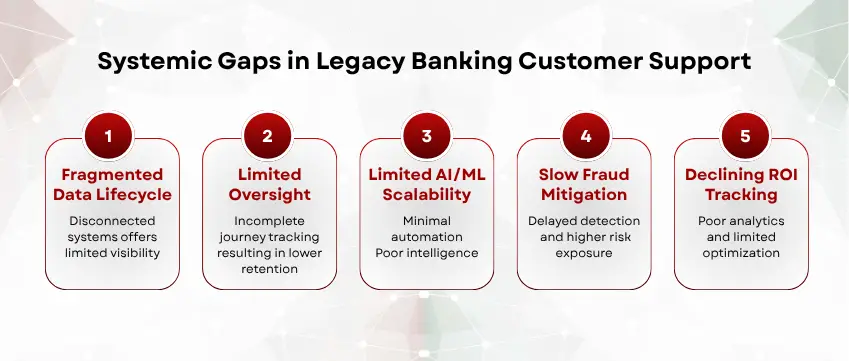
First, they experience fragmented data lifecycles. Many financial organizations continue to operate with isolated data silos. Consequently, this isolation limits real-time visibility.
Second, traditional frameworks offer limited oversight of the customer journey. They struggle to track and optimize customer journeys. Furthermore, they fail to improve critical retention scores.
Third, institutions lack the ability to scale AI/ML. Financial firms frequently fail to apply artificial intelligence to actual business cases. They cannot deploy machine learning at scale.
Fourth, legacy infrastructures suffer from slow fraud mitigation. They cannot detect and mitigate transactional fraud in real time. They also fail to quickly stop other risks.
Fifth, organizations deal with declining ROI tracking. Outdated setups lack analytical tools. Therefore, they cannot accurately monitor and improve overall Return on Investment. Addressing these gaps requires a robust framework for GBS in Banking.
Modern GBS in Banking: Restructuring the Financial Infrastructure
A recent study highlights the power of centralized data. This study focused on analytics maturity for GBS in Banking. Best-in-class organizations fully leverage their data assets. Consequently, they deliver more than 1.5 times the strategic impact of their industry peers.
This strategic impact reflects directly in improved metrics. For instance, it increases employee and customer satisfaction. It also drives revenue growth. Furthermore, it results in reduced fraud risk.
Unlocking greater value from existing data remains critical. It drives comprehensive transformation across the enterprise. Financial enterprises must make data available for use at scale. This accessibility enables organizations to leverage big data. Therefore, they can monitor customer experiences while maintaining baseline metrics.
The historical evolution of shared services underscores this structural shift. Originally, shared services focused on specialized activities. These activities served specific countries or regions. Usually, firms centralized them in lower-cost locations.
However, the modern iteration has evolved into its third wave. This model represents a comprehensive global banking service delivery framework. This model is truly global and multifunctional. It supports finance, HR, IT, and other essential areas. Specifically, it manages the back, middle, and front offices. Enterprise deployment of GBS in Banking bridges these operational worlds.
Driving Value Through Structural Process Standardization Models
The traditional CFO role has undergone a substantial transformation. This change extends far beyond basic operational tasks. Today, executives face intense expectations. They must deliver speed, accuracy, transparency, quality, and trust.
Implementing GBS in Banking enables a next-generation approach. It delivers on these exact core imperatives across four main dimensions.
- Quality: The model delivers enhanced governance and quality control through standardized processes. Consequently, it improves operational consistency, regulatory compliance, and transparency.
- Cost: The framework leverages automation and Generative AI (GenAI). This technology reduces manual effort significantly. It enables vendor self-service. Thus, it improves operational efficiency while lowering costs.
- Insight: The system applies AI, analytics, and enterprise data. This application supports faster decision-making. Furthermore, it improves supplier negotiations and generates actionable business insights.
- Value: As a result, organizations optimize working capital management. They also improve enterprise cash flow. This optimization enables more strategic capital allocation, driving long-term value. Strategic execution of GBS in Banking secures these benefits.
The Evolution of GBS: How Belize GBS Hubs 2026 Power High-Value Financial Operations
For years, outsourcing decisions were largely driven by cost reduction. However, the modern BFSI ecosystem requires specialized providers. Partners must handle complex, compliance-heavy workflows with precision and accountability.
This shift has accelerated the rise of Knowledge Process Outsourcing (KPO). This growth is highly visible within the Belize GBS hubs in 2026. Today, leading providers support advanced financial processes. These tasks extend well beyond traditional customer service operations.
For example, Fusion CX supports BFSI-related outsourcing. This provider manages high-value workflows through Belize GBS hubs 2026. The specialized functions span multiple operational capabilities:
- Credit & Risk Analytics: This covers loan pre-screening, underwriting support, and risk scoring.
- KYC & AML Compliance: Teams manage identity verification and fraud detection workflows.
- Insurance Claims Processing: This includes FNOL management, adjudication support, and subrogation scoring.
- Wealth Management Support: Specialists handle NAV auditing, reconciliation, and portfolio administration.
- Financial Customer Support: This provides omnichannel servicing with bilingual expertise
Credit & Risk
Analytics
- Loan Pre-screening
- Underwriting Support
- Risk Scoring
KYC & AML
Compliance
- Identity Verification
- AML Screening
- Fraud Detection
Insurance
Claims Processing
- FNOL Management
- Adjudication Support
- Subrogation Scoring
Wealth
Management
- NAV Auditing
- Reconciliation
- Portfolio Administration
Financial Customer Support
Omnichannel customer servicing with bilingual banking experts delivering seamless support across voice, email, chat, and digital channels.
This transition enables financial institutions to redirect internal teams. Consequently, corporate teams focus on innovation, product development, and customer growth. Meanwhile, operational specialists manage high-volume transactional workloads. This setup acts as an ideal GBS for US enterprises seeking nearby expertise. This structural evolution redefines how institutions view GBS in Banking.
Redefining the Right in Right-Shoring Delivery Models
The old debate between offshore and nearshore has evolved. Modern enterprises demand an agile, dedicated partner. This strategy prioritizes quality, cultural alignment, and operational continuity. It focuses heavily on business outcomes.
The model is about placing critical financial workflows in optimal geographic regions. Choosing a nearshore GBS location offers technical talent and regulatory familiarity. It also ensures operational proximity. For major banking institutions, anchoring operations with a provider offers distinct structural advantages. This strategy serves as an effective rightshoring GBS approach.
First, it provides Real-Time Operational Proximity. Modern fintech services are mostly instant solutions. For this reason, customer issues require immediate resolution. This model uses centers that operate in synchronous time zones of primary markets. This setup eliminates communication delays. Consequently, services feel seamless to end clients. Real-time collaboration helps to keep tight control over service quality.
Second, it delivers Cultural Fluency and Empathy. Customer interactions are inherently high-stakes. This is true in retail banking, wealth management, and insurance customer support. Right-shore teams offer a natural alignment and structural empathy. This directly improves first-contact resolution rates and boosts CSAT scores.
Third, it ensures Business Continuity and Geopolitical Stability. A resilient framework cannot rely on a single geographical basket. Diversifying your operational footprint across stable right-shore locations mitigates risk. It ensures robust disaster recovery. Most importantly, it protects continuous uptime for critical financial processes. Therefore, optimization relies on a strong framework for GBS in Banking.
Leveraging Fusion CX for Global Banking Service Delivery
Enterprise leaders require a mature partner to execute these models. Fusion CX aligns perfectly with these advanced global frameworks. By implementing standardized governance, Fusion CX helps optimize GBS in Banking. It addresses legacy data silos and integrates front, middle, and back-office functions seamlessly.
Furthermore, the infrastructure ensures complete compliance with global financial standards. It utilizes advanced automation and analytics to drive measurable ROI. Transitioning to this setup minimizes operational risks.
Frequently Asked Questions (FAQs)
What is the main difference between traditional Shared Services and GBS in Banking?
How does data utilization in a modern global banking service delivery framework impact performance?
What specific dimensions of value do structural process standardization models deliver to CFOs?
Which specialized BFSI functions are managed through Belize GBS hubs in 2026?
Why is real-time operational proximity crucial for rightshoring GBS delivery models?
Partner with Fusion CX for NextGen Customer Support in Banking
Transforming financial operations requires moving beyond legacy functional silos. Embracing modern GBS in Banking ensures robust data compliance, real-time fraud mitigation, and exceptional customer journeys. Fusion CX stands ready to optimize your operational infrastructure globally. Contact Fusion CX today to implement NextGen Customer Support in Banking and secure long-term operational value.