
Travel has always been personal. Every itinerary reflects a unique purpose—whether it is a family vacation, a business trip, a honeymoon, or an adventure halfway across the world. Yet for years, customer interactions across the travel industry have remained surprisingly generic. Travelers still receive irrelevant promotions, have information repeated to multiple agents, and experience disconnected support across channels.
That approach is no longer sustainable.
In 2026, Hyper-Personalization in the Travel Customer Experience has become one of the most significant competitive differentiators for airlines, hotels, online travel agencies (OTAs), cruise operators, and destination management companies. Travelers no longer compare brands solely on price or convenience. They compare experiences.
Brands that understand individual preferences, anticipate customer needs, and deliver contextual support throughout the travel journey are building stronger loyalty and increasing operational efficiency.
This shift is transforming the way travel companies engage customers—from the first website visit to long after the trip has ended.
What Is Hyper-Personalization in Travel Customer Experience?
Unlike traditional personalization, which relies on basic customer information such as names or previous bookings, Hyper-Personalization in Travel Customer Experience combines real-time data, behavioral insights, artificial intelligence, predictive analytics, and customer history to create highly relevant interactions.
Instead of simply recommending another beach destination because a traveler previously visited Bali, hyper-personalization evaluates factors such as:
- Travel frequency
- Preferred airlines
- Spending behavior
- Loyalty status
- Real-time location
- Weather conditions
- Previous customer service interactions
- Device preferences
- Communication channels
- Booking patterns
The result is an experience that feels proactive rather than reactive.
Modern travelers increasingly expect brands to remember their preferences and eliminate unnecessary friction. Every interaction should feel connected, whether it happens through a website, mobile app, chatbot, social media, email, or live agent.
Why Travelers Expect More Than Ever
Customer expectations have evolved dramatically over the past few years.
Digital-first consumers interact daily with platforms that provide highly personalized recommendations. Streaming services remember viewing habits. Online retailers anticipate purchases. Food delivery apps understand ordering patterns.
Travel brands are now expected to deliver the same level of intelligence.
Imagine a traveler whose flight is delayed because of severe weather. Instead of waiting for the customer to contact support, a travel company could automatically:
- Notify the traveler immediately.
- Suggest alternative flights.
- Update hotel check-in times.
- Arrange airport transportation.
- Offer compensation based on loyalty status.
- Connect the traveler with an agent already aware of the situation.
This level of proactive service dramatically reduces customer effort while improving satisfaction.
Delivering these experiences requires far more than automation—it requires intelligent orchestration across every touchpoint.
AI Is Powering the Next Generation of Personalized Travel Customer Service
Artificial intelligence has become the foundation of Personalized Travel Customer Service.
Today’s AI solutions continuously analyze customer behavior and operational data to predict traveler needs before they arise.
Some of the most impactful applications include:
Intelligent Booking Recommendations
AI analyzes customer preferences, travel history, budgets, and browsing behavior to recommend destinations, hotels, flights, or vacation packages that are genuinely relevant.
Predictive Customer Support
Instead of waiting for travelers to report problems, predictive systems identify potential disruptions and automatically initiate support.
Multilingual Conversations
International travelers expect assistance in their preferred language. AI-powered translation combined with multilingual agents creates seamless global experiences without sacrificing personalization.
Smart Contact Center Routing
Rather than routing customers randomly, intelligent systems connect travelers with agents best equipped to resolve their specific issue based on language, booking type, loyalty tier, or previous interactions.
The result is faster resolution times and significantly improved customer satisfaction.
Hyper-Personalization Extends Beyond Marketing
Many organizations still associate personalization primarily with promotional campaigns.
In reality, the greatest opportunities exist within Travel Customer Support Services.
Every customer service interaction generates valuable insights that can improve future experiences.
For example:
A guest who consistently requests late check-outs should not have to repeat that preference during every hotel stay.
A business traveler who regularly books aisle seats should automatically receive relevant recommendations.
A family traveling with young children should receive different communications than a solo backpacker.
By integrating customer support data with booking systems and CRM platforms, travel companies create a unified customer profile that improves every future interaction.
Support becomes an extension of the customer journey—not merely a problem-solving function.
The Business Benefits of Hyper-Personalization
Implementing Hyper-Personalization in Travel Customer Experience delivers measurable advantages across the organization.
Increased Customer Loyalty
Travelers are far more likely to return to brands that consistently understand their preferences and remove friction throughout the journey.
Higher Revenue Opportunities
Relevant recommendations generate stronger conversion rates than generic promotions.
Personalized upgrades, ancillary services, travel insurance, airport transfers, and premium experiences become natural extensions of the booking process rather than aggressive sales attempts.
Reduced Customer Effort
Customers spend less time repeating information or navigating multiple support channels.
Lower effort often translates directly into higher satisfaction scores.
Better Operational Efficiency
AI handles routine inquiries while providing agents with contextual customer information before conversations begin.
This allows human agents to focus on complex, high-value interactions instead of repetitive administrative tasks.
Stronger Brand Reputation
Exceptional customer experiences naturally generate positive reviews, referrals, and long-term advocacy.
In an industry where reputation significantly influences purchasing decisions, this competitive advantage is difficult to overstate.
Building Travel Customer Experience Solutions That Scale
Creating personalized experiences requires more than adopting new technology.
Successful organizations build integrated Travel Customer Experience Solutions that connect people, processes, and platforms.
These solutions typically include:
- Omnichannel customer support
- AI-powered virtual assistants
- Customer relationship management (CRM) integration
- Predictive analytics
- Knowledge management systems
- Multilingual support capabilities
- Workforce optimization
- Quality monitoring
- Customer sentiment analysis
Together, these capabilities enable organizations to deliver consistent experiences regardless of channel or geography.
As travel businesses expand internationally, maintaining that consistency becomes increasingly important.
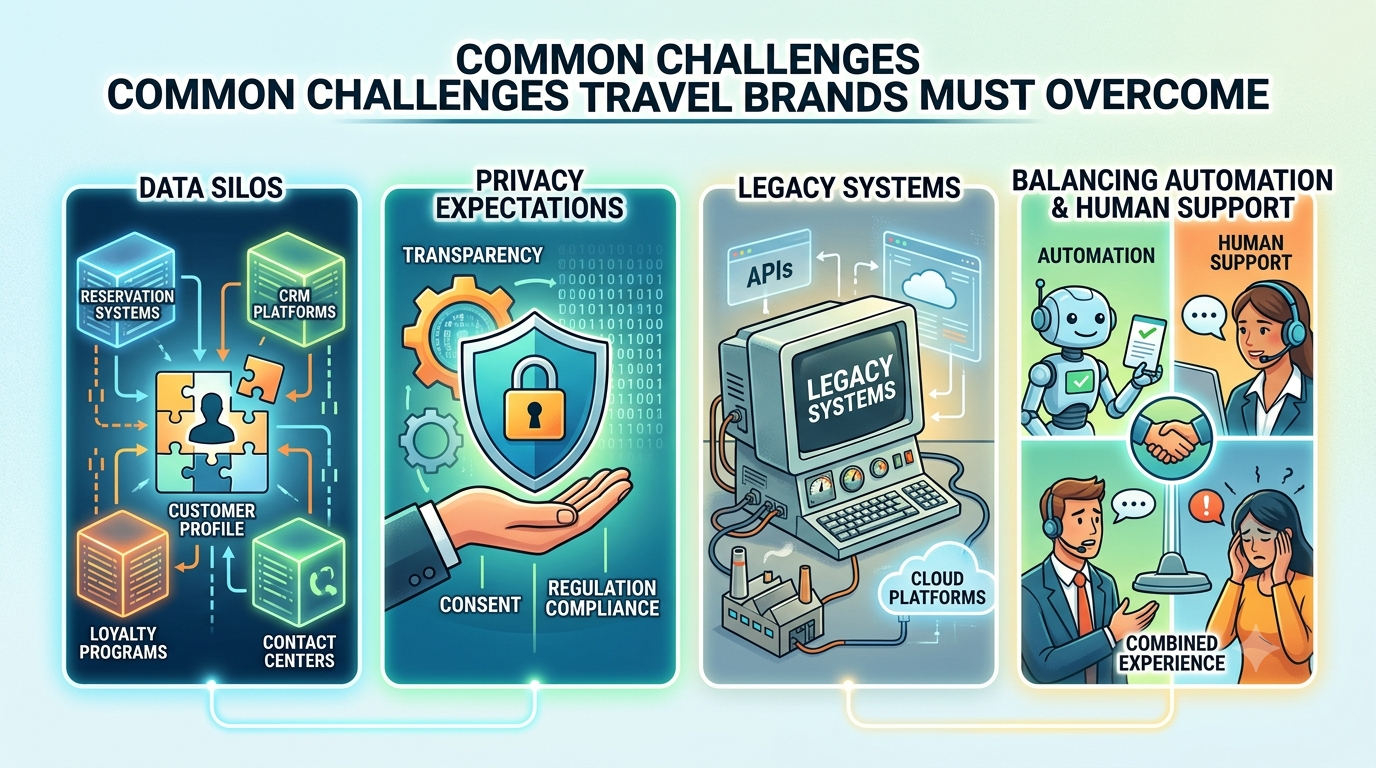
Common Challenges Travel Brands Must Overcome
While the benefits are compelling, implementing hyper-personalization presents several challenges.
Data Silos
Customer information often resides across reservation systems, CRM platforms, loyalty programs, and contact centers.
Without integration, creating a complete customer profile becomes difficult.
Privacy Expectations
Travelers appreciate personalized experiences but also expect responsible data handling.
Organizations must maintain transparency, obtain appropriate consent, and comply with evolving privacy regulations.
Legacy Systems
Many travel organizations continue to operate on outdated technology that limits their personalization capabilities.
Modern APIs, cloud platforms, and AI-powered customer experience platforms help bridge these gaps.
Balancing Automation with Human Support
Automation improves efficiency, but empathy remains essential during flight disruptions, cancellations, medical emergencies, or other emotionally sensitive situations.
The strongest customer experiences combine intelligent automation with skilled human agents.
The Future of Hyper-Personalization in Travel
The next evolution of Hyper-Personalization in the Travel Customer Experience will go beyond merely responding to customer behavior.
It will anticipate traveler intent.
Future travel experiences may include:
- AI-generated travel itineraries based on personal interests.
- Dynamic loyalty rewards tailored to individual preferences.
- Real-time travel assistance using predictive analytics.
- Voice-enabled customer support across connected devices.
- Personalized offers that adapt instantly to changing travel conditions.
- Intelligent post-trip engagement designed to encourage repeat bookings.
As AI continues to mature, personalization will become increasingly seamless, making every stage of the customer journey feel connected and effortless.
Why Fusion CX Is the Right Partner for Hyper-Personalized Travel Experiences
Delivering Hyper-Personalization in Travel Customer Experience requires more than implementing AI or deploying a new CRM platform. It demands a strategic partner that understands the complexities of the travel ecosystem and can seamlessly connect technology, people, and processes to create exceptional traveler experiences.
At Fusion CX, we help travel brands transform customer interactions into meaningful, loyalty-building moments. Our deep expertise across airlines, hotels, online travel agencies (OTAs), cruise lines, car rental companies, and destination management organizations enables us to design customer experience strategies that are both scalable and tailored to the unique demands of the travel industry.
Our approach combines human expertise with intelligent automation to deliver personalized experiences at every stage of the traveler journey. From pre-booking inquiries and reservation support to disruption management, post-trip engagement, and loyalty program assistance, we empower brands to deliver consistent, context-aware service across every touchpoint.
Fusion CX’s travel-focused capabilities include:
- AI-powered customer engagement that delivers faster, more personalized interactions.
- Omnichannel support across voice, chat, email, messaging platforms, and social media.
- Multilingual customer support that helps global brands serve travelers in their preferred language.
- Intelligent agent assistance and knowledge management tools that reduce resolution times while improving service quality.
- Advanced analytics and customer insights that uncover behavioral trends and enable proactive engagement.
- Flexible, scalable support models that adapt to seasonal demand, unexpected disruptions, and business growth.
As travelers’ expectations continue to evolve, personalization is no longer a luxury—it is a business necessity. Fusion CX combines industry expertise, digital innovation, and customer-first thinking to help travel brands deliver experiences that increase customer satisfaction, strengthen loyalty, and create lasting competitive advantage in an increasingly experience-driven market.
Conclusion
Travel has become an experience economy, where customer expectations evolve faster than ever.
Generic interactions are no longer enough to inspire loyalty or differentiate a brand. Today’s travelers expect organizations to recognize their preferences, anticipate their needs, and deliver meaningful support across every touchpoint.
That is why Hyper-Personalization in Travel Customer Experience is no longer an emerging trend—it is becoming the foundation of modern travel service.
Organizations that invest in Personalized Travel Customer Service, strengthen their Travel Customer Support Services, and implement scalable Travel Customer Experience Solutions will be better positioned to improve customer satisfaction, increase loyalty, and drive long-term business growth.
As competition continues to intensify throughout 2026 and beyond, the question is no longer whether travel brands should embrace hyper-personalization.
The real question is how quickly they can make it a reality.