
Picture this. A major system update rolls out across your airline’s booking and operations infrastructure late on a Friday night. By early Saturday morning, your support queues begin to fill—passengers unable to complete bookings, check-in failures, mobile app glitches, payment errors, and a rising number of complaints across social and voice channels. By midday, your technical support and customer service teams are handling thousands of interactions, all tied to system friction that requires immediate resolution. This is what happens when you do not have Airlines Technical Support Services.
Your in-house team, built to handle steady operational demand, is suddenly overwhelmed by a surge that simultaneously cuts across technical support and customer experience. Average resolution times begin to increase as agents struggle to diagnose issues, escalation rates spike as first-line teams lack system-level visibility, and customer frustration escalates rapidly across channels. Meanwhile, airport support teams are fielding on-ground complaints from passengers who cannot check in, access boarding passes, or resolve booking discrepancies.
And then, as systems stabilize, volumes begin to drop—until the next disruption, peak travel window, or operational event triggers the same pattern again.
This is not an isolated incident. This is the structural reality of airlines technical support services at scale.
Get Ready for Peak Season
Is Your Airline CX Operation Ready for Sudden Peaks in Customer Engagement?
Talk to Fusion CX about building scalable airline technical support services designed for operational disruptions, peak travel demand, and growing passenger expectations. We can have dedicated support teams trained and ready before the next surge hits.
The Scale Problem: Most Airlines Underestimate
The aviation industry operates in an environment where operational continuity and customer experience are tightly intertwined. Yet many airlines still treat technical support and customer service as parallel functions rather than interconnected systems. As passenger volumes increase and digital touchpoints expand—from mobile apps and self-service kiosks to online booking engines and loyalty platforms—the volume and complexity of support interactions grow at a pace rarely anticipated.
The common assumption is that demand for support will scale proportionally with passenger growth, allowing airlines to expand their internal teams gradually. In reality, demand for airline support behaves very differently.
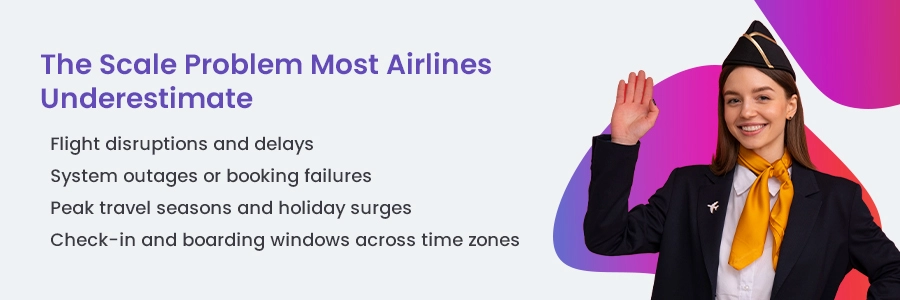
Instead of a steady flow of interactions, airlines experience concentrated spikes in demand, driven by:
- Flight disruptions and delays
- System outages or booking failures
- Peak travel seasons and holiday surges
- Check-in and boarding windows across time zones
These spikes create periods of extreme pressure followed by relatively stable intervals, making it difficult to maintain an in-house model that is both cost-efficient and capable of delivering consistent service quality.
As a result, airlines attempting to manage this internally often find themselves caught between overstaffing for peak periods and underperformance during critical operational windows—both of which directly impact passenger satisfaction and operational efficiency.
Why Airlines Technical Support Services Are Structurally Different
Traditional customer service models in travel environments are largely transactional. A customer books a service, encounters an issue, and contacts support. These interactions are typically isolated and distributed over time.
Airlines technical support services do not follow this pattern.
In aviation, support demand is event-driven at scale, meaning that a single operational issue—such as a system glitch, delayed flight, or payment failure—can trigger thousands of simultaneous interactions across multiple channels. Unlike other industries, where issues affect individual customers, airline disruptions often affect entire cohorts of passengers at once.
This creates a fundamentally different support environment where:
- Technical issues and customer experience are inseparable
- Contact volumes spike simultaneously across voice, chat, email, and airport desks
- Resolution requires both system-level knowledge and customer handling skills
A failure in one part of the system—whether it is a booking engine error or a mobile app outage—does not remain contained. It cascades across digital channels, contact centers, and physical airport touchpoints, amplifying the operational impact.
This is why traditional in-house support models struggle to keep pace. The complexity lies not just in volume but in the interdependence among systems, channels, and passenger expectations.
Learn how better customer experience can change the whole experience of your customers.
The Core Interaction Types That Define Airline Support Operations
To understand where support models break, it is essential to examine the types of interactions that dominate airline environments. These are not generic customer queries—they are operationally critical events that require immediate and accurate resolution.
Booking and Payment Failures
One of the most common triggers for inbound volume is failure within booking systems, including payment processing errors, transaction timeouts, or discrepancies in fare display. These interactions often occur at scale, particularly during peak booking periods or promotional campaigns.
Passengers encountering these issues expect immediate resolution, and delays can lead to abandoned bookings, revenue loss, and a negative brand perception. Resolving these queries requires agents who can navigate both customer-facing systems and backend workflows, ensuring that issues are addressed without unnecessary escalation.
Check-In and Boarding Issues
Check-in failures—whether through mobile apps, web platforms, or airport kiosks—represent another high-volume category of interactions. These issues are time-sensitive and often occur within narrow operational windows, where passengers are under pressure to complete processes before boarding deadlines.
When these interactions are not resolved quickly, they escalate from digital inconvenience to on-ground disruption, placing additional strain on airport staff and increasing the risk of delays.
This is where call center services for airports become critical, serving as an extension of on-the-ground operations and ensuring passengers receive timely support across channels.
Flight Disruptions and Rebooking Requests
Flight delays, cancellations, and schedule changes generate immediate spikes in contact volume, as affected passengers seek information, alternative options, and reassurance. These interactions are inherently complex, requiring coordination between systems, policies, and real-time availability.
Handling these effectively requires more than basic customer service—it requires agents who understand airline operations, fare rules, and rebooking logic, enabling them to resolve issues efficiently without creating additional friction.
Loyalty Program and Account Support
Frequent flyer programs and loyalty accounts introduce another layer of complexity, as passengers engage with points, upgrades, and tier benefits that are often tied to multiple systems. Issues related to account access, point redemption, or status discrepancies can generate high volumes of support requests, particularly among high-value customers.
These interactions require precision and consistency, as errors or delays can impact long-term customer loyalty.
When In-House Airline Support Models Break
At smaller scales, in-house teams can manage these interaction types through a combination of staffing flexibility and operational adjustments. As airlines grow, however, the limitations of this approach become increasingly evident.
The breakdown typically follows a predictable pattern:
- Contact volumes spike beyond baseline capacity during disruptions or peak travel periods
- Resolution times increase as agents struggle with both technical and customer-facing queries
- Escalation rates rise due to a lack of system-level expertise at the front line
- Passenger dissatisfaction increases as delays in support impact the travel experience
- Airport teams become overloaded as unresolved issues spill into physical touchpoints
- Internal teams experience burnout due to recurring high-pressure cycles
At this stage, airlines are forced into a difficult trade-off between maintaining excess capacity and accepting inconsistent service quality—neither of which is sustainable in a competitive environment.
What Outsourcing Airlines Services Actually Changes
The decision to outsource airline services is often framed as a cost-optimization strategy, but in practice, its primary value lies in addressing structural inefficiencies and enhancing operational capabilities.
A specialized outsourcing model introduces several key advantages:
Elastic Workforce Management
Outsourcing enables airlines to dynamically scale support capacity in response to demand fluctuations, ensuring peak periods are adequately staffed without maintaining excess resources during off-peak periods.
24/7 Airlines Customer Support Across Time Zones
Air travel is inherently global, and passenger support needs do not align with fixed operating hours. A dedicated outsourcing partner provides 24/7 airline customer support, ensuring continuous coverage across regions, time zones, and channels, and eliminating service availability gaps.
Technical and Operational Expertise
Outsourced teams are trained in both airline systems and customer-interaction protocols, enabling them to handle complex queries spanning technical troubleshooting and passenger communication. This reduces escalation rates and improves first contact resolution.
Integrated Omnichannel Support
Modern airline support requires seamless interaction across voice, chat, email, social media, and airport desks. Outsourcing partners provide unified support models that ensure consistency across channels, improving the overall passenger experience.
What to Look for in an Airline Support Partner
Not all outsourcing providers are equipped to handle the complexity of airline operations. Selecting the right partner requires careful evaluation of several key factors:
- Proven experience in aviation and airline support environments
- Capability to deliver airline technical support services alongside customer service
- Infrastructure for 24/7 airline customer support across multiple regions
- Integration with airline systems, including booking engines and operational platforms
- Ability to support airport operations through dedicated call center services for airports
- Workforce models designed to handle demand spikes during disruptions and peak travel periods
- Strong data security and compliance standards
A partner that can demonstrate measurable performance across these areas is significantly better positioned to support airline operations at scale.
How Fusion CX Delivers Airline Support at Scale
Fusion CX provides specialized support solutions tailored to the aviation industry, combining technical expertise with customer experience management to address the unique challenges of airline operations.
Its approach includes:
- Dedicated teams trained in airline systems, workflows, and passenger interaction standards
- Scalable workforce models designed to handle peak demand and operational disruptions
- Integrated omnichannel support covering digital and on-ground touchpoints
- AI-enhanced quality frameworks that ensure consistency, accuracy, and compliance
By aligning support operations with the realities of airline environments, Fusion CX enables airlines to manage increasing passenger volumes without compromising service quality or operational efficiency.
Final Thought
Airline support operations do not fail because of isolated issues. They fail when systems, processes, and teams are not designed to handle the scale and variability of demand that defines the industry.
Passengers experience this not as operational complexity, but as friction—delays in resolution, inconsistent communication, and gaps in support that directly impact their journey.
Addressing this requires more than incremental improvements. It requires a structural approach that aligns support capabilities with the realities of airline operations.
In this context, airlines’ technical support services are not just a support function—they are a critical component of operational resilience and passenger experience, and the ability to scale them effectively determines how well an airline performs under pressure.