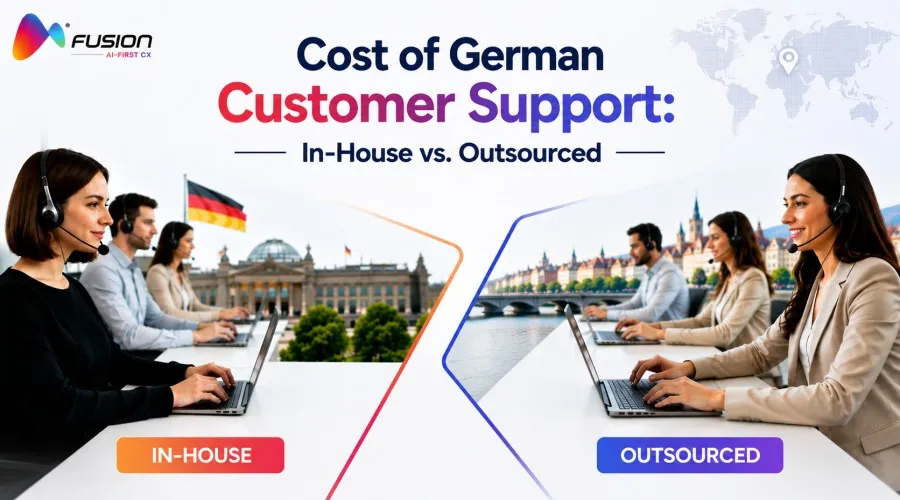
When businesses budget for German customer support, they usually start with one number: the agent’s salary. That is where the miscalculation begins. In Germany, the advertised wage is only the foundation of a much larger cost structure, and the gap between gross salary and fully loaded cost is where finance teams get surprised. Understanding the real German call center cost means looking past the paycheck to social contributions, recruitment, management, technology, facilities, compliance, and attrition, and then asking the more important question: is it cheaper to build the team in-house or to outsource it? This guide breaks down both sides so you can budget with the true numbers.
What “German Call Center Cost” Really Includes
A German call center cost is a fully loaded number, not a salary line. Beyond gross pay, an employer in Germany carries mandatory social security contributions, statutory levies, recruitment and onboarding, supervision and quality management, technology and workstations, facilities, and the ongoing cost of attrition. Germany is one of Europe’s higher-cost hiring markets precisely because of its strong worker protections and comprehensive social system, so any honest comparison has to load all of those costs onto both the in-house and the outsourced side before you can judge value.
The True Cost of In-House German Support
Building your own team means absorbing every one of those costs directly. Start with gross salary: a competent German customer service agent typically earns somewhere in the region of €30,000 to €38,000 per year. On top of that, employer social security contributions, covering pension, health, unemployment, and long-term care insurance, add roughly 19% to 23% of gross, with additional statutory levies adding another 2% to 3%. As a rule of thumb, total employment cost in Germany runs about 1.2 to 1.35 times base salary before you have paid for anything else.
Then come the indirect costs that rarely make the first budget: recruitment and hiring (which commonly takes four to twelve weeks in Germany), management and supervision, training, workstations and software, telephony, real estate, payroll administration, and GDPR and BDSG compliance overhead. Layer in attrition and retraining, and a fully loaded in-house seat for a call center in Germany often lands between €55,000 and €90,000 per agent per year. Strong statutory notice periods also make it slow and costly to scale down when volume falls.
The typical in-house cost stack looks like this:
- Gross salary — ~€30,000–€38,000 per agent.
- Employer social contributions — +19%–23% of gross.
- Statutory levies — +2%–3% of gross.
- Recruitment, management, training — significant, and recurring with attrition.
- Technology, workstation, telephony, facilities — fixed overhead per seat.
- Compliance and payroll administration — ongoing GDPR/BDSG and reporting burden.
The Cost of Outsourced German Support
Outsourcing replaces that stack with a single, predictable per-seat or per-hour rate, and the partner absorbs recruitment, facilities, technology, compliance, and attrition. There are two broad options. Onshore German BPO keeps delivery inside Germany with native agents, and while it still carries the country’s premium labor costs, it removes your build cost, management burden, and hiring risk. Nearshore German support, delivered from lower-cost hubs on Central European Time, cuts the rate substantially while preserving German-language quality and aligned hours.
| Model | Cost per agent (approx.) | Setup & risk | Scalability |
|---|---|---|---|
| In-house (Germany) | €55K–€90K/yr fully loaded | High (you carry it all) | Slow, rigid |
| Onshore BPO (Germany) | Below in-house (no build cost) | Low (partner-managed) | Moderate |
| Nearshore BPO (EMEA) | 40%–60% below onshore | Low | High, fast |
Why Outsourcing Lowers the Real Cost
The savings are not only about wages. When you outsource, you stop paying for recruitment cycles, empty seats between hires, workforce management, QA tooling, facilities, and the compliance machinery that German employment demands. You also convert a large fixed cost into a flexible one, scaling up for peaks and down again without statutory notice penalties. For most programs, that shift from a rigid in-house cost base to a flexible partner model is where the real German call center cost comes down, well before language location even enters the equation.
Nearshore and Right-Shore: The Cost Sweet Spot
Nearshore German-language delivery from hubs such as Albania, Kosovo, and Morocco runs on Central European Time, so you get identical working hours to Germany with no coverage gap, delivered by German-fluent and native-level diaspora agents at 40% to 60% below onshore cost. The most cost-efficient structure is usually a right-shore blend: keep the most sensitive, complex, or data-restricted work onshore in Germany, and route high-volume interactions to nearshore hubs, all under one partner and one quality standard. Delivered through a unified multilingual operation, right-shoring gives you native precision where it matters and nearshore economics everywhere else.
Inbound vs. Outbound: Cost Considerations
Cost also depends on the type of program. An inbound call center handling customer care, order support, and issue resolution is volume-driven and benefits most from nearshore scale and flexible staffing, since demand fluctuates with your business. An outbound call center running sales, lead generation, and retention is outcome-driven, where the right pricing model ties cost to results. Matching the cost structure to the program, rather than applying one rate to everything, is part of controlling the real number.
Beyond Rate: Total Cost of Ownership
The lowest hourly rate is not always the lowest true cost. Attrition, training, first-contact resolution, and repeat contacts all move the number that actually matters: cost per resolved interaction. A slightly higher-quality operation that resolves issues the first time can cost less per solved problem than a cheaper one that generates repeat contacts. This is why total cost of ownership, not sticker rate, should anchor any in-house versus outsourced decision, and why quality management and the right delivery mix pay for themselves.
Final Thoughts
The real cost of German customer support is always the fully loaded cost, and on that basis in-house is the most expensive and least flexible option for most businesses. Onshore BPO removes the build burden, nearshore delivery cuts the rate by 40% to 60%, and a right-shore blend captures the best of both. Budget with the true numbers, weigh total cost of ownership over sticker rate, and the path to lower-cost, higher-quality German CX becomes clear.
Fusion CX delivers German-language support onshore in Germany and nearshore from our EMEA hubs in Albania, Kosovo, and Morocco, all on Central European Time, with transparent, fully loaded pricing and a right-shore model built around your volumes. Talk to our German CX experts for a clear in-house vs. outsourced cost comparison tailored to your business.