

For most of the last decade, customer support for crypto exchanges meant answering “where’s my deposit” tickets and resetting two-factor authentication. That era is over now. In 2026, a support ticket about a delayed withdrawal or a flagged transaction is no longer just a service issue — it’s a compliance event, and regulators are watching closely how exchanges handle it.
The regulatory floor under the crypto industry has risen faster in the past eighteen months than at any point since Bitcoin’s early years, and it’s still rising. As a result, exchanges, wallet providers, and DeFi platforms trying to keep pace now find that the front line of compliance has quietly shifted to the support desk. That’s why customer support for crypto exchanges is being redesigned from the ground up — including decisions about who delivers it and how.
The Regulatory Tide Reshaping Crypto Exchanges in 2026
Specifically, a few developments explain why compliance has become the defining CX challenge of the year.
United States: The GENIUS Act and the CLARITY Act
The GENIUS Act created the first federal framework for payment stablecoins, requiring issuers to meet bank-style standards for reserves, licensing, and anti-money-laundering controls. Regulators must finalize the implementing rules by mid-2026, and full enforcement will follow by early 2027. As a result, exchanges that list or facilitate stablecoin transactions are now operating against a hard compliance clock. In addition, the CLARITY Act is working its way through Congress to settle a long-standing turf war between the SEC and the CFTC over which digital assets fall under whose jurisdiction — a question that directly affects how exchanges classify and disclose the assets they support.
European Union: MiCA’s Stablecoin Standard
The EU’s Markets in Crypto-Assets Regulation (MiCA) has been in full force since 2024, and it requires a licensed e-money institution to issue any euro- or other fiat-pegged stablecoin with fully transparent reserves. Consequently, for exchanges serving EU users, this affects which assets they can list and how they must word onboarding disclosures.
Asia-Pacific: Hong Kong’s Stablecoins Ordinance
Meanwhile, Hong Kong issued its first licenses under its new Stablecoins Ordinance in April 2026, joining Japan and South Korea in tightening regional oversight of stablecoins. As a result, exchanges operating across APAC now face a patchwork of jurisdiction-specific eligibility rules that support teams must apply correctly at onboarding.
Global AML Standards: FATF Travel Rule and FinCEN’s Shift
At the same time, FinCEN is overhauling its anti-money-laundering supervisory approach, shifting the emphasis away from box-ticking technical compliance and toward whether a firm’s program actually works at catching bad actors. This standard puts real scrutiny on how front-line teams handle suspicious activity, not just on whether a policy document exists. Likewise, enforcement is moving just as quickly: regulators have shown they’re willing to act decisively against platforms that fall short, including recent sanctions actions against several exchanges that facilitated illicit fund flows.
2026 Regulatory Landscape at a Glance
Why Customer Support for Crypto Exchanges Has Become a Compliance Touchpoint
Every Ticket Is a Compliance Record
In fact, this new wave of regulation places most of its obligations outside the legal or compliance department — within customer interactions instead. For example, a user who can’t withdraw funds because of a sanctions-screening flag is calling support. A trader who didn’t pass KYC verification is messaging live chat. A community member asking why their transfer is delayed under the new Travel Rule data-sharing requirements is posting on Discord.
Ultimately, every one of these moments is, in regulatory terms, a compliance touchpoint. How the team handles it determines whether the exchange results in a documented, defensible response or an undocumented gap that surfaces later during an audit. This is precisely why customer support for crypto exchanges can no longer function as a generic help desk.
Where Support Agents Become Compliance Touchpoints
- KYC review and onboarding — verifying identity documents and explaining rejections without revealing sensitive screening criteria
- Withdrawal holds and sanctions screening — explaining delays that OFAC or watchlist matches cause, without compromising the investigation
- Travel Rule data requests — handling transfers that require originator/beneficiary information exchange between platforms
- Dispute and chargeback documentation — creating the audit trail regulators expect to see after the fact
- Community and social escalations — catching compliance-relevant complaints before they spread across Discord or Telegram
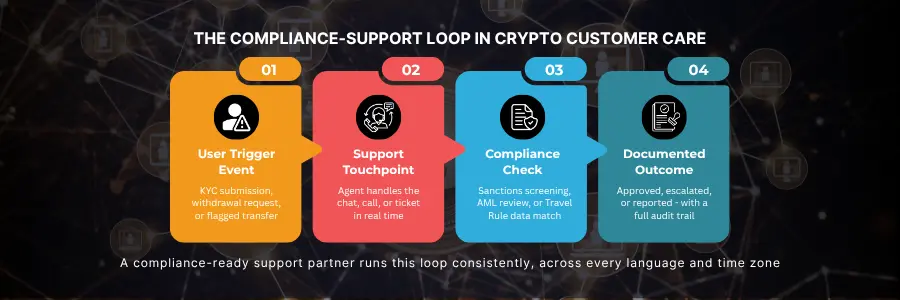
Therefore, customer support for crypto exchanges has become inseparable from compliance strategy. An agent who doesn’t understand why a withdrawal carries a hold, who gives a user inaccurate information about KYC status, or who fails to escalate a sanctions-related case through the right channel isn’t just creating a bad customer experience — they’re creating regulatory exposure.
The Cost of Getting Customer Support for Crypto Exchanges Wrong
Reputational Risk in a Fear-Driven Market
Indeed, the crypto market in 2026 is unusually fear-driven. Bitcoin’s pullback from earlier highs, a wave of ETF outflows, and high-profile moves — such as a major corporate holder selling Bitcoin for the first time in years — have left users jumpy and quick to escalate concerns. As a result, in that environment, a support interaction that mishandles a compliance-sensitive issue doesn’t stay contained; instead, it becomes a screenshot in a Telegram group within minutes.
Financial and Operational Risk
Beyond reputational damage, the exposure is concrete. In particular:
- Regulatory fines or mandated remediation programs following AML or sanctions-screening failures
- Loss of banking and payment partnerships that exchanges depend on to operate
- Increased audit scrutiny and longer, costlier examination cycles
- Visible user churn after a compliance-sensitive case goes wrong
Ultimately, for platforms competing for user trust in a market still recovering from past collapses, a single compliance misstep at the support layer can undo years of brand-building.
Why Crypto Exchanges Are Turning to Customer Support Outsourcing
Speed and Assurance During Volatility
Rather than building an entirely new in-house compliance-support function from scratch — recruiting agents, training them on KYC/AML procedures, building escalation workflows, and keeping it all current as rules change every few months — exchanges increasingly turn to crypto support outsourcing partners that already operate compliance-trained support teams.
However, the appeal isn’t just cost; it’s speed and assurance. A specialized partner brings agents who are already fluent in onboarding verification, sanctions screening, jurisdictional eligibility checks, and dispute documentation, along with the infrastructure to prove, in an audit, that the team handled every flagged case correctly. This matters enormously during volatile periods — a new token listing, a market sell-off, or a regulatory deadline — because ticket volume spikes then, and an undertrained or understaffed team is most likely to make a costly mistake.
Solving the Global Jurisdiction Problem
Additionally, as more jurisdictions roll out their own licensing regimes, exchanges need to verify user eligibility and respond to inquiries across dozens of countries and languages, often with region-specific compliance nuances.
Multilingual Reach
For instance, a support outsourcing partner with established multilingual operations can scale language and regional coverage far faster than an internal hiring plan, without diluting compliance accuracy across markets.
24/7 Coverage for Market Swings
Crypto markets don’t keep business hours. Therefore, round-the-clock coverage means the team handles compliance-sensitive issues — a frozen withdrawal during an overnight sell-off, for instance — correctly the first time, instead of leaving them in a queue until morning.
What Compliance-Ready Customer Support for Crypto Exchanges Looks Like
Not every outsourced support team builds for this. Specifically, compliance-ready CX for a crypto exchange typically includes:
- Identity verification and sanctions screening are woven directly into onboarding conversations
- Clear, documented escalation paths for any case touching AML, fraud, or frozen funds
- Jurisdictional checks that confirm a user’s eligibility under local rules before a transaction proceeds
- Audit trails detailed enough to satisfy a regulator’s request months after the fact
- Multilingual coverage that doesn’t dilute compliance accuracy across languages or regions
The Human + AI Balance
Increasingly, this also means pairing AI-assisted monitoring — automated flagging of anomalous transaction patterns or duplicate-identity attempts — with human agents trained to handle the judgment calls that automation can’t make on its own. After all, regulators have made clear they want effectiveness, not just automation theater, so the human layer still matters as much as the technology behind it.
In-House vs. Outsourced Compliance-Ready Support
Choosing the Right Partner for Customer Support for Crypto Exchanges
Before signing on with a partner, it’s worth asking the following questions:
- Do they have demonstrable experience with crypto-specific compliance frameworks (GENIUS Act, MiCA, FATF Travel Rule), rather than generic call-center compliance training?
- Can they scale support up or down quickly in response to listing events or market volatility without sacrificing quality?
- Do they offer the multilingual and multi-region coverage your actual user base needs?
- Can they show — not just claim — an audit-ready process for every compliance-sensitive interaction?
Final Thoughts
In short, crypto regulation isn’t going to slow down in 2026, so the platforms that treat customer support as a compliance asset rather than a cost center will be best positioned to keep growing through it.
Ultimately, customer support for crypto exchanges is no longer optional infrastructure — it’s a regulatory safeguard. Fusion CX builds its crypto and blockchain support solutions around exactly this overlap — combining KYC/AML-trained agents, multilingual coverage, and AI-driven compliance tools to help exchanges, DeFi platforms, and wallet providers deliver customer support that meets regulatory scrutiny and user expectations.
Ready to make your support compliance-ready? Get a free quote to see how Fusion CX can help your exchange handle regulation-sensitive support at scale, or visit our homepage to explore our full range of CX and outsourcing solutions.