What Healthcare Data Annotation Is
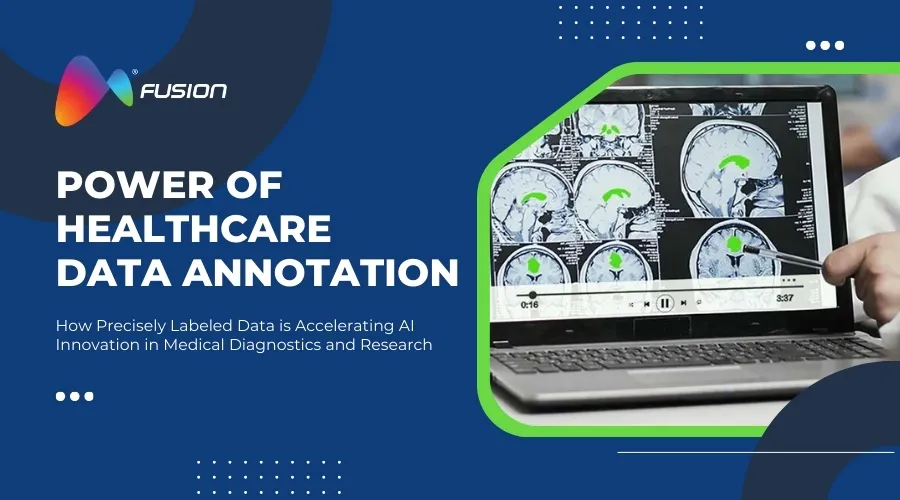
Healthcare data annotation is the process of adding structured, machine-readable labels to medical data — radiology images, pathology slides, clinical notes, genomic sequences, surgical videos, and physiological sensor data — so that machine learning models can learn to recognize patterns, make predictions, or generate outputs from it.
The difference between healthcare annotation and general-purpose annotation is the stakes. A mislabeled product in a retail computer vision training set yields an incorrect recommendation. A mislabeled tumor in a radiology AI training set can lead to an incorrect diagnosis — potentially at scale, across every patient whose scan is processed by the deployed model. The accuracy requirements, annotator qualifications, and quality assurance standards for healthcare annotation are fundamentally different from those of any other annotation domain.
“In medical AI, the annotation is the model. Every systematic labeling error in your training data becomes a systematic error in your model’s predictions. The annotation quality standard has to be set before the first label is applied — not discovered after the model fails in clinical validation.”
— Clinical AI Research Lead, Academic Medical Center
Types of Healthcare Data Annotation by Clinical Domain
| Data Type | Annotation Applied | AI Application |
|---|---|---|
| Radiology images (X-ray, CT, MRI) | Bounding boxes, segmentation, and classification of pathology findings | Diagnostic AI, triage prioritization, and incidental finding detection |
| Pathology slides (WSI) | Cell boundary annotation, tissue classification, and mitosis counting | Cancer diagnosis, grading, and treatment planning support |
| Clinical notes and EHR text | Named entity recognition, relation extraction, negation annotation, and temporal labeling | Clinical NLP, coding automation, population health analytics |
| Medical audio (clinical encounters) | Transcription, speaker diarization, clinical entity tagging, and intent classification | Ambient clinical documentation, voice AI for EHR, clinical call analytics |
| Surgical video | Instrument tracking, tissue segmentation, phase recognition, and anatomy labeling | Surgical robotics, procedure guidance, skills assessment, and adverse event detection |
| Dermatology images | Lesion segmentation, condition classification, and severity grading | Dermatology AI, teledermatology, primary care decision support |
| Genomic data | Variant annotation, gene expression classification, phenotype labeling | Precision medicine, drug discovery, and rare disease diagnosis |
| Physiological sensor data (ECG, EEG, RPM) | Event classification, anomaly labeling, rhythm annotation | Cardiac AI, seizure detection, and remote patient monitoring algorithms |
Why Accuracy Standards in Healthcare Annotation Are Different
Healthcare data annotation operates under accuracy requirements that have no equivalent in commercial AI applications. The reason is straightforward: medical AI systems make decisions — or assist clinicians in making decisions — that directly affect patient health and safety. The acceptable error rate is correspondingly lower.
Consider the radiology AI use case. A model trained to detect pulmonary nodules in CT scans is potentially evaluated on millions of scans annually. If the model’s recall is 95% — meaning it misses 5% of true nodules — and it processes one million scans per year, it misses 50,000 nodules that a correctly trained model would have flagged. Many of those are early-stage lung cancers. The annotation quality of the training dataset determines that miss rate as directly as any model architecture choice.
The clinical AI accuracy standard requires:
- Expert annotators — radiologists, pathologists, oncologists, and other clinical specialists annotating data in their domain, not trained general annotators approximating clinical judgment
- Multiple independent annotators with adjudication — consensus annotation with expert panel adjudication for disagreements, rather than single-annotator labeling
- IoU thresholds above commercial norms — medical image segmentation typically requires IoU > 0.85 compared to > 0.75 for general computer vision
- 100% QA review for safety-critical annotation — oncology, pathology, and cardiac applications require 100% QA, not sampling-based review
- Traceability — annotator qualification records, version-controlled annotation guidelines, and audit-ready documentation
Regulatory and Compliance Requirements for Healthcare Annotation Programs
Healthcare data annotation programs are subject to regulatory requirements that commercial annotation programs are not. Understanding these requirements is essential for any organization building medical AI training data or selecting a healthcare annotation partner.
HIPAA
Medical data used for AI training — radiology images, clinical notes, pathology slides, genomic data — frequently contains protected health information. Even de-identified data carries HIPAA obligations during the de-identification process. Any annotation partner accessing patient data in the course of their work is a business associate and must execute a BAA. PHI access controls, encrypted data handling, and HIPAA training for all annotators are non-negotiable. This connects to the broader healthcare compliance framework that governs all Fusion CX healthcare programs.
FDA Software as a Medical Device (SaMD) Guidance
AI systems used as clinical decision support tools that meet the FDA’s definition of Software as a Medical Device are subject to FDA premarket review requirements. The FDA’s AI/ML-based SaMD guidance requires detailed documentation of training data quality, including annotator qualification records, quality metrics, and the methodology used to validate annotation accuracy. Organizations building FDA-regulated medical AI must maintain this documentation from the beginning of annotation — retroactive documentation is not acceptable.
EU AI Act — High Risk Classification
The EU AI Act classifies medical AI systems as high-risk, imposing requirements for training-data quality documentation, human-oversight provisions, and transparency. For organizations building medical AI for EU markets, annotation quality standards and documentation are now regulatory compliance requirements — not just best practices.
ISO 13485
The medical device quality management standard ISO 13485 extends to software development for medical devices — including the training-data quality processes that produce medical AI systems. Annotation programs for ISO 13485-compliant medical AI development must operate within a documented quality management system.
Medical AI training data demands specialist annotators, clinical domain expertise, and documentation standards that most general annotation vendors cannot provide.
Annotera.ai — Fusion CX’s specialist data annotation brand — provides healthcare data annotation for radiology, pathology, clinical NLP, surgical video, and genomic applications — with clinical annotator teams, HIPAA-compliant data handling, and FDA SaMD documentation standards.
High-Impact Healthcare AI Applications Powered by Data Annotation
Radiology AI — Early Detection at Scale
Radiology AI leads all medical AI categories in clinical validation in 2026. Major health systems and teleradiology providers now use FDA-cleared algorithms for chest X-ray analysis, mammography screening, CT pulmonary embolism detection, and brain MRI lesion identification. Developers trained every one of these systems on thousands to millions of expert-annotated radiology studies. Radiologists verified the findings, delineated boundaries accurately, and maintained strict quality standards. The performance difference between radiology AI systems comes mainly from the quality of their training data annotation — not from differences in model architecture.
Clinical NLP — Unlocking the Unstructured EHR
Approximately 80% of clinically relevant information in healthcare resides in unstructured text — physician notes, discharge summaries, referral letters, radiology reports, and pathology narratives. Clinical NLP systems extract structured information from this text: diagnoses, medications, procedures, lab values, clinical relationships, and temporal sequences.
Training clinical NLP requires annotation that goes beyond general NLP labeling. Negation annotation — correctly labeling whether a finding is present, absent, or uncertain — is critical for clinical accuracy and is a common failure mode in clinical NLP systems trained on inadequately annotated data. Temporal annotation — identifying when clinical events occurred relative to each other — requires clinical knowledge that general NLP annotators don’t have.
Surgical Robotics — Precision Requires Precision Annotation
Surgical robotics AI systems — those that provide real-time guidance, instrument tracking, anatomy recognition, or adverse-event warnings during robotic procedures — require surgical video annotation at a level of precision with no commercial equivalent. Annotating the boundary between healthy and cancerous tissue visible during a laparoscopic procedure requires surgeons or surgical oncologists, not annotators trained on a general annotation platform.
The surgical video annotation workflow typically involves frame-by-frame instrument tracking, tissue-type segmentation, surgical-phase recognition, and adverse-event labeling — all requiring annotators with direct surgical knowledge and specialized tooling for frame-level video annotation.
Remote Patient Monitoring AI — Making Sensor Data Clinically Actionable
As covered in our guide to remote patient monitoring for chronic disease, RPM devices generate continuous physiological data streams. The AI algorithms that process those streams — detecting arrhythmias in ECG data, predicting decompensation in heart failure patients, identifying seizure patterns in EEG signals — are trained on annotated physiological recordings where clinical events are precisely labeled.
RPM AI annotation requires cardiologists to label ECG rhythms, neurologists to identify EEG events, and clinical experts to validate alert thresholds. The annotation programs that produce reliable RPM AI systems are staffed by clinicians, not crowdsourced labeling operations.
Healthcare Data Annotation Quality Standards
| Quality Standard | Healthcare Requirement | General Annotation Benchmark |
|---|---|---|
| Intersection over Union (IoU) | >0.85 for most clinical segmentation; >0.90 for oncology | >0.75 standard for general CV |
| Inter-annotator agreement (IAA) | Cohen’s Kappa >0.80; expert panel adjudication for disagreements | Kappa >0.75 typical target |
| QA coverage | 100% for oncology, cardiac, and safety-critical annotation | 15–20% sampling standard |
| Annotator qualification | Clinical specialists for domain-specific tasks; documented credential records | Task-specific training; no clinical credential required |
| Traceability | Full annotator records maintained for regulatory audit; version-controlled guidelines | Output quality metrics; annotator performance tracking |
| HIPAA compliance | BAA required; PHI access controls; encrypted data handling | NDA standard; no HIPAA framework required |
How to Choose a Healthcare Data Annotation Partner
The evaluation criteria for a healthcare annotation partner are more demanding than for general annotation. Generic annotation vendors with healthcare clients are not healthcare annotation specialists. The specific capabilities to assess:
- Clinical annotator pool — does the partner maintain annotators with medical training in your specific clinical domain? Radiology annotation requires radiologists, not medical students or trained laypersons. Request credentials and experience documentation for the annotator team that would work on your program.
- HIPAA compliance documentation — BAA execution, PHI access controls, documented training records, and data handling procedures. This is table stakes; any partner who can’t provide documentation is not a viable option for clinical data.
- Quality metrics for medical data — request IAA data and IoU benchmarks for annotation programs comparable to yours. Partners who can’t provide this data haven’t adequately measured their quality.
- FDA SaMD documentation familiarity — if you’re building FDA-regulated medical AI, the partner must understand what documentation is required and how to produce annotation records that satisfy those requirements.
- De-identification capability — can the partner de-identify medical data appropriately before annotation where full PHI access is not required? What standards do they apply (Safe Harbor vs. Expert Determination)?
- Tooling for medical data formats — DICOM for radiology, WSI formats for pathology, FHIR-compatible text annotation — ensure the partner’s tooling supports your data formats natively.
Annotera.ai — Fusion CX’s specialist data annotation brand — provides healthcare annotation across radiology, pathology, clinical NLP, surgical video, and genomic data, with clinical annotator teams, HIPAA-compliant workflows, and documentation standards aligned to FDA SaMD requirements.
The Human-in-the-Loop Requirement in Medical AI Annotation
Foundation models and AI-assisted annotation tools are accelerating annotation workflows across most data types. In healthcare, the human-in-the-loop is not optional — it is a regulatory and quality requirement. AI pre-annotation in medical imaging can generate draft annotations that clinical experts review and correct — reducing annotation time by 40–70% — but the clinical expert review step cannot be replaced by automated QA alone.
The reason is both technical and regulatory. Technically, AI pre-labelers for medical data fail systematically on the edge cases, rare presentations, and novel findings that are disproportionately important for clinical AI performance. Regulatory frameworks for FDA-regulated medical AI specifically require human oversight during training data preparation for high-risk applications.
The most effective healthcare annotation programs in 2026 deploy AI-assisted workflows that pre-annotate at scale and direct expert clinical annotators to the cases that require their judgment — rather than requiring clinical experts to annotate every image from scratch. This approach is covered in depth in our broader guide to how AI is reshaping connected healthcare.
Building a medical AI system that needs to work in clinical environments — and needs training data that will hold up to FDA scrutiny, clinical validation, and real-world deployment?
Annotera.ai — Fusion CX’s specialist data annotation brand — provides HIPAA-compliant healthcare data annotation for radiology, pathology, clinical NLP, surgical video, and genomic AI programs. Clinical annotator teams. FDA SaMD-aligned documentation. Expert panel adjudication. Human-in-the-loop quality assurance at every stage.