
The financial services industry is witnessing a seismic shift. Moving away from simple generative bots toward the sophisticated implementation of Agentic AI in Banking. Unlike legacy automation, the new technology does more than merely summarize text or provide canned responses. It is a new class of intelligent systems capable of analyzing data and making informed decisions.
Agentic AIs can help in executing complex tasks autonomously across multiple banking systems. For which, the adoption of Agentic AI in Banking is no longer a futuristic experiment. It has become the core engine driving operational resilience and superior customer experience.
Why is Agentic AI in Banking Important?
Traditional BPO models and legacy “GenAI” chatbots have hit the ceiling. Decision-makers scouting for high-tier partnerships are increasingly noticing specific inefficiencies in current market offerings:
- Workflow Fragmentation: Most chatbots can “talk” but cannot “do,” requiring human intervention to bridge the gap between a customer query and a back-end system update.
- Contextual Amnesia: Standard AI tools often treat every interaction as an isolated event, failing to leverage long-term customer financial history for predictive service.
- Compliance Lag: In the highly regulated BFSI sector, simple generative models often lack the “explainability” required for audits, posing a significant risk to the institution.
- Human-AI Friction: Without tools like Arya, agents often find themselves fighting against the AI rather than being empowered by it.
Industry Insights of Agentic AI Adoption in Banking
According to Gartner, by the end of 2026, 40% of enterprise applications will feature task-specific AI agents, a massive leap from less than 5% in 2025.
McKinsey research suggests Agentic AI could unlock $200 billion to $340 billion in annual value. Specifically, this value comes from “Digital Workforces” that manage core banking workflows. Similarly, Deloitte projections highlight a shift in the global banking sector. In fact, the winners in 2026 will move beyond isolated GenAI pilots. Instead, these leaders will build Agentic AI ecosystems that prioritize governance over growth.
Strategic Insight
“Agentic AI will lead to a 5.4% EBITDA improvement for the average company annually… while pioneers gain a 4% ROTE advantage.”
Neurons Lab • 2026 Research Roundup
Moving from Reactive Chatbots to Autonomous Banking Workflows
The mechanism behind Agentic AI involves modular agents collaborating on complex, multi-step tasks. In the “Do-It-For-Me” (DIFM) economy, customers expect instant execution. They no longer want a guide; they want a partner who completes the task immediately after verification.
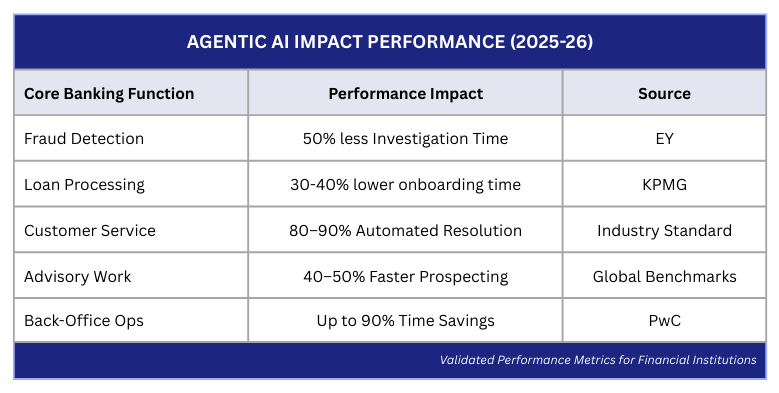
Quantifiable Impact of Agentic AI
Data from leading firms shows that Agentic AI is moving from “experiment” to “engine.” Below is the validated impact on core banking functions:
The “Intelligent Co-Pilot” in Contact Centers
In a contact center, Agentic AI acts as a high-speed partner. It summarizes customer history in milliseconds. Furthermore, it recommends the “next best action” for first-contact resolution. Specifically, McKinsey reports that such human-AI collaboration can drive 30% gains in workforce efficiency.
Consequently, human professionals can stop fighting data-intensive workflows. Instead, they can focus on empathy and judgment when discussing sensitive financial matters. In fact, banks that embrace this shift are seeing a 15% improvement in their overall efficiency ratios.
The Fusion CX Advantage – Governance, Tools, and Compliance
At Fusion CX, we provide “people-powered, AI-enhanced” solutions that allow institutions to deploy Agentic AI in Banking with built-in human guardrails. We designed our proprietary tech stack specifically for COOs’ vetting needs.
- Arya (The Co-Pilot): An agentic orchestrator that sits alongside the agent, pulling real-time data from core banking systems to automate the “boring” parts of CX.
- Accent Harmonizer: Ensures that as we scale global delivery centers, the brand voice remains consistent, local, and trusted, regardless of where the agent is located.
- MindVoice Analytics: Uses predictive modeling to identify customer sentiment shifts before they lead to churn.
- SOC 2 & PCI DSS Compliance: Our AI models are built with “Compliance-by-Design,” ensuring every autonomous action is logged, auditable, and transparent.
Technical Integration and Operational Resilience
The transition to Agentic AI in Banking demands a modernized data architecture, such as a data mesh, to ensure that these autonomous agents have access to high-quality information. Without organized data, Agentic AI in Banking risks making misinformed or non-compliant decisions.
Fusion CX bridges this gap by integrating directly with your existing infrastructure through secure APIs. Our agents don’t just “chat”—they monitor transactions in real-time, flag anomalies, and can even initiate a “freeze” on a compromised account faster than a human ever could. This level of technical integration reduces fraud response times from hours to seconds.
Strategic Readiness for 2026 with Fusion CX
Financial brands achieve faster, more accurate answers by shifting to value-driven Agentic AI. In addition, the future belongs to those balancing AI efficiency with human strengths. Consequently, Fusion CX provides more than headcount. Instead, we provide the strategic architecture for your digital transformation.
Revolutionizing BFSI Operations with Human + AI advantage. Contact us today.

Sayan Sinha
Sayan Sinha is an BFSI-focused CX and BPO professional who helps insurers turn complex customer journeys into growth-ready, compliant experiences. At Fusion CX, he works closely with sales and delivery teams to design scalable CX solutions that improve efficiency, build trust, and deliver measurable business impact.


