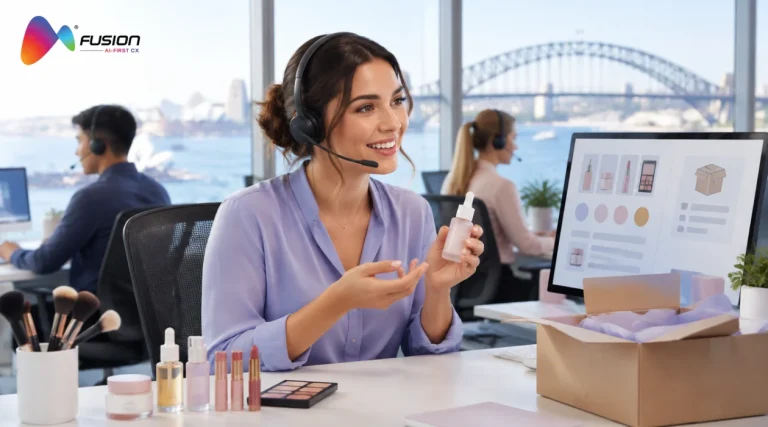

Picture this. Your quarterly billing run completes on a Friday night. By Monday morning, your contact center has received 9,000 contacts — billing disputes, box modification requests, failed payment queries, and cancellation attempts. Your in-house team of 12 agents is drowning. Average handle time is climbing. Save desk conversions are falling. And this happens every single quarter, like clockwork.
This is not a crisis. This is the structural reality of beauty subscription customer service.
The global beauty subscription box market reached $42.5 billion in 2025 and is growing at a 12.64% CAGR, with North America generating $8.1 billion in revenue last year alone. As subscriber bases scale, the contact center demands that come with them scale just as fast — and the brands that are growing without breaking are the ones that have stopped trying to handle it in-house.
This blog breaks down exactly why beauty subscription customer service is different, where in-house models break down, and what outsourcing actually delivers when it is built around the subscription lifecycle rather than retrofitted from a standard beauty product customer service model.
Why Beauty Subscription Customer Service Is Different From Standard Beauty Retail
Most beauty call center models are built around a simple premise: a customer buys a product, something goes wrong or right, and they contact support. The interaction is event-driven. It is triggered by a purchase, a delivery, or a return — all of which are tied to a single transaction.
Beauty subscription customer service does not work this way.
In a subscription model, contacts are cycle-driven. They arrive on a predictable schedule, tied to billing dates, box shipment windows, quarterly renewal periods, and the subscriber lifecycle itself. A brand with 80,000 annual and seasonal subscribers does not experience a steady drip of contacts throughout the year. It experiences waves — concentrated, high-volume surges that arrive every billing cycle and demand agent capacity that simply cannot be maintained year-round without significant overstaffing between cycles.
This fundamental structural difference is why brands at scale consistently find that their standard call center for beauty and cosmetics brands breaks under subscription volume. The interaction types are different. The staffing model is different. The agent training requirements are different. And the performance metrics that matter — save desk conversion rate, failed payment recovery rate, first billing cycle resolution — are not tracked by generalist call centers because generalist call centers were not built for subscription.
The Four Contact Types That Define Beauty Subscription Customer Service
Understanding what actually lands in a beauty subscription contact center — and why each interaction type requires specialist handling — is the foundation of building a support model that protects subscriber retention rather than accelerating churn.
Billing Disputes and Renewal Queries
Quarterly and annual billing create predictable surges in contact. The moment a charge appears on a subscriber’s card, inbound volume spikes. Charge confusion is common — particularly for annual subscribers who forgot they auto-renewed, or seasonal subscribers who expected to be charged a different amount following a price adjustment or promotion.
These are not complex interactions. But they require agents who understand the exact billing logic of your subscription model, can access subscriber account history instantly, and can resolve the query at first contact. A generalist agent reading from a generic script does not know the difference between an annual plan renewal and a seasonal plan auto-charge. A subscription-trained agent does — and resolves it in under three minutes instead of escalating it, creating a repeat contact, and damaging the subscriber relationship before they have even received their next box.
For brands running beauty subscription box customer service outsourcing through a specialist partner, first contact resolution on billing queries consistently outperforms in-house models because the agents are trained on the billing architecture of the subscription, not just on general call handling.
Box Modification, Skip, and Swap Requests
Subscribers customizing their quarterly box generate a second wave of contacts that require a very different skill set. Skip requests, product swap selections, shade preference updates, and delivery address changes all arrive in volume during the pre-shipment window, which is typically a 10 to 14-day period before the box ships each quarter.
These interactions require process accuracy and direct platform integration. An agent who cannot access your subscription management platform cannot resolve a modification request at first contact. They escalate. The subscriber calls back. The modification misses the cutoff window. The wrong box ships. The subscriber cancels.
This is where 24/7 support for beauty and wellness retailers becomes operationally critical — not just as a convenience, but as a structural requirement. Modification windows are short. Subscribers contact you on their schedule, not yours. A beauty subscription contact center operating across all time zones closes that gap completely.
Cancellation Attempts and Save Desk Interactions
Every cancellation attempt is a revenue moment. It is also the highest-skill interaction in the entire beauty subscription customer service operation — and the one most commonly handled badly.
A subscriber who initiates a cancellation is not always committed to leaving. Research consistently shows that a significant proportion of subscription cancellations are driven by perceived lack of value, billing confusion, or product dissatisfaction with a single box — not fundamental disengagement with the brand. A well-trained save desk agent who understands beauty subscription churn psychology can identify the real reason for cancellation, present the right retention offer — a pause option, a discounted renewal, a product swap — and recover the subscription.
A generic call center agent who follows a save script will not achieve this. Save desk performance in beauty subscription models requires agents who understand the subscriber lifecycle, know which offers work for which cancellation reason, and can communicate in the brand voice of a premium beauty company — not the transactional language of a standard retention desk.
This is the single most valuable function in outsourcing beauty subscription customer service. Brands that outsource their sales desk to a specialist partner consistently report that this single function pays for the entire outsourcing program. You can learn more about how return support for beauty products and retention programs work together in protecting long-term subscriber value.
Failed Payments and Involuntary Churn
Involuntary churn — subscriber loss caused by failed payments rather than active cancellations — is one of the most underestimated revenue leaks in the beauty subscription industry. Across subscription businesses, dunning techniques saved $254 million in recovered revenue in 2023 alone. For beauty subscription brands, failed payments are particularly common around quarterly billing cycles, where subscribers may have updated card details, hit credit limits, or simply have outdated payment information on file.
Failed payment recovery is not an admin function. It is an outbound contact program — structured, empathetic, and brand-aligned — that reaches out to subscribers with declined payments, assists them in updating their information, and recovers the subscription before involuntary churn registers. A specialist BPO services for skincare and makeup brands partner builds this into the operational model as a standing program, not an afterthought.
When In-House Beauty Subscription Customer Service Breaks Down
The in-house model works well on a small scale. A team of four or five agents can manage billing-cycle surges for 5,000 subscribers with some overtime. At 20,000, the math starts to break. Cross 50,000 and the in-house model creates one of two outcomes — chronic overstaffing to cover quarterly peaks, or consistent SLA breach during billing windows.
Neither is acceptable. Overstaffing means carrying agent headcount during off-cycle weeks when contact volumes drop to baseline levels — paying for capacity you do not need three weeks out of every four. SLA breach during billing windows means subscribers waiting too long for resolution on billing disputes and modification requests, which directly correlates with increased cancellation rates.
Here are the clearest signs that your beauty subscription customer service has outgrown your in-house model:
- Contact volumes spike more than three times your baseline during quarterly billing windows
- Average handle time increases during box shipment periods due to agent overload
- Save desk conversion rate has dropped below 20% — or you are not measuring it at all
- First contact resolution falls during renewal periods as agents rush through interactions
- Agent attrition is rising due to the pressure of recurring volume surges
- Modification requests are missing the pre-shipment cutoff window due to backlog
- Failed payment recovery is handled reactively rather than as a structured outbound program
If three or more of these are true, you are already absorbing the cost of an under-resourced beauty subscription contact center. For a broader view of how retail customer service outsourcing solves structural capacity problems across retail verticals, the pattern is consistent — the question is not whether to change the model, it is how quickly you can make the transition before the next billing cycle compounds the problem.
What Beauty Subscription Customer Service Outsourcing Actually Delivers
The case for outsourcing beauty subscription customer service is not primarily about cost reduction — although elastic staffing models do eliminate the overstaffing problem entirely. The primary case is capability. There are four specific capabilities that a specialist beauty subscription BPO delivers that an in-house team or generalist call center cannot replicate at subscription scale.
- Billing cycle staffing elasticity – A specialist outsourcing partner builds your quarterly billing surge into the workforce management model from day one. Agent capacity scales up in the 72-hour window around billing dates and scales back during off-cycle weeks. You pay for what you need, when you need it — without the fixed headcount overhead that makes in-house scaling uneconomical.
- Subscription-trained save desk operations – Not generic retention scripts, but agents trained in beauty subscription churn psychology — why subscribers cancel at each lifecycle stage, which retention offers work for which cancellation reason, and how to communicate in the brand voice of a premium beauty company. A specialist partner builds this into the training model, not the script.
- Direct platform integration – Agents working inside your subscription management platform — not alongside it. Box modification requests, skip activations, and subscription pauses are resolved at first contact, in real time, without escalation. This alone reduces repeat contacts by a material margin.
- Structured failed payment recovery programs – Outbound contact to subscribers with failed payments, using empathetic brand-aligned communication — not an automated dunning email sequence. A trained agent who facilitates the payment update retains the relationship rather than damaging it.
Together, these capabilities transform beauty subscription customer service from a cost center into a retention engine that protects subscriber lifetime value at every billing cycle. This mirrors the broader case for outsourced retail call centers — the value lies in structural capabilities that in-house models cannot replicate at scale.
What to Look for in a Beauty Subscription Customer Service Outsourcing Partner
Not every BPO partner can deliver specialist beauty subscription support. When evaluating outsourcing partners for your beauty subscription customer service operation, the following criteria separate specialist providers from generalist call centers:
- Subscription lifecycle experience: Proven experience with quarterly, annual, and monthly beauty subscription billing models, not just transactional retail customer service
- Dedicated save desk capability: Measurable save desk conversion rates from existing subscription clients, not a generic retention script
- Subscription platform integration: Direct API integration with Recharge, Skio, Bold Subscriptions, or your custom subscription stack
- Elastic staffing model: Workforce management built around billing cycle peaks, not a fixed FTE contract that ignores seasonal variance
- Brand voice alignment: Agents onboarded on your brand tone, product range, and subscriber communication standards, not shared across unrelated accounts
- PCI-DSS certification: Non-negotiable for handling subscriber payment data securely
- Omnichannel coverage: Voice, live chat, email, and social media managed by a single unified team, ensuring a consistent subscriber experience regardless of channel
For beauty subscription brands specifically, the most important question to ask any prospective BPO partner is: show me your save-desk conversion rate data for an existing beauty subscription client. If they cannot answer that question with real data, they are not a specialist subscription partner.
Understanding how loyalty program support for beauty brands integrates with subscription retention programs is also a key differentiator to look for — the best partners run both as a unified subscriber lifecycle operation, not as separate functions.
How Fusion CX Delivers Beauty Subscription Customer Service at Scale
Fusion CX provides beauty brand call center outsourcing built around the structural realities of subscription, not adapted from a standard retail model.
Our dedicated beauty subscription support teams are specialists in subscriber lifecycle management, billing cycle contact patterns, save desk operations, and failed payment recovery programs. Every interaction is managed within an AI-enhanced quality framework that monitors brand voice consistency, empathy benchmarks, and resolution accuracy across 100% of contacts — not a sample.
Our retail call center solutions operate on an elastic staffing model built specifically for quarterly billing surges. Agent capacity scales to your billing cycle, not the other way around. Our teams work directly within your subscription management platform — resolving modification requests, reducing desk interactions, and recovering failed payments at first contact.
With PCI-DSS certification, 28 language support, and a global delivery footprint across NALATAM, EMEA, and APAC, Fusion CX gives beauty subscription brands the contact center infrastructure to grow subscriber bases without growing internal operational complexity.
For brands running or expanding into subscription-box models, auto-replenishment, or beauty membership programs, our subscription box and auto-replenishment support for CPG brands demonstrates how Fusion CX builds these programs across adjacent categories — the same operational discipline applies across the full beauty and personal care subscription spectrum.
Our retail customer service outsourcing model is designed for brands that see customer experience as a competitive advantage — and understand that beauty subscription customer service outsourcing is not a cost decision, it is a retention decision.
Ready to scale?
Managing a growing beauty subscription base?
Let’s build a contact center program around your billing cycle — not against it.
No commitment. Speak to a retail BPO specialist within 24 hours.
Frequently Asked Questions
What is beauty subscription customer service outsourcing?
Beauty subscription customer service outsourcing is the practice of partnering with a specialist BPO provider to manage the full range of subscriber contacts generated by a beauty subscription business — including billing queries, box modification requests, save desk and cancellation recovery interactions, and failed payment outreach programs. Unlike standard beauty product customer service, outsourcing beauty subscription customer service requires a partner with specialist knowledge of subscription billing models, subscriber lifecycle dynamics, and retention operations built around quarterly and annual renewal cycles.
How does outsourcing beauty subscription customer service reduce churn?
Outsourcing reduces both active and involuntary churn through two specific mechanisms. First, a specialist save desk operation — staffed by agents trained in beauty subscription retention — converts a measurable percentage of cancellation attempts into retained subscriptions by identifying the real reason for cancellation and presenting the right offer. Second, a structured failed-payment recovery program proactively reaches out to subscribers with declined payments, recovering subscriptions before involuntary churn occurs. Together, these two functions protect subscriber retention at the points in the lifecycle where revenue loss is highest.
Which beauty subscription brands benefit most from outsourcing customer service?
Beauty subscription brands at the growth inflection point — typically crossing 20,000 active subscribers, managing quarterly or annual billing cycles, or operating multi-tier membership models — benefit most from outsourcing beauty subscription customer service. At this scale, quarterly billing windows generate contact volumes that in-house teams cannot absorb without chronic overstaffing between cycles. Brands operating skincare replenishment programs, curated lifestyle boxes, and beauty membership services with complex customization options also benefit significantly from direct platform integration and specialist save-desk capabilities that generalist call centers do not provide.