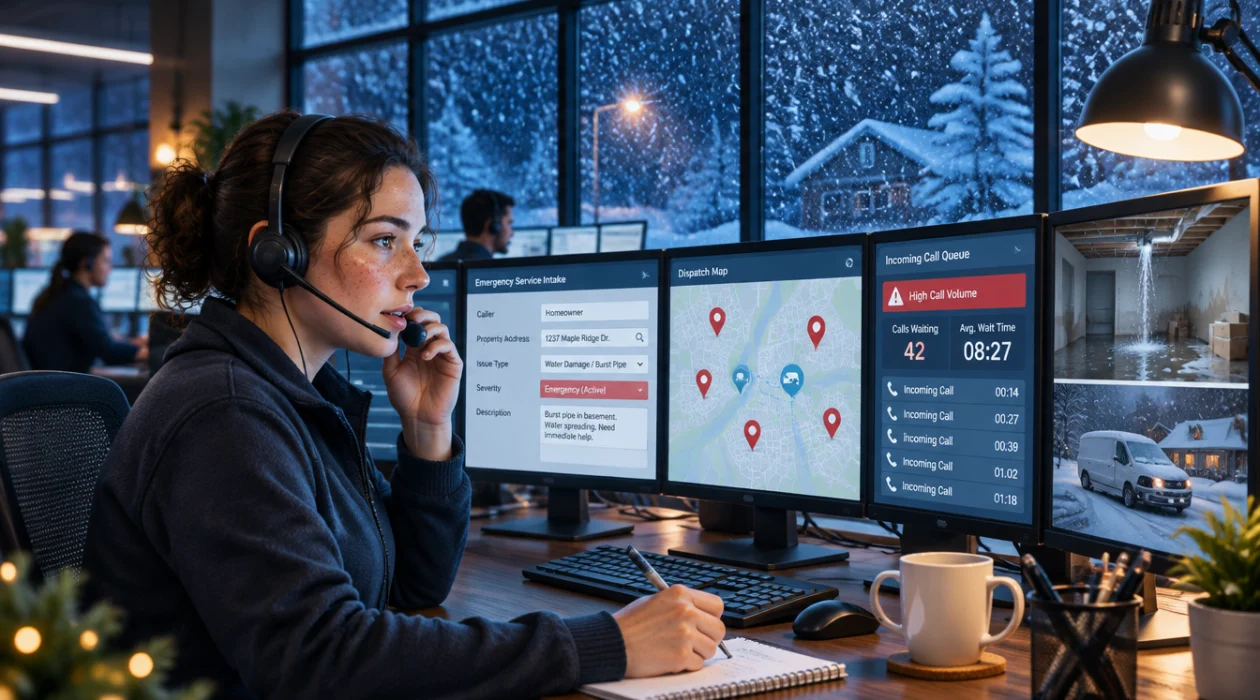
Winter weather rarely creates a neat, predictable rise in calls. A hard freeze can turn one burst pipe into dozens of urgent requests across the same service area. A storm can send roof-leak calls, water intrusion, property-damage inquiries, and inspection requests into the queue at almost the same time.
For a restoration company, the problem is not simply that the phone is ringing more often. Dispatchers may already be coordinating field crews. Technicians may be at capacity. Branches may be dealing with different levels of demand. Meanwhile, every unanswered call could represent a customer who needs help now and may call the next available provider.
A restoration answering service therefore has to do more than collect names and numbers. During a winter surge, it should help capture the right information, apply the restoration company’s approved intake rules, separate different types of demand, and move each caller toward the right next step.
The scale of severe winter weather helps explain why preparation matters. NOAA reports that U.S. winter storms meeting its billion-dollar-disaster threshold averaged $4.1 billion in cost per event between 1980 and 2021. Those figures measure much more than restoration work, but they make one thing clear: a major winter event can create serious property and operational disruption in a short period.
When the Weather Changes, the Queue Changes With It
A normal home-services day gives an operation at least some room to forecast demand. Storm-driven demand behaves differently. Calls can arrive in concentrated bursts, often from the same affected geography and often outside normal business hours.
A single weather system can create frozen pipe calls, burst pipe emergencies, active leaks, water-mitigation inquiries, roof damage and general property-damage requests. Some callers may need urgent escalation. Others need an inspection, an appointment or an update. Still others may live outside the company’s service area.
Sending every caller into one queue creates work for the people who should be coordinating the response. A restoration call center or overflow team should instead help turn that unstructured demand into usable information. For companies already thinking about how to manage weather-driven peaks, Fusion CX has previously examined how BPOs can support home improvement companies during storm surges. The next question is more specific: what should actually happen when each restoration call comes in?
What Should a Restoration Answering Service Actually Do?
Picture the first call after a major freeze. The caller may simply say, “There’s water everywhere.” The person answering cannot diagnose the property problem from a contact center, and should not try to. But they can make sure the restoration team receives a complete, structured intake instead of an incomplete voicemail.
Depending on the company’s approved process, that may mean capturing:
- the caller’s name and best callback number;
- the property address and service-area eligibility;
- whether the property is residential or commercial;
- the general type of damage being reported;
- whether the issue is active or contained, based on the caller’s description;
- when the incident began;
- insurance or job information where the restoration company requires it;
- the appropriate priority classification from an approved decision tree; and
- the correct routing, dispatch, scheduling or escalation path.
The point is not to make the contact-center agent a restoration technician. It is to remove avoidable friction between the incoming call and the people who need to act on it.
Fast answering matters. Useful intake matters more. The goal is to turn an urgent call into enough structured information for the restoration operation to decide what happens next.
Not Every Storm Call Belongs at the Top of the Queue
During a surge, speed without prioritization can simply move the bottleneck from the phone queue to dispatch.
The restoration company should decide in advance which situations require immediate escalation and which can follow the standard scheduling process. An outsourced team then follows those rules rather than making technical judgments of its own.
Depending on the company’s procedures, higher-priority situations may include an active burst pipe, ongoing water intrusion, significant roof leakage or another condition the business has specifically designated for rapid escalation. Contained damage, inspection requests, scheduled mitigation follow-ups and routine status questions may follow a different path.
This distinction is important. Good emergency restoration call handling does not mean treating every conversation as identical. It means gathering enough information to apply the company’s own response model consistently.
Water Damage Calls Need More Than a Callback Number
Water and freezing losses are a recurring issue for property owners. Based on 2020–2024 data, the Insurance Information Institute reports that approximately one in 70 insured homes has a property-damage claim caused by water damage or freezing each year.
For a water damage restoration answering service, that means the intake needs enough structure to be useful without asking agents to diagnose the loss.
The restoration company may want the team to establish where the issue is occurring, when it started, whether the caller says the water source is still active, which part of the property appears affected, whether the property is residential or commercial, and what information the company requires before routing the job.
That matters especially during widespread freezes. If dozens of people are calling about frozen or burst pipes, dispatch should not have to call every customer back simply to collect the basic information that could have been captured during the first conversation.
Roofing Has Its Own Version of the Same Problem
Heavy rain, wind, ice, and snow can produce the same demand compression for roofing businesses. Active leaks, inspection requests, and storm-damage calls may all arrive while crews are already working through the affected area.
An answering service for roofers during peak storm periods can provide another intake path when the internal office cannot answer every call.
The information required will differ from water mitigation, but the principle stays the same: establish who is calling, where the property is located, what the caller is reporting, and which next step the roofing company has defined.
For contractors looking beyond storm-specific coverage, our guide to the competitive advantage of contractor answering services looks more broadly at how phone coverage affects lead capture and customer response.
Overflow Does Not Have to Mean Outsourcing Everything
One reason companies delay adding outside support is the assumption that outsourcing means moving the entire customer operation. It does not.
For restoration and home-services businesses, the cleaner model may be to identify the part of the workload that creates the bottleneck.
After-hours coverage
An after-hours restoration answering service can cover the hours when the office is closed while following a defined on-call escalation path.
Overflow coverage
The internal team can remain the primary point of contact while excess calls move to an external queue when volume or wait conditions cross an agreed threshold.
Specific queues or territories
A company can also outsource particular call types, branches, service territories or scheduling functions instead of moving the entire operation.
That flexibility becomes increasingly useful for multi-location operators. Fusion CX’s Home Improvement customer experience operations are built around the broader customer journey across home-services and improvement businesses, while customer engagement services can support structured interactions across voice and digital channels.
If the bigger question is how much capacity to maintain around predictable and unpredictable demand, our earlier article on planning Home Improvement support for seasonal surges provides additional context.
How Do You Know When Internal Call Handling Has Become the Constraint?
You do not need a sophisticated model to spot every warning sign. Often, the symptoms are already visible inside the operation.
- Weather events regularly push calls to voicemail.
- Dispatchers spend significant time answering calls instead of coordinating work.
- After-hours contacts are growing but coverage has not changed.
- Different branches use different intake or escalation processes.
- Managers cannot easily see how many calls went unanswered.
- Capacity that works on an average week fails during localized spikes.
- Expansion into new territories is putting additional pressure on the same central team.
If several of these are happening together, adding another internal phone line does not solve the underlying problem. The company needs to decide which interactions should remain internal and which can be handled through overflow, after-hours, or outsourced capacity.
For businesses where intake should ultimately turn into booked work, the same thinking extends into home improvement appointment scheduling. Answering the call is only useful if the next step is clear.
What Should You Expect From a Restoration Call Center Provider?
Buying restoration call center services based only on agent availability misses the harder questions.
A prospective provider should be able to explain how the operation would work when demand is normal and what changes when a storm hits. Ask about:
- required-hours and after-hours coverage;
- how overflow calls are triggered and routed;
- how client-approved intake scripts are maintained;
- service-area and branch-routing logic;
- on-call and escalation workflows;
- how scheduling or dispatch handoffs are managed;
- how staffing assumptions change during surge periods;
- how quality is measured across a rapidly changing queue;
- what reporting managers receive during and after an event;
- multilingual requirements, where relevant;
- business continuity; and
- the implementation work required before calls can be moved.
Workforce planning deserves particular attention. A provider can claim it will “scale,” but buyers should ask what demand signals, staffing assumptions and lead times sit behind that statement. Fusion CX’s workforce management capabilities are designed around forecasting, scheduling and operational visibility across contact-center environments.
Quality also becomes harder to monitor when volumes rise rapidly. Fusion CX AI QMS provides another layer of quality monitoring across customer interactions rather than relying only on a small manual sample.
What does scaling customer operations look like beyond one location?
Storm overflow is one form of scale. Geographic growth creates another. See how Fusion CX supported nationwide scaling for a U.S. home renovation leader and how the operating model was built around a larger service footprint.
Some Work Should Stay With the Restoration Team
A useful outsourcing model has boundaries. Structured activities such as answering, initial intake, information capture, service-area qualification, overflow handling, after-hours coverage, routing, appointment requests, and routine status support can be suitable for an external team when the workflow is clearly defined.
Technical restoration decisions belong with qualified internal or field personnel. The same is true for specialist mitigation decisions, unusual claims issues, complex job decisions, and escalations the restoration company specifically wants to own.
The outsourced team should not improvise technical answers. Its job is to make the customer handoff cleaner and help the internal operation spend its time where expertise is actually required.
The Storm Plan Should Exist Before the Storm
If the first time a company defines its escalation process is when the phone queue is already backed up, the team is working against the clock.
Before the next major freeze or storm, operators should be able to answer a few practical questions:
- Which calls can an external team handle?
- What information must be collected on every call?
- Which situations trigger immediate escalation?
- Which ZIP codes, territories, or branches should receive each request?
- Who is on call, and when?
- Which requests can be scheduled rather than escalated?
- What changes when volume exceeds the normal forecast?
- What should managers be able to see in reporting during the event?
Those decisions create the operating playbook. The staffing model comes after that.
Planning beyond one storm?
These Fusion CX guides cover the neighboring decisions: surge capacity, roofing call handling, contractor answering, seasonal staffing, and appointment flow.
Managing Home Improvement Storm Surges
How BPO capacity can support weather-driven demand.
Never Miss a Roofing Storm Call
Answering-service coverage during roofing peaks.
Contractor Answering Services
Why call handling matters to lead capture and response.
Preparing for Seasonal Support Surges
Planning capacity around changing Home Improvement demand.
Streamlining Appointment Scheduling
What should happen after the initial call is qualified.
Frequently Asked Questions
What is a restoration answering service?
A restoration answering service handles inbound calls when a restoration company’s internal team is unavailable, overloaded, or outside normal operating hours. Depending on the agreed workflow, the service can capture caller information, qualify the request, follow approved triage rules, and route the contact for scheduling, dispatch, or escalation.
Can a restoration answering service handle winter storm call overflow?
Yes. An external team can be configured to receive overflow during periods of unusually high demand. The restoration company should define the service areas, intake questions, priority rules, escalation contacts, and routing procedures before the surge occurs.
Can a company outsource only after-hours restoration calls?
Yes. Outsourcing does not require transferring the whole operation. A company may use an external provider only for after-hours coverage, overflow, selected branches, specific call types or defined territories.
What should be collected during a water-damage call?
The required intake will depend on the restoration company. It may include caller details, property location, general damage category, when the problem began, whether the caller says the issue is still active, property type, and information needed for routing or escalation.
Should an outsourced agent decide whether property damage is technically severe?
No. The external team should follow the restoration company’s approved intake and escalation rules. Technical assessments and restoration decisions should remain with appropriately qualified personnel.
If the next storm doubles the queue, what happens to the next call?
If the answer is voicemail, an overloaded dispatcher, or “we will figure it out when it happens,” the capacity problem is already visible.
Fusion CX can help you assess the call types, coverage hours, service territories, intake requirements, escalation paths, and staffing model needed for a practical restoration answering service and overflow operation. You do not need to move the whole customer operation to solve the part that breaks during a surge.
Tell us what happens to your calls during a normal week and during a storm. That is enough to start the conversation.