Medical device after-sales support is one of those functions that every manufacturer agrees matters, yet few evaluate as rigorously as they evaluate the device itself. By the time a team is reading a piece like this, the awareness stage is over. The question is no longer whether support matters. It is how to run it well, how to measure it, and whether the current model can carry the installed base as volume, coverage hours, and compliance demands grow. This guide is built for that decision. It covers what strong after-sales support looks like, the benchmarks that signal health, the compliance layer that makes medical devices different, and how to weigh building versus outsourcing.
Table of Contents
What Medical Device After-Sales Support Actually Covers
Medical device after-sales support covers every interaction that happens once a device is in clinical use. That includes installation help, setup and calibration questions, troubleshooting when an alarm or error code appears, warranty and field-service dispatch, consumables reordering, and the structured capture of complaints and safety events. It is a service function and a compliance function at the same time, which is what sets it apart from ordinary customer support.
The callers are rarely casual users. They are nurses, biomedical engineers, lab technicians, surgeons, and procurement managers who depend on a working device to deliver care. That raises the stakes on every contact. A missed detail on a consumer gadget is an inconvenience. A missed detail on an infusion pump or ventilator can become a patient-safety issue and, eventually, a reportable event.
Why After-Sales Support Is a Revenue Decision, Not Just a Cost
The old framing treated support as overhead to be minimized. The economics no longer support that view. McKinsey’s analysis of customer-centric medtech services notes that service-focused companies can generate up to 35 percent of their revenue from services. That recurring income helps stabilize margins against capital-equipment cycles. The equipment maintenance market, in the same analysis, has grown at double-digit rates since 2020.
The experience side carries real numbers too. McKinsey estimates that a 10 to 20 percent jump in customer satisfaction can lift revenue by roughly 32 percent and reduce service costs by up to 50 percent. For a device company, the support line is where much of that satisfaction is won or lost. It is also the channel through which consumables, service contracts, warranty extensions, and upgrades flow. Every clean interaction protects revenue that is already on the books.
Expert Insight: If support still reports purely as a cost center, you are measuring the wrong thing. Track revenue retained per account and service-contract attach rate alongside cost per contact. The business case for investing in support usually reframes itself.
The Compliance Layer That Makes Medical Devices Different
This is the factor that separates medical device support from every other kind of customer service. It should weigh heavily in any model you consider. A support interaction can trigger formal obligations. This happens whenever it signals that a device may have malfunctioned or may have contributed to a serious injury or death.
Two anchors govern the work. Complaint handling is a required part of the FDA Quality System Regulation, which sets out how complaints must be received, reviewed, and evaluated. Qualifying events must then move into the manufacturer’s Medical Device Reporting process within set timelines. For manufacturers operating under ISO 13485, the quality-management standard carries parallel requirements for feedback and complaint handling across global markets.
The practical implication is that agents do two jobs at once. They solve the customer’s problem, and they recognize the regulatory signal inside it. A support model that captures these signals cleanly protects both patients and the manufacturer. One that misses them creates exposure that no cost saving can justify. Any evaluation of how to run support should start here. It rules out any option that cannot document and escalate to this standard.
Compliance Insight: The complaint record begins the moment the agent answers. Build intake fields and escalation triggers into the agent workflow itself. Documentation then becomes a byproduct of the call rather than something reconstructed later from memory.
The Building Blocks of a Strong Support Operation
A mature operation is assembled from a defined set of functions, each with its own workflow, documentation, and escalation path. Mapping your current coverage against this list is a useful first exercise. Gaps tend to hide in the functions that feel secondary until something breaks.
| Function | What It Covers | Why It Matters |
|---|---|---|
| Technical troubleshooting | Error codes, alarms, setup, calibration, usability questions | Keeps devices in service and avoids unnecessary field dispatches |
| Warranty and service dispatch | Coverage verification, RMA, field scheduling, loaner coordination | Controls downtime and cost per service incident |
| Complaint intake | Structured capture of complaints and potential safety events | Feeds the regulatory reporting system and quality records |
| Consumables and reorders | Reagents, cartridges, accessories, replacement parts | Protects recurring revenue and prevents care interruptions |
| Account and order support | Billing questions, order status, contract and SLA queries | Reduces administrative friction for procurement teams |
| Proactive outreach | Preventive maintenance reminders, recall notices, training follow-ups | Lowers failure rates and demonstrates ongoing stewardship |
The Role of the Medical Device Call Center
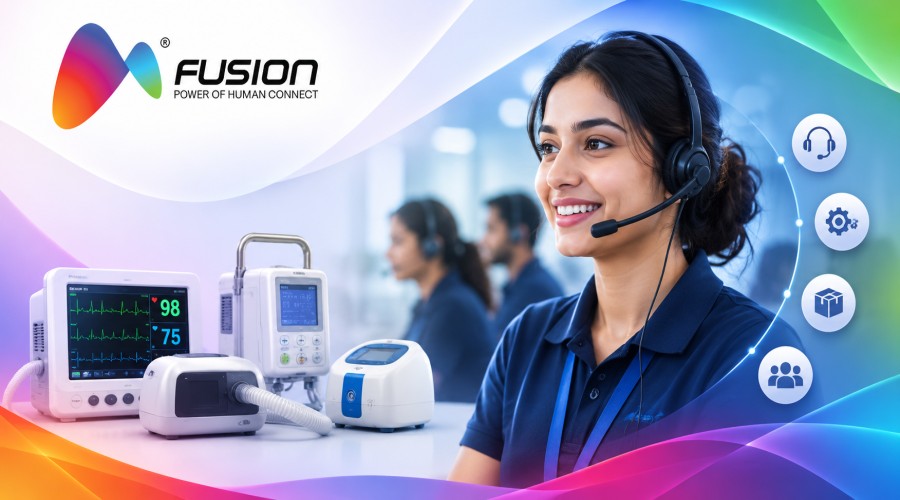
Most of this work is coordinated through the medical device call center. A medical call center handling device support is not a general customer service line. Its agents need to speak to clinical context, follow validated scripts and decision trees, and recognize when a routine question is actually a safety signal. That signal must then be escalated and documented. The difference between a generic agent and a trained one shows up in resolved issues, avoided truck rolls, and complaints captured correctly the first time.
Demand splits naturally in two directions, and a complete operation runs both. An inbound call center handles the clinician calling in with an error code, a setup question, or a complaint. Here, speed to a knowledgeable agent is everything. An outbound call center handles the proactive side: preventive maintenance reminders, recall and field-safety outreach, satisfaction follow-ups, and consumables replenishment. Together they convert support from a reactive queue into a managed relationship with the installed base.
A typical inbound flow runs in five steps: verify caller and device; triage against a validated decision tree; resolve at first contact where possible; escalate to Level 2 or field service when needed; and log the interaction, complaint indicators included, in the quality system.
Benchmarks That Signal a Healthy Operation
At the consideration stage, the useful question is not “do we have support?” It is “is our support performing, and against what?” The metrics below tell the real story. They matter whether you run the operation internally or through a partner, and they are worth putting in front of any model you evaluate.
| Metric | What It Tells You |
|---|---|
| First-contact resolution | How often a device issue is solved without a callback or dispatch |
| Average speed of answer | Whether clinicians reach a knowledgeable agent fast enough to matter |
| Complaint capture and turnaround | Whether safety signals are logged and escalated within required timelines |
| Device uptime / downtime per incident | The clinical and revenue impact support is actually preventing |
| CSAT and repurchase / attach rate | Whether service quality is translating into loyalty and recurring revenue |
| Quality-monitoring coverage | What share of interactions is reviewed for compliance and escalation accuracy |
Expert Insight: Treat first-contact resolution and complaint turnaround as clinical metrics, not just contact-center metrics. The same data that proves service quality to a hospital also demonstrates to auditors that your complaint-handling system is working.
In-House, Outsourced, or Hybrid: Framing the Build-vs-Buy Decision
Most manufacturers reach a point where the internal team can no longer absorb it all at once: support volume, extended hours, multilingual demand, and compliance workload. That is the moment the build-versus-buy question surfaces. It is rarely all or nothing. The table below frames the trade-offs so the decision rests on your volume, device risk profile, and growth rate rather than on habit.
| Consideration | In-House | Outsourced Partner |
|---|---|---|
| Scaling for volume | Slow to hire and train for spikes | Flexible capacity across shifts and seasons |
| Coverage hours | Expensive to staff 24/7 | Around-the-clock coverage built in |
| Compliance infrastructure | Must be built and maintained internally | Established QMS, certifications, and audit trails |
| Cost structure | High fixed cost | Variable, tied to volume and SLA |
| Clinical and product knowledge | Deep but concentrated in a few people | Requires structured knowledge transfer and training |
Many manufacturers land on a hybrid. They keep complex Level 2 and clinical specialists in-house, and partner for front-line volume, extended hours, and multilingual coverage. The condition on any partner is that it has the certifications and complaint-handling rigor the regulatory environment requires. If a provider cannot document and escalate to the FDA and ISO 13485 standard, cost is irrelevant.
How AI and Full-Coverage Monitoring Change the Economics
Technology is shifting the math on all three models. AI-enabled voice agents can deflect routine, high-volume questions: order status, basic setup, consumables reordering. That frees trained human agents to spend their time on clinical troubleshooting and complaint handling, where judgment matters. McKinsey’s medtech-services work points to automation and gen AI in exactly these areas, from scheduling to predictive troubleshooting. It is a consistent marker of the operations that pull ahead.
Monitoring is the other shift. In most industries, quality teams review a small manual sample of calls. In medical devices, a single missed complaint signal has outsized consequences, so sampling is a weak control. AI-driven quality assurance makes it practical to review every interaction for compliance language, escalation accuracy, and complaint-capture completeness. Fusion CX applies its Omind suite along these lines: Sayin.AI for voice automation and deflection on repeatable contacts, AI-driven QA for full-coverage interaction monitoring, and Semantify to turn conversation data into insight product and quality teams can act on. The point for a buyer is less about any one product and more about the capability. At scale, full monitoring and selective automation are what keep an operation both efficient and auditable.
A Practical Way to Evaluate Your Options
Whichever direction you lean, a short set of questions keeps the evaluation grounded. How does the model capture complaints, and is that capture auditable? How are potential adverse events escalated, and within what timelines? What share of interactions is monitored for quality? How quickly can capacity scale for a product launch or a recall? And what certifications and data-protection controls are in place, given the patient and device data involved?
These questions apply equally to an internal build and an outsourced partner. They move the conversation away from headline cost. What determines risk and value in this category is simpler: whether the operation can perform clinically and stand up to an audit at the same time.
Final Thoughts
Medical device after-sales support sits where customer experience, clinical reliability, and regulatory compliance meet. The manufacturers who treat it as a measured, strategic capability protect their installed base, their recurring revenue, and their patients at once. The ones who leave it to run on inertia tend to discover the gaps during an audit or a renewal. That is the most expensive time to find them. The consideration stage is the right time to pressure-test your model against the benchmarks and compliance standards above, before volume forces the decision for you.
Fusion CX runs medical device and healthcare support programs built for this environment: trained inbound and outbound agents, compliant complaint handling, AI-enabled deflection and full interaction monitoring, and multilingual coverage across 40 centers in 13 countries, all under HIPAA, ISO/IEC 27001:2022, PCI DSS 4.0.1, HITRUST CSF, and SOC 2 Type II. If you are weighing how to scale after-sales support for your devices, talk to our medical device support team about benchmarking your current model.