The electric vehicle industry has entered a phase where affordability, not novelty, determines survival. With battery costs representing roughly 40% of an EV’s total cost and legacy automakers reporting billions in EV-related write-downs, the pressure to reduce EV manufacturing costs has never been more acute. Ford’s recent pivot toward a $30,000 EV involved shrinking battery size, cutting parts by 20%, and reducing fasteners by 25%—a clear signal that the era of cost-insensitive electrification is over.
For OEMs and EV manufacturers, the question is no longer whether to outsource engineering functions, but how to do so strategically. The right EV engineering outsourcing partnerships can deliver not just labor arbitrage, but genuine structural cost reduction through modular platform design, thermal optimization, and lifecycle support efficiencies. This article outlines seven engineering outsourcing strategies that, when executed correctly, can reduce EV manufacturing costs by 20% or more—and explains how Fusion CX is positioned to help automotive and e-mobility brands achieve these outcomes.
The Cost Imperative: Why Outsourcing Is No Longer Optional
The traditional automotive OEM model—keeping core engineering in-house while outsourcing only peripheral functions—is breaking down under the weight of EV cost pressures. Honda’s recent decision to outsource an entire vehicle platform to Tata Technologies marked a historic departure for the Japanese automaker, driven explicitly by the need to cut costs and accelerate development. The message is clear: even the most engineering-centric brands are recognizing that external expertise can deliver cost advantages that internal teams cannot match at speed.
The strategies below represent the highest-impact areas where EV engineering outsourcing can directly attack EV production costs.
Strategy 1: Modular Platform Design Outsourcing
Cost Impact: 8–12% reduction in development and tooling costs
Modular platform design allows multiple vehicle models to share core architecture, components, and manufacturing processes. GM’s strategy of sharing drive units, rechargeable energy storage systems, and integrated power electronics across its BEV and battery electric truck platforms demonstrates how commonized propulsion architecture achieves significant manufacturing efficiency and cost optimization. Similarly, Tata Technologies’ eVMP modular platform claims to reduce time to market by up to six months while offering one-click scalability for rapid configuration.
Outsourcing modular platform design to an experienced engineering partner allows OEMs to:
- Access proven architecture frameworks rather than building from scratch
- Reduce engineering headcount during the design phase
- Leverage partner expertise in component commonization across vehicle segments
The key distinction is between outsourcing discrete design tasks and outsourcing the platform strategy itself. The latter delivers compounding savings as multiple models are derived from a single optimized foundation.
Strategy 2: Thermal Modeling and Battery Cooling Optimization
Cost Impact: 5–8% reduction in battery system costs and warranty exposure
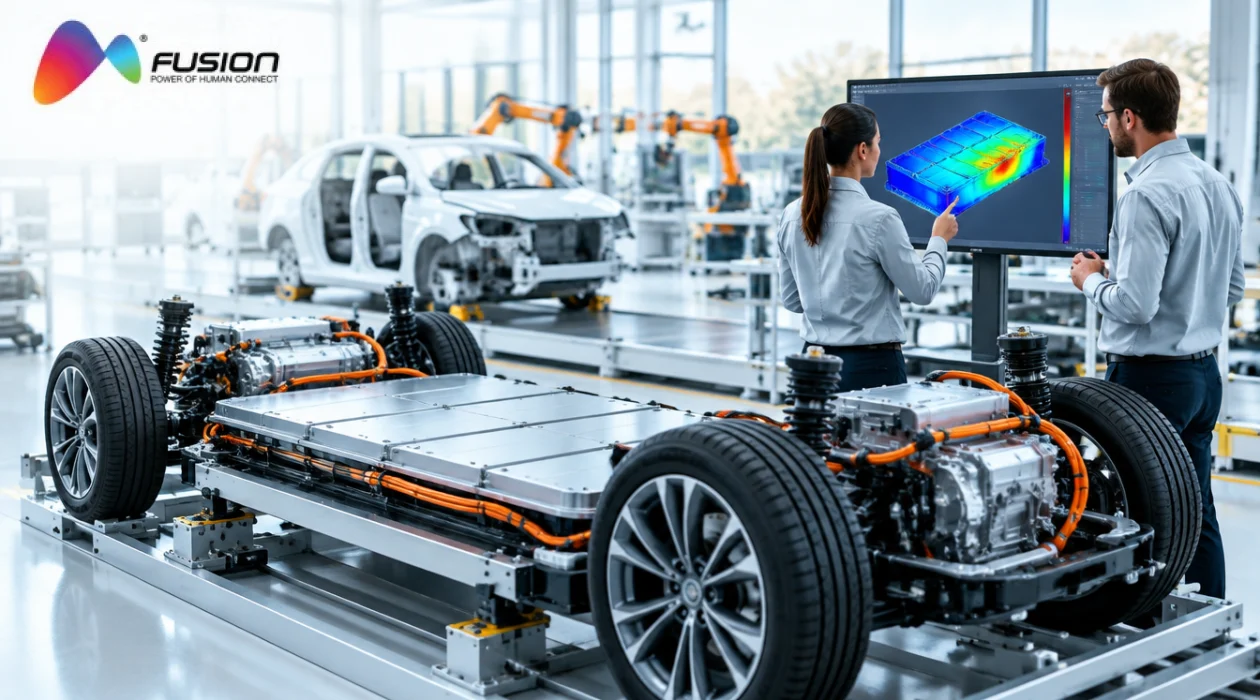
Battery thermal management is both a performance and a cost problem. Cell-to-cell temperature variation accelerates degradation, and over-engineered cooling systems add weight, complexity, and bill-of-materials cost. Advanced thermal modeling allows engineers to optimize cooling plate design, reduce coolant volume, and minimize safety margins without compromising durability.
Outsourcing thermal modeling to specialized engineering partners provides access to multi-scale simulation frameworks that would take years to develop in-house. These frameworks can reduce lifetime evaluation from years of physical testing to hours of simulation, enabling faster design iteration and earlier identification of cost-reduction opportunities. For EV programmes facing compressed timelines, this acceleration directly translates to engineering cost savings.
Strategy 3: Wiring Harness Optimization
Cost Impact: 3–5% reduction in harness material and assembly costs
Modern vehicles contain wiring harnesses exceeding 5 kilometers in length and weighing over 60 kilograms. Ford’s next-generation EV platform achieved a wiring harness over 4,000 feet shorter and 22 pounds lighter than its first-generation electric SUV, directly improving range through weight reduction.
AI-driven wiring harness optimization, particularly through zonal E/E architecture clustering, has demonstrated measurable cost savings. Research shows that a 12-zone configuration minimized total harness length to 241 meters and weight to 22.92 kilograms, with estimated per-vehicle savings reaching approximately €150 at high production volumes. Outsourcing this optimization work to partners with specialized routing algorithms and zonal architecture expertise allows OEMs to capture these savings without building internal capabilities.
Ready to Cut Your EV Production Costs?
Before you continue reading, consider this: every strategy outlined here requires specialized expertise that most OEMs cannot build fast enough internally. Fusion CX brings 22 years of automotive and e-mobility operational experience, with 40+ delivery centers across 13 countries and a 98% client retention rate. Whether you need to scale engineering support, optimize your automotive e-mobility customer support operations, or both, our team can design a delivery model tailored to your cost-reduction targets.
Strategy 4: Customer Support and After-Sales Engineering Outsourcing
Cost Impact: 4–6% reduction in total cost of ownership through reduced warranty claims and improved first-contact resolution
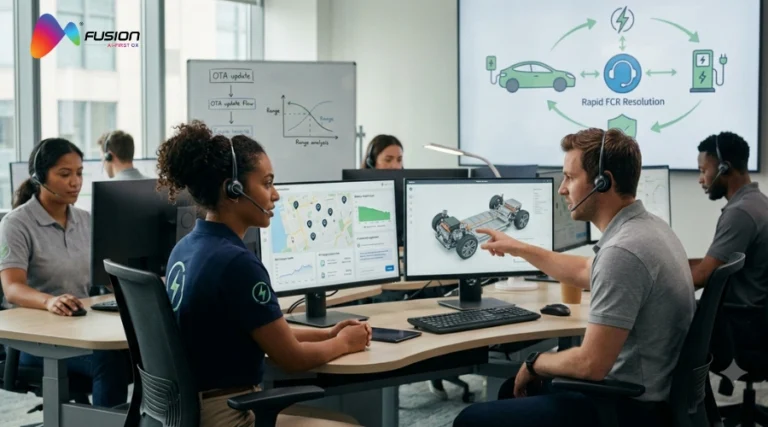
This strategy is often overlooked in engineering-focused cost discussions, but it deserves attention. EV owners have fundamentally different support needs than ICE vehicle owners—they ask about charging infrastructure, battery range, software updates, and OTA troubleshooting at all hours. Inefficient support operations drive up warranty costs, erode brand loyalty, and generate downstream engineering escalations that consume valuable internal resources.
Fusion CX provides automotive e-mobility customer support that is embedded in the client’s workflows rather than treated as a generic ticket queue. Agents receive product-specific training on EV vehicles, apps, and escalation protocols, and the service operates 24/7 customer support across voice, chat, email, WhatsApp, and in-app channels in 28 languages. The operational result is faster first-contact resolution, fewer escalations to internal engineering teams, and lower cost-to-serve.
For OEMs, this means engineering resources can focus on design and manufacturing rather than fielding routine support questions. For the overall EV program, the cost savings compound: every avoided warranty claim and every reduced escalation represents a direct reduction in operating expenses.
Strategy 5: Engineering Talent RPO and Staff Augmentation
Cost Impact: 3–5% reduction in engineering labor costs with faster ramp timelines
The automotive engineering talent shortage is acute, particularly for EV-specific skills like battery management systems, thermal modeling, and software-defined vehicle architecture. Building these teams internally requires significant recruitment costs, competitive compensation, and time that most EV programs cannot spare.
Outsourcing partners can provide Recruitment Process Outsourcing (RPO) services specifically targeting automotive engineering roles. A documented case saw an automotive giant achieve a 100% fill rate for 607 specialized engineering professionals needed for its EV transition. Staff augmentation models allow OEMs to scale engineering capacity up or down without the fixed costs of permanent headcount, providing flexibility that is particularly valuable during the volatile launch phases of new EV models.
Strategy 6: Back-Office and Non-Core Function Outsourcing
Cost Impact: 2–4% reduction in overhead costs
Finance, HR, IT support, and procurement administration are necessary functions that do not differentiate an EV product but consume significant management attention and operational budget. Outsourcing these functions to a partner with automotive domain expertise frees leadership to focus on electrification strategy and reduce EV manufacturing costs.
Fusion CX provides AI-native back-office operations with proprietary tools embedded from day one, including AI QMS for automated quality scoring that moves from sample audits to up to 100% interaction coverage. For automotive clients, this means administrative processes are handled with the same rigour and technology investment that customer-facing operations receive—without the OEM bearing the full cost of building and maintaining those capabilities.
Strategy 7: Integrated CX and Engineering Support Ecosystem
Cost Impact: 2–3% reduction through consolidated vendor management and shared infrastructure
The final strategy is less about a single function and more about the operating model. Rather than managing separate vendors for engineering services, customer support, and back-office operations, OEMs can consolidate these functions under a single partner with automotive domain expertise. This reduces vendor management overhead, enables shared knowledge across functions, and creates a unified data layer for continuous improvement.
Fusion CX’s model is explicitly designed as an “embedded, not outsourced” engagement. The discovery and scoping process maps the customer journey, product complexity, and support gaps before designing a delivery model. Integrated delivery means the partner connects to existing CRM, ticketing, and customer data platforms rather than forcing a parallel system. Continuous improvement is driven by weekly QA reviews, AI-driven interaction scoring, and voice-of-customer surveys. For an EV program already stretched across multiple engineering and manufacturing partners, this consolidation reduces complexity and the associated management costs.
How Fusion CX Helps Solve the Cost Problem
Fusion CX occupies a specific position in the automotive and e-mobility value chain: the operational and customer-facing layer that supports the entire ownership lifecycle, combined with the AI-native infrastructure to deliver these services at lower cost-to-serve.
The core capabilities relevant to reducing EV manufacturing costs include:
| Capability | How It Reduces Costs | Evidence / Scale |
|---|---|---|
| EV-specific CX and technical support | Reduces warranty escalations and field service costs through accurate first-contact resolution | 22 years in operation; 40+ delivery centers |
| 24/7 customer support and multilingual coverage | Eliminates need for internal after-hours staffing across global markets | 28 languages; 13 countries |
| AI-native operations | Delivers 40–60% lower support costs through automation and AI QMS | Proprietary AI embedded from day one |
| Automotive back-office | Reduces overhead and frees leadership for core engineering | 98% client retention |
| Scalable ramp model | Supports launches and software rollouts without fixed internal cost | Redundant sites and fast ramp plans |
The key distinction is that Fusion CX does not claim to replace the engineering service providers who handle modular platform design or thermal modeling. Instead, Fusion CX addresses the operational and customer-experience layer that surrounds the vehicle, ensuring that the cost of supporting EVs after sale does not erode the margins gained through manufacturing optimization.
Why Fusion CX Stands Apart from Other Outsourcing Providers
The outsourcing market for automotive services is crowded with generalist BPO providers and engineering-focused firms that operate in separate silos. Fusion CX competes on a different axis: deep e-mobility domain expertise combined with AI-native delivery and a global footprint built for the complexity of EV support.
| Differentiation Factor | Fusion CX | Typical Generalist BPO | Engineering-Only Provider |
|---|---|---|---|
| EV domain training | Agents trained on EV product lines, charging ecosystems, software terminology | Generic scripts, limited EV knowledge | Deep technical but no customer support capability |
| Channel coverage | Voice, chat, email, social, WhatsApp, in-app, SMS in one history | Often voice-heavy with limited digital | Not applicable |
| AI integration | Proprietary AI (Omind) embedded from day one; AI QMS for quality | Limited or third-party AI tools | Simulation and design AI, not CX AI |
| Global delivery | 40+ centers in 13 countries; onshore, nearshore, offshore options | Variable footprint, often single-region | Usually concentrated in low-cost engineering hubs |
| 24/7 customer support capability | Redundant sites and fast ramp plans for launches and outages | Limited after-hours coverage | Not applicable |
| Automotive certifications | PCI DSS, ISO/IEC 27001:2022 | Varies widely | Technical certifications, not CX security |
| Client retention | 98% | Industry average or lower | Not comparable |
The practical implication for an EV manufacturer is that Fusion CX can serve as a single partner for the customer-facing and operational layers of the business, while engineering service providers focus on the vehicle itself. This separation of concerns reduces vendor complexity and ensures that both domains receive specialized attention.
Conclusion: The 20% Target Is Achievable—But Requires the Right Partner Mix
Reducing EV production costs by 20% is not a fantasy. Ford’s redesign of its next-generation platform demonstrates that part reduction, wiring optimization, and architecture simplification can deliver double-digit savings when approached holistically. Modular platform sharing, thermal simulation, and wiring harness optimization each contribute measurable percentage points toward the target.
The critical insight is that no single outsourcing partner can deliver all seven strategies. The optimal model combines engineering service providers for design and simulation work with operational partners like Fusion CX for the customer-facing and back-office functions that determine total cost of ownership. Together, these partnerships allow an EV manufacturer to focus internal resources on the core vehicle—battery chemistry, propulsion integration, and manufacturing—while external experts handle the specialized and scalable functions that surround it.
For OEMs and EV brands facing the dual pressure of affordability and profitability, the question is not whether to outsource, but how to architect the outsourcing ecosystem for maximum cost impact. The seven strategies outlined here provide a roadmap. The right partner selection determines whether that roadmap reaches the 20% target.
→ Request a cost-reduction assessment from Fusion CX to evaluate how your EV program’s automotive e-mobility customer support and back-office operations can contribute to your EV manufacturing cost targets.