
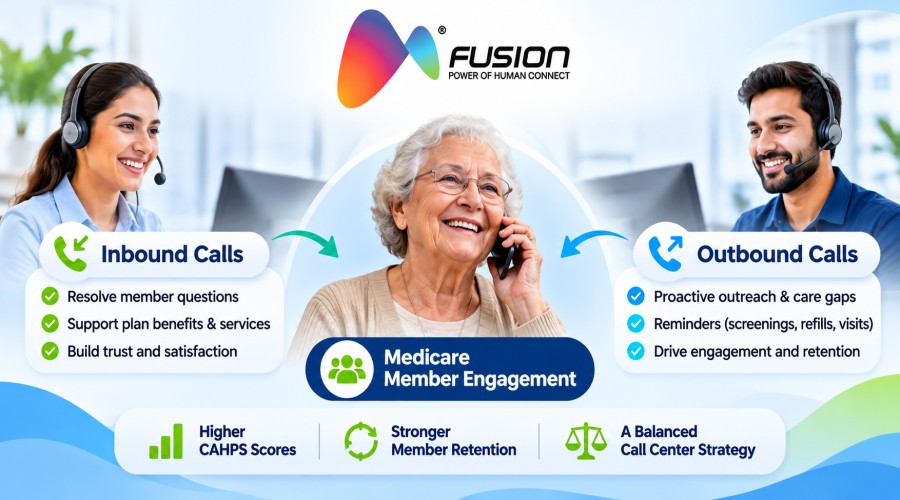
Medicare member engagement is where health plans now win or lose on both revenue and retention, and most of it still runs through the phone. A plan can design generous benefits and a wide network and still lose a member who cannot get a question answered or who never hears from the plan until renewal. The strategic question is not whether to call members. It is which calls should come in and which should go out. Inbound and outbound calls do different jobs in member engagement, and getting the balance right shapes CAHPS scores, Star Ratings, and the revenue that rides on both.
Table of Contents
What Medicare Member Engagement Really Means
Member engagement covers every interaction a plan has with a beneficiary across the year, not just the annual enrollment window. It includes answering benefit questions, resolving claims and authorization issues, closing care gaps, running health risk assessments, reminding members about screenings and refills, and following up after a complaint. Done well, it keeps members healthy, satisfied, and enrolled. Done poorly, it shows up as low survey scores and higher disenrollment.
The stakes are large because the market is large. According to KFF, 35.2 million people were enrolled in Medicare Advantage in 2026, which is 55 percent of all eligible Medicare beneficiaries. Enrollment grew by about 1.1 million, or 3 percent, from the prior year, a slower pace than before. Slower growth changes the game. When fewer new members enter the pool, retaining and engaging the members you already have becomes the primary lever. The call center is the front line of that effort.
Why the Channel Mix Matters More Than It Used To
Member experience has a direct line to money through Star Ratings. CMS reweighted its program so that member experience measures, drawn largely from the CAHPS survey, moved from a 4x weight to a 2x weight beginning with the 2026 Star Ratings. Even at half the old weight, these measures still move the overall rating. A plan’s rating, in turn, drives quality bonus payments and rebate dollars. How members experience the plan on the phone feeds directly into those survey answers.
Inbound service also carries a hard compliance floor. Under CMS call center monitoring, plans are tested through the Accuracy and Accessibility Study. It uses secret-shopper calls to measure the availability of TTY services and foreign-language interpreters, plus the accuracy of the information agents provide. A medicare call center that fails these tests puts the plan’s compliance standing at risk. That is why the inbound side cannot be treated as a cost to minimize.
Insight for buyers: Treat inbound and outbound as one engagement system with two motions, not two separate budgets. The plans that score well on CAHPS tend to be the ones where an inbound complaint triggers an outbound follow-up. The member feels heard twice.
Inbound Calls: Service, Trust, and the Compliance Floor
Inbound calls are member-initiated. The member has a question or a problem, and the plan’s job is to resolve it quickly and correctly. This is the trust-building side of engagement, because it is where members judge whether the plan is on their side.
A Medicare inbound call center typically handles benefit and coverage questions, claims and billing issues, provider and network lookups, prior-authorization status, ID card and enrollment questions, grievances, and pharmacy or formulary queries. Speed and accuracy matter on every one. Picture an older caller who waits too long, gets transferred repeatedly, or receives a wrong answer. That experience goes straight into the next CAHPS survey.
The inbound line is also where accessibility obligations live. Agents need to handle TTY calls, connect interpreters for members with limited English, and give accurate answers that match CMS guidance. These are not optional service niceties; they are measured, and they feed the plan’s rating.
Outbound Calls: Proactive Engagement and Retention
Outbound calls are plan-initiated. Instead of waiting for a member to reach out, the plan reaches the member first. This is the proactive side of engagement, and it is where plans influence health outcomes and loyalty rather than just react to problems.
A Medicare outbound call center runs welcome and onboarding calls for new members, health risk assessments, medication adherence reminders, care-gap and preventive-screening outreach, appointment scheduling support, and retention calls before and during the annual election period. These calls do real work. A completed health risk assessment helps the plan understand a member’s needs early. A timely adherence reminder can keep a chronic condition in check.
Outbound also carries its own rules. Calls must respect CMS marketing and communication guidelines, scrubbing against do-not-call preferences and staying inside permitted contact windows. The goal is engagement that feels like service, not sales pressure. A clumsy outbound program can damage the same survey scores a good one lifts.
Expert Insight: Measure outbound by outcomes completed, not dials made. A program judged on health risk assessments finished, gaps closed, and members retained behaves very differently from one judged on call volume. It also serves the member better.
Inbound vs. Outbound: How They Compare
The two motions are not interchangeable. Each has its own trigger, its own engagement goal, and its own set of measures. The table below frames the difference for a buyer deciding how to resource each one.
| Dimension | Inbound Calls | Outbound Calls |
|---|---|---|
| Who starts it | The member | The plan |
| Primary goal | Resolve the issue, build trust | Drive health actions and retention |
| Typical work | Benefits, claims, grievances, pharmacy | HRAs, adherence, care gaps, welcome calls |
| Compliance focus | Accuracy, TTY, interpreter access | Marketing rules, contact windows, consent |
| Key metrics | First-contact resolution, speed of answer, CSAT | Completion rate, gap closure, retention |
| Star Ratings link | Member experience (CAHPS), accessibility | Clinical and adherence measures, retention |
Where the Two Work Together
The real gains show up when inbound and outbound stop operating as silos. A member who calls in with a complaint is a candidate for an outbound follow-up once the issue is fixed. That turns a negative moment into a loyalty moment. A new member who was hard to reach for a welcome call may call in later with a benefits question. That inbound contact is the chance to complete the onboarding that outbound missed.
This closed loop is what separates a transactional contact center from a member engagement engine. It depends on shared data, so both motions see the same member history. It also depends on consistent quality standards across inbound and outbound teams. When the two are run together, every contact, whoever started it, moves the member relationship forward.
What B2B Buyers Should Evaluate in a Medicare Call Center Partner
If you are choosing a partner to run member engagement, the evaluation should go beyond staffing and price. Look at how the partner handles the CMS accuracy and accessibility requirements, including TTY and interpreter coverage. Ask how it measures quality across both inbound and outbound, and whether it monitors a meaningful share of interactions rather than a small sample. Check for Medicare-specific experience, because agents who understand benefits, grievances, and HRAs ramp faster and make fewer compliance errors.
Data protection belongs on the same list, given the protected health information involved. The partner should be able to document its security and compliance posture, not just assert it. And it should connect its work back to the measures that matter to you: CAHPS, Star Ratings, adherence, and retention, rather than reporting call volume in isolation.
Final Thoughts
Inbound and outbound calls are two halves of Medicare member engagement, and neither works as well alone. Inbound builds trust and carries the compliance floor that protects the plan’s rating. Outbound drives the proactive health actions and retention that lift it. Enrollment growth has slowed, and member experience still shapes Star Ratings revenue. In that market, the plans that treat these two motions as one coordinated system are the ones that keep members healthy and keep them enrolled.
Fusion CX runs Medicare member engagement programs that connect both sides of the phone. That means compliant inbound service with TTY and interpreter coverage, plus outbound outreach for HRAs, adherence, care gaps, and retention. All of it is backed by quality monitoring tied to CAHPS and Star Ratings outcomes. If you are planning your member engagement model for the year ahead, talk to our Medicare experts about balancing inbound and outbound for your membership.