
Residential electric satisfaction just hit its lowest recorded point. J.D. Power’s 2026 data puts it at 499 on a 1,000-point scale. The American Customer Satisfaction Index shows the same trend: energy utility scores dropped again this year, down to 73 out of 100. Only 41% of customers can even recall hearing from their utility during a recent outage. The answer lies in energy customer service outsourcing built in the wrong way — heavy on apology, light on real answers — is a big part of why.
Here’s the strange part. Most utilities aren’t short on politeness. Support scripts are full of apologies. Agents say “sorry” constantly. And customers are still getting angrier.
That’s not a coincidence. Endless apologies without a straight answer don’t calm people down — they stall them. This is exactly the gap that well-designed energy customer service outsourcing is built to close: not friendlier scripts, but more honest ones.
The Politeness Trap
J.D. Power’s 2026 outlook makes the fix look almost too simple. Utilities that proactively communicate about outages score 52 points higher on customer satisfaction than those that don’t. Utilities that share real updates on grid investment score 82 points higher.
Notice what’s driving those gains. It isn’t friendliness. It’s information, delivered before the customer has to ask for it.
Brand appeal tells the same story from the other direction. According to J.D. Power’s 2026 Utility Brand Appeal study, appeal scores drop 57 points among customers who experience an outage. The drop isn’t really about the outage itself. It’s about what the utility does, or doesn’t say, while the lights are out.
Table 1: The 2026 Energy Utility Satisfaction Snapshot
Where “Nice” Scripts Actually Live
Kim Scott’s book Radical Candor maps every kind of feedback onto two simple axes: how much you care personally, and how directly you challenge. Cross them, and four styles appear.
Radical Candor sits in the corner every energy support call should aim for — high care, high challenge. The agent is warm, but also specific and honest.
Ruinous Empathy sits right next to it, and it’s where most “nice” scripts actually live. High care, low challenge. Endless warmth, zero real information. An agent who says “I completely understand your frustration” five times in one call, without ever naming a restoration time, is being ruinously empathetic. It feels kind. It resolves nothing.
The other two corners matter too. Obnoxious Aggression is blunt without warmth — technically accurate, but cold. Manipulative Insincerity is the worst of both: scripted, hollow, and short on real care or real information.
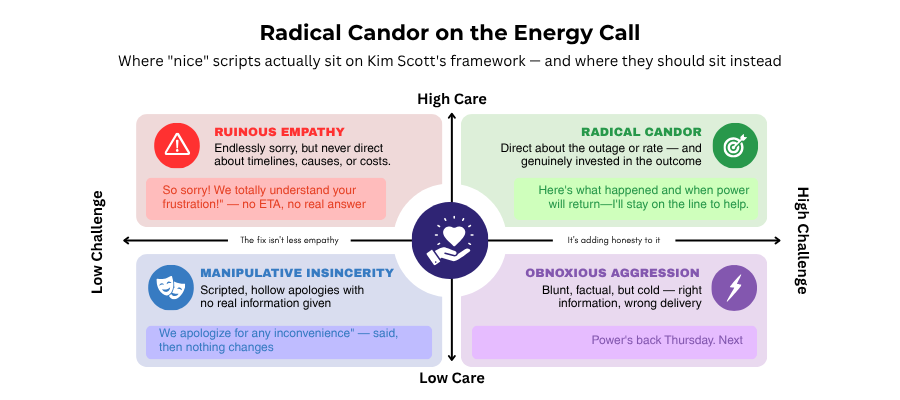
Radical Candor on the Energy Call — where “nice” scripts actually sit, and where they need to move.
The Real Cost of Staying “Nice”
A ruinously empathetic call doesn’t just fail to help. It usually creates a second call.
A customer who hears only apology, with no restoration time and no explanation, has one reasonable next move: call back and ask again. That repeated contact adds cost to the utility’s side and frustration to the customer’s side, and neither problem gets solved by being nicer the second time.
Compare the two approaches side by side.
Table 2: Same Situation, Two Very Different Responses
Direct Doesn’t Mean Cold
It’s worth being precise here, because candor gets misread as bluntness all the time.
Radical Candor isn’t Obnoxious Aggression with better branding. The care has to be real. An agent still needs to sound like someone who wants the customer’s problem solved, not like someone reading facts off a screen.
The difference lies in what happens after empathy. A ruinously empathetic agent stops at “I’m sorry.” A radically candid one continues: “And here’s exactly what’s happening, and here’s what I’m doing about it right now.”
Why Energy Customer Service Outsourcing Gets This Right at Scale
Training one agent to balance warmth and honesty is manageable. Training an entire seasonal storm-response team to do it consistently, across thousands of simultaneous calls, is a different problem entirely.
This is where dedicated energy call center outsourcing services earn their place. A specialized partner builds radical-candor coaching directly into onboarding, scores calls on whether real information was actually given, and flexes staffing up during storm season without diluting quality with rushed new hires. The best energy call center outsourcing services treat every “I’m sorry” as the start of the answer, not the whole answer.
Table 3: In-House Support vs. Energy Customer Service Outsourcing
Three Habits Worth Coaching Into Every Call
Skip the script rewrite. These three habits work inside almost any existing call flow.
- Name it, then move past it: One honest acknowledgment of frustration is enough. Repeating “I’m sorry” doesn’t add comfort — it delays the answer.
- Give a number, not a feeling: A time, a cause, or a dollar figure does more than any amount of expressed sympathy.
- Stay on the line for the outcome: Candor without follow-through is just Obnoxious Aggression in disguise. The care still has to show up in the action.
The Kindest Thing an Agent Can Do Is Tell the Truth
None of this argues for less warmth on an energy support call. It argues for warmth that actually delivers something.
Satisfaction scores are falling industry-wide, not because agents aren’t nice enough, but because “nice” has quietly become a substitute for direct answers. Fixing that doesn’t require a longer call or a bigger team. It requires agents trained to combine real care with real information — consistently, at storm-season scale.
That combination is exactly what strong energy customer service outsourcing is built to deliver.
Fusion CX trains energy and utility support teams in radical candor techniques, storm-season surge staffing, and QA built around real resolution — not just handle time.
ANSWERS OVER APOLOGIES
Give Your Customers Something Better Than “Sorry”
Talk to us about energy customer service outsourcing that pairs real empathy with real answers — built for storm season and everyday calls alike.