
Nearly 1 in 20 U.S. households were in utility collections or arrears by mid-2026. In parts of the South and Appalachia, it’s closer to one in 12. The average overdue balance has climbed 32% in three years, from $597 to $789. Utility customer support outsourcing built on negotiation, not threats, is emerging as the fix — because something in the standard collections process clearly isn’t working.
Most utilities still run collections like a countdown clock. A bill goes out. A reminder follows. Next comes a warning. Then, finally, a shutoff. But debt rarely disappears because someone got scared. It disappears because someone found a workable way to repay it. That single shift in approach is why smart utility customer support outsourcing — built around negotiation, not threats — is starting to outperform the old script.
This piece looks at why the threat-based model is breaking down, what a better call actually sounds like, and what it takes to run it at scale.
The Shutoff Script Isn’t Working Anymore
Start with the numbers. They tell a clear story.
Across Ohio’s regulated electric utilities, 7.7% of customers had their power shut off for unpaid bills in the most recent reporting year — the highest rate in three consecutive periods. The companies disconnected households roughly 345,000 times between June 2025 and May 2026. Average arrears at the moment of shutoff reached $558, up from $495 the year before.
The pattern isn’t local. Nationally, utilities disconnected residential electric service more than 13 million times in a single year. Natural gas providers sent out 27 million final notices. And the trend keeps accelerating, not slowing down.
Table 1: U.S. Utility Disconnection and Arrears Snapshot, 2026
Rising debt with rising disconnections means one thing. The current approach isn’t recovering more money. It’s just losing more customers along the way.
What Chris Voss Would Say Before Your Next Collections Call
Chris Voss spent years negotiating hostage releases for the FBI. His approach, laid out in Never Split the Difference, wasn’t about pressure. It was about information. A negotiator who talks less and listens harder gets further than one who threatens.
That idea translates directly to a past-due utility call. Four techniques do most of the work.
- Mirroring. Repeat the last few words a customer says. It sounds small, but it invites them to keep explaining — and explanation is where useful information lives.
- Labeling. Name the emotion before naming the balance. “It sounds like this bill caught you off guard” lands very differently than “You owe $340.”
- Calibrated questions. Ask “how” and “what,” never “why.” “What would make this payment work for you this month?” opens a conversation. “Why haven’t you paid?” closes one.
- The no-oriented question. People relax when they can say no. “Is now a bad time to talk about your balance?” often gets more honesty than any yes-or-no pitch for a payment plan.
None of this requires a longer call. It requires a different first thirty seconds.
Why Threats Cost More Than They Collect
Utilities aren’t ignoring the debt problem. Many have simply outgrown their old collections model without realizing it.
Historically, the bad debt ratio for electric utilities was near 0.20%. Recent data show many utilities now running at two to three times that level. Only 11% of utilities report that fewer than 5% of their customers are behind on payments — meaning arrears have become the norm, not the exception, at most utilities surveyed.
Meanwhile, the share of customers in arrears now outpaces the share receiving financial assistance. That gap means threats are landing on households that genuinely cannot pay on the old terms, no matter how firm the reminder call sounds.
Table 2: Why the Threat-Based Collections Model Is Losing Ground
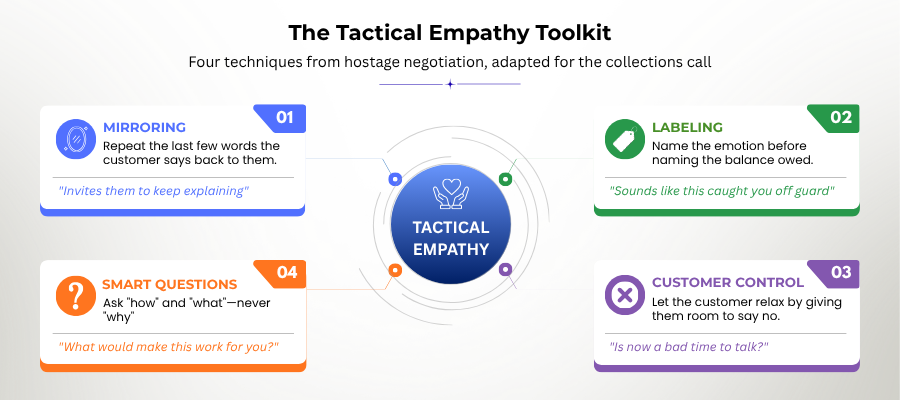
The Tactical Empathy Toolkit — four negotiation techniques from hostage negotiation, adapted for the collections call
Payment Plans Only Work If the Conversation Does
Regulators and consumer advocates increasingly point to two structures instead of straight shutoffs.
An arrearage management program, or AMP, forgives part of a past-due balance over time, as long as the customer keeps paying current bills on schedule. A percentage-of-income payment plan, or PIPP, caps the bill at a set share of household income for eligible customers.
Both programs work well on paper. But paper isn’t where they succeed or fail. They succeed in the conversation where an agent explains it to them, checks eligibility, and helps a stressed customer enroll before a disconnection notice goes out.
Table 3: The Two Payment Structures Replacing Straight Shutoffs
Can Your Team Actually Do This at Scale?
Here’s the hard part. Tactical empathy is a skill. Skills need training, coaching, and constant reinforcement — not a script taped to a monitor.
Most utility collections teams were built for volume, not negotiation. Adding negotiation training on top of an already stretched in-house team is slow, and it competes with daily call-volume pressure for time and attention.
This is exactly where utility customer care outsourcing services change the equation. A specialized partner brings negotiation-trained agents, built-in AMP and PIPP enrollment workflows, and quality scoring based on de-escalation and resolution — not just average handle time. The right utility customer care outsourcing services treat every past-due call as an opportunity to retain a customer, not just close a ticket.
Table 4: In-House Collections vs. Utility Customer Support Outsourcing
Four Moves for Every Collections Call
For CX leaders building this into a training program, the framework fits on one page.
- Label before you quantify. Name the customer’s situation before naming the balance owed.
- Ask “how,” never “why.” Calibrated questions get real answers. Interrogation-style questions get silence.
- Offer the plan before the customer has to ask. Present AMP or PIPP options proactively, not as a last resort.
- Confirm the plan in their words. Have the customer repeat the agreement back to you. It cuts default rates and repeat calls.
Four moves. No script rewrite required — just a different opening line.
The Cheapest Disconnection Is the One That Never Happens
A shutoff isn’t free for the utility either. Someone eventually absorbs that cost: written-off debt, a rate increase spread across other customers, or a reconnection visit that a proactive payment plan would have avoided entirely.
Tactical empathy doesn’t ignore the debt. It just gets to a workable answer faster and keeps the customer connected in the process.
For most utilities, the fastest way to bring negotiation-trained collections calls into every market is to partner with a proven utility customer support outsourcing partner — one that treats a past-due call as a conversation to win, not a script to read.
Fusion CX trains collections teams on tactical-empathy techniques, AMP and PIPP enrollment workflows, and seasonal scaling for utilities across North America.
Collections That Keep Customers Connected
Stop Scripting Threats. Start Negotiating Outcomes.
Talk to us about utility customer support outsourcing built on tactical empathy, AMP/PIPP enrollment, and seasonal scale.