
Carriers have spent the last three years — and tens of billions of dollars — buying spectrum for fixed wireless access. AT&T alone committed $23 billion to EchoStar’s airwaves. Yet in 2026, something inconvenient is happening: FWA net additions are flattening, and for the first time, subscribers are churning not just from cable to wireless, but between FWA providers themselves. The carriers pulling ahead are the ones treating telecommunications call center outsourcing — not more spectrum — as their next growth lever.
Geoffrey Moore warned us about this moment more than thirty years ago. In Crossing the Chasm, he showed that technology products don’t fail because early growth stalls — they fail because the customer who buys next is fundamentally different from the customer who bought first. FWA has reached that exact inflection point. And the bridge across it will not be built from spectrum. It will be built by the frontline — which is why telecommunications call center outsourcing is quietly becoming the most strategic decision in the FWA playbook.
The Chasm, Explained in FWA Terms
Moore’s technology adoption life cycle divides buyers into innovators, early adopters, an early majority, a late majority, and laggards. Between the early adopters and the early majority sits the chasm — the graveyard of promising technologies.
The distinction is behavioral, not demographic. Early adopters buy a vision and forgive friction. The tech enthusiast who signed up for 5G home internet in 2023 happily walked around the house holding a gateway to hunt for signal, tolerated speed dips during peak hours, and treated the whole thing as a fun experiment.
The early majority — the pragmatists — buy a reference. The suburban household switching from cable in 2026 is not experimenting. They are replacing a utility. They expect the router to work on day one, the speed to match the promise, and the first bill to match the quote. When any of those expectations break, they don’t troubleshoot. They leave.
Here is the uncomfortable truth for every FWA product team: the product didn’t change; the customer did. The same install flow, the same speed variance, and the same support scripts that early adopters shrugged off are now churn triggers.
The Data Says the Easy Growth Is Over
The 2026 numbers tell the story of the chasm with unusual clarity. New Street Research estimates the big three US carriers now have capacity for roughly 32 million FWA subscribers — double their 2024 estimate — yet expects net additions to slow from 2026 onward.
Table 1: US Big Three — FWA Net Additions (New Street Research, 2026)
The global picture confirms that the opportunity is enormous — and that the winners will be decided by execution, not availability.
Table 2: The FWA Market at the Chasm — Key 2026 Signals
Read those five signals together and one conclusion is unavoidable: when acquisition slows, and churn rises at the same time, retention economics take over. And retention is a service problem, not a network problem.
Where FWA Customers Actually Fall Off the Bridge
Pragmatist churn is rarely caused by a catastrophic failure. It is caused by a sequence of small, predictable stumbles in the first month — each one survivable alone, fatal in combination.
Table 3: The Four Failure Points of the FWA First 30 Days
That last row deserves a contrarian underline: an FWA outage is a broadband outage — but most carriers still staff and script it like a phone problem. A dropped mobile call is an annoyance. A dropped home connection cancels the work-from-home meeting, the telehealth appointment, and the kids’ homework. The emotional stakes are categorically different, and the frontline response has to be too.
The FWA Onboarding Bridge — how the first 30 days of service carry customers across the adoption chasm
Onboarding Is the Bridge: The First 30 Days Decide Year One
Look again at the diagram above. The bridge has four planks, and none of them is made of spectrum.
A structured onboarding program converts the four failure points into four loyalty moments. Guided activation support at Day 0 turns a frustrating self-install into a five-minute assisted win. A proactive quality-of-experience check on Day 3 catches the signal wobble before the customer ever notices it. A Day 14 usage-and-billing review eliminates first-bill shock — the single most corrosive event on trust in telecom. And a Day 30 conversation, made on a foundation of three positive touches, is the natural moment to introduce the speed-tier upgrades and bundles that Omdia identifies as the real 5G FWA monetization engine.
The operational challenge is that this playbook is both high-touch and high-volume. FWA demand arrives in waves — market by market, launch by launch — which makes staffing brutal for an in-house team. This is precisely the problem telecommunications call center outsourcing was built to solve: elastic capacity that scales with launch calendars, agents cross-trained in both wireless and home broadband troubleshooting, and 24/7 coverage from day one, without the carrier having to build any of it internally.
Why Telecom Inbound Call Center Outsourcing Beats Building In-House for FWA
The build-versus-partner decision for FWA support comes down to the shape of the demand curve. FWA volumes are lumpy: a new market launch generates a spike of installs, week-one calls, and first-bill queries, then settles into a steady state. An in-house team sized for the spike sits idle afterward; a team sized for the steady state drowns during every launch.
Table 4: In-House FWA Support vs. Telecom Inbound Call Center Outsourcing
There is also a quality argument that gets less attention than the cost one. Telecom inbound call center outsourcing partners who run programs across multiple carriers accumulate pattern knowledge no single in-house team can: which gateway models generate the most placement calls, which bill-presentation formats trigger disputes, which retention scripts actually save a wavering pragmatist. A specialized telecommunications call center partner brings this playbook ready-made — refined through millions of interactions — rather than having you learn it at your customers’ expense.
What Good Looks Like: The FWA Onboarding Playbook
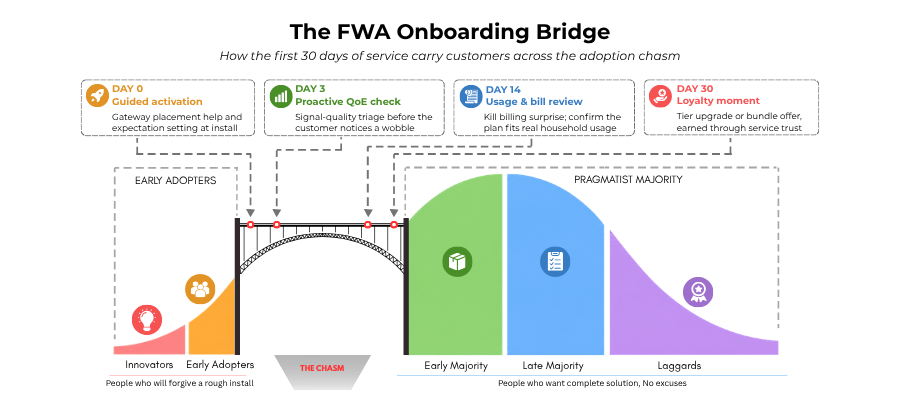
Adapted from Geoffrey Moore’s technology adoption life cycle
For CX and product leaders building the business case for telecommunications call center outsourcing, here is the bridge blueprint in five steps:
- Pre-install expectation setting. A short outbound contact before the gateway ships: what speeds to expect, where to place the device, what the first bill will say.
- Guided activation support. Live or callback-based help during self-install, with photo/video-assisted gateway placement — the difference between a 20-minute win and a returned box.
- Day-3 proactive QoE check. Outbound signal-quality triage that fixes the week-one wobble before it becomes a complaint.
- Day-14 usage and billing review. Confirm the plan fits real household usage and walk through the first bill line by line. Kill bill shock before it kills trust.
- Day-30 loyalty conversation. With three positive touches banked, introduce the reliability-based upsell — the QoE-driven tier upgrade that turns a support relationship into ARPU growth.
Five touches. Thirty days. That’s the bridge.
Conclusion: You Built the Network. Now Build the Bridge.
The chasm was never going to be crossed with more airwaves. The spectrum is bought, the towers are lit, and 350 million FWA connections are coming by 2031 — but they will not distribute themselves evenly. They will concentrate on carriers that treat the first 30 days of service as a product in its own right.
The pragmatists are here. They don’t read coverage maps; they read their first bill, their week-one speeds, and the tone of their first support call. Winning them is a frontline discipline — and for most carriers, the fastest, most economically rational way to build that discipline is a specialized telecommunications call center outsourcing partnership.
Fusion CX runs onboarding, inbound support, and retention programs for telecom and broadband providers across the globe — with the cross-trained agents, launch-wave elasticity, and proactive outreach cadence that FWA’s next chapter demands.
Build Your Onboarding Bridge
Don’t Let Your FWA Customers Fall Into the Chasm
Talk to us about a telecommunications call center outsourcing partnership built for FWA onboarding, retention, and launch-wave scale.