
Mobile virtual network operators are living through a strange paradox. The global MVNO market is projected to grow from roughly $80–100 billion in 2026 to well over $170 billion within the next several years, and subscriber counts are set to climb from 333 million today to 438 million by 2030. By every top-line measure, this is a growth industry. And yet 60% of MVNOs fail — not because the market is too small, but because most of them are fighting the same losing war: the race to the bottom on price. MVNO customer service — not marketing spend, not another rate cut — is what actually decides who survives that fight.
Churn tells the real story. In mature markets like Germany and the Netherlands, MVNO churn already runs 1.5 times higher than the host carriers they lease spectrum from. In the UK, churn in saturated segments sits near 15% — a level that makes sustainable growth almost impossible once acquisition costs are factored in. The uncomfortable arithmetic is simple: a subscriber who churns in month four never repays a $60 acquisition cost. Price-only positioning doesn’t just fail to build loyalty — it actively recruits the customers most likely to leave for the next discount.
The MVNOs pulling ahead of this trap have made a different bet. They’ve stopped competing on rate plans and started competing on identity — serving a specific community, in its own language, with support built around that community’s real needs. And that bet changes everything downstream, starting with how they staff and run MVNO customer service call center outsourcing.
The Positioning Mistake That’s Killing MVNOs
April Dunford’s positioning framework, from her book Obviously Awesome, makes a simple but brutal point: if you don’t consciously choose your positioning, the market chooses it for you — and the default position it hands you is “cheaper than the alternative.” That’s not a position. It’s a waiting room for the next competitor with a lower price.
This is precisely what’s happening across the MVNO landscape. Industry researchers now describe “generic discount brands” as a structurally weak category: founders who launch with an undifferentiated, low-cost plan and no answer to “why us, specifically” are the ones filling the 60% failure rate. Meanwhile, MVNO analysts tracking 2026 launches note that niche MVNOs — built around ethnic and diaspora communities, students, seniors, gamers, or fan bases — consistently outgrow generic prepaid brands, because their subscribers feel specifically recognized rather than generically discounted.
The reason is structural, not sentimental. A price-only MVNO has zero switching cost working in its favor — the subscriber who joined for a $10 rate will leave for a $9 rate. A niche MVNO builds a different kind of asset: a support relationship, a community identity, a language of service that a generic competitor cannot easily replicate. That asset is the brand moat price-only operators don’t have.
The Data: Price Wars Are a Race to the Bottom
The 2026 numbers make the economics of the discount trap explicit.
Table 1: The 2026 MVNO Market at a Glance
Read together, these signals describe an industry where the addressable market is expanding, and the failure rate is holding steady — because most operators are still fighting each other over the same undifferentiated prepaid customer, on the same lever: price.
Why Niche Positioning Changes the Support Economics
The clearest way to see the difference positioning makes is to compare the unit economics side by side. This isn’t a marketing preference — it’s a different profit-and-loss statement.
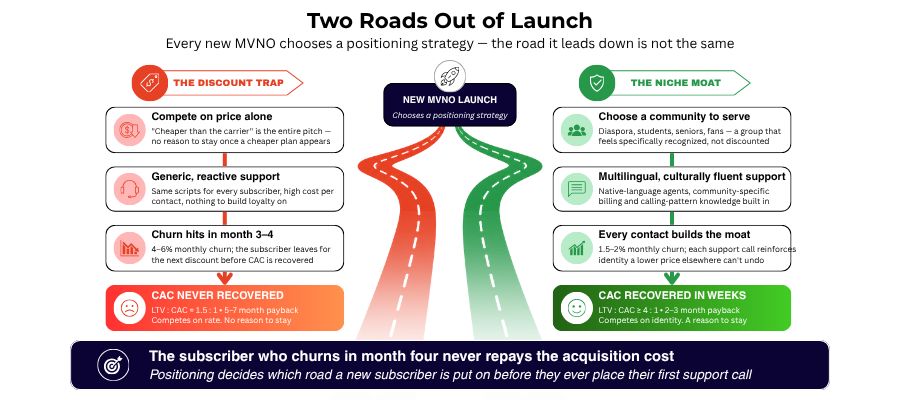
The Discount Trap vs. Niche Positioning — how positioning strategy rewrites MVNO support economics
A price-only MVNO typically churns 4–6% of its base monthly, takes five to seven months to recover its acquisition cost, and runs an LTV: CAC ratio around 1.5:1 — thin enough that a single bad quarter of promotions can erase the margin entirely. A niche-positioned MVNO, serving a defined community with support built for that community, typically holds churn closer to 1.5–2% monthly, recovers CAC in two to three months, and sustains an LTV: CAC ratio of 4:1 or better. The difference isn’t the network. Both operators lease the same towers. The difference is what happens the moment a subscriber needs help.
What Niche Support Actually Requires
Niche positioning isn’t just a marketing headline — it’s an operational commitment that shows up first and most visibly in customer support. Consider how differently three common MVNO niches need to be served.
Table 2: Support Requirements by MVNO Niche
Notice what’s common across all three rows: none of them can be solved with a better rate plan. Each is a support design problem — and for the largest of these niches, the language dimension is the single biggest support hurdle most MVNOs underestimate. Research from CSA Research finds that 76% of consumers prefer to buy and receive support in their native language — which is precisely why multilingual MVNO call center support has become a competitive requirement rather than a nice-to-have for any MVNO serious about a diaspora, immigrant, or global niche.
Why MVNO Customer Service Call Center Outsourcing Beats Building In-House for Niche Support
Once an MVNO commits to real niche positioning, the support burden multiplies: multiple languages, cultural context, community-specific billing questions, and — for diaspora brands especially — 24/7 coverage across the time zones where the community lives. Building that in-house, market by market, creates exactly the kind of overhead that erodes the margin advantage niche positioning is supposed to deliver.
Table 3: In-House MVNO Support vs. MVNO Customer Service Call Center Outsourcing
This is precisely why MVNO customer service call center outsourcing has become the operational backbone behind most successful niche MVNO brands: Lycamobile and Lebara didn’t win diaspora loyalty through pricing alone — both built support models around language and cultural fluency that a generic reseller can’t easily copy. A specialized telecommunications call center partner with multilingual capability and telecom-specific training turns “niche positioning” from a marketing slogan into an operational reality subscribers actually experience on their first support call.
Multilingual MVNO Call Center Support as the Moat
Gartner reports that 64% of customers now expect real-time responses regardless of location, and CSA Research’s finding that 76% of consumers prefer native-language service applies with particular force to diaspora and immigrant subscribers — the exact base that ethnic and community MVNOs depend on. When multilingual MVNO call center support is done well, it doesn’t just resolve tickets faster. It becomes the retention mechanism price competitors can’t replicate: a Tagalog-speaking subscriber who reaches a Tagalog-speaking agent who understands remittance timing and home-country calling patterns isn’t evaluating whether a rival’s plan is $2 cheaper. That interaction is the brand moat.
The Niche MVNO Support Playbook
For MVNO founders and CX leaders building the business case for a support model that matches their positioning, here is the blueprint in five steps:
- Map the niche to its actual support needs. Diaspora, student, senior, or fan-community subscribers each need a different support design — not just a different plan.
- Build language coverage before launch, not after complaints. Native-language support in the top two or three languages of your target community should be live on day one.
- Train agents on cultural and community context. International calling patterns, remittance timing, and community-specific billing questions are as important as product knowledge.
- Match channel mix to the niche’s actual habits. Chat-first for students and digital natives; patient phone support for seniors and less digitally fluent subscribers.
- Treat every support contact as a retention moment. A well-handled call in a subscriber’s own language is worth more than another percentage point off the plan price.
Five commitments. One durable moat that a price cut can’t erase.
Conclusion: Positioning Is the Real Growth Lever
The MVNO market isn’t short on growth — it’s short on differentiation. With subscriber counts climbing toward 438 million by 2030 and roughly 60% of operators still failing on the same undifferentiated playbook, the winners will be the brands that stopped competing on price and started competing on who they serve, and how well they serve them.
Niche positioning isn’t a slogan. It’s a support commitment — in the right language, with the right cultural fluency, available when the community actually needs it. For most MVNOs, the fastest and most economically rational way to deliver that commitment is a specialized MVNO customer service call center outsourcing partnership built for multilingual, community-specific care.
Fusion CX supports MVNO brands worldwide with 28 languages, right-shore delivery, and telecom-specific compliance expertise — turning niche positioning into a support experience subscribers actually feel.
Build the Support Model Your Positioning Promises
Don’t Let a Cheaper Plan Undo Your Niche Positioning
Talk to us about MVNO customer service call center outsourcing with multilingual, community-specific support built in from day one.