For consumer electronics brands, the holiday support peak does not necessarily end when the product ships. In many categories, that is when it begins.
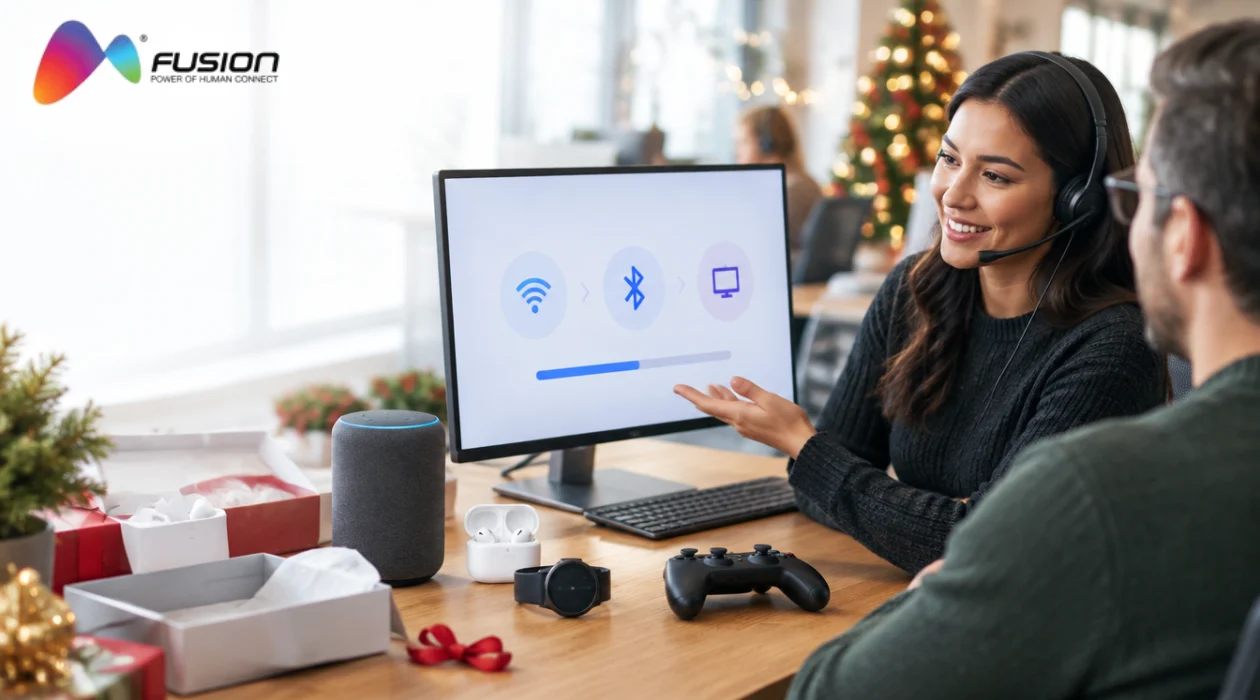
Christmas gifts are unboxed within a remarkably concentrated window. Smart TVs need to connect. Earbuds need to pair. Wearables need apps and accounts. Gaming devices require updates. Smart-home products have to join existing ecosystems. Appliances may need installation, registration, or configuration before customers can use them.
When any of those steps fail, the sale can quickly turn into a support contact, an escalation, a poor review, or a return.
That is why consumer electronics technical support outsourcing can play a much larger role than simply adding call-center capacity for the holidays. A well-designed outsourced model gives brands trained post-purchase capacity for setup, activation, connectivity, troubleshooting, warranty guidance, and other repeatable technical interactions exactly when demand becomes concentrated.
For customer care, after-sales, warranty, ecommerce, and service operations leaders, the question is therefore not simply whether holiday sales will increase. The more important question is whether the support operation can handle what happens when customers actually open and use those products.
Why the Consumer Electronics Support Peak Starts After the Sale
Many retail transactions effectively end when the customer receives the product. Consumer electronics are different.
Instead, ownership often begins with another sequence of actions. Customers may need to install, power, activate, register, pair, connect, configure, update, or integrate the product before they receive the value they expected from the purchase. As a result, holiday sales create a second demand curve: the ownership-support curve.
This issue becomes especially important after Christmas because thousands of customers can reach the same stage of the ownership journey at almost the same time. Consequently, contact volume may shift rapidly from order-status and delivery questions to setup, activation, connectivity, and troubleshooting.
Brands therefore need to think beyond conventional consumer electronics and appliance customer support. The post-gifting operation needs enough technical knowledge, system access, escalation coverage, and flexible capacity to resolve problems before frustration becomes a return.
What Actually Drives the Christmas Setup Surge?
The Christmas support spike rarely comes from one issue. Instead, it develops because many customers enter different stages of product ownership during the same short period.
Setup and activation
New devices may require account creation, product registration, app installation, activation codes, initial configuration, software updates, or permissions before customers can use them.
Even a simple activation problem can feel like a product failure to someone who has just opened a gift and expects it to work immediately. Therefore, brands need frontline teams that can distinguish routine setup friction from genuine technical failure.
Connectivity and pairing
Wi-Fi, Bluetooth, mobile applications, routers, smartphones, home assistants, and other connected devices create dependencies that customers may not immediately understand.
For example, the product itself may work correctly while a network setting, pairing step, application permission, or compatibility issue blocks successful setup. In that situation, skilled guidance can resolve the experience without moving the interaction into warranty or returns.
Product understanding
Customers also contact support because they do not know how a feature works, whether two products are compatible, how to transfer settings, or how to achieve the experience shown in the product description.
Good technical support therefore requires more than reading a script. Agents need accurate product knowledge, clear troubleshooting logic, and access to the right information while they are speaking with the customer.
Troubleshooting
A device may fail to connect, update, charge, recognize another product, or complete setup. Customers can then conclude that the product is defective before anyone has completed basic troubleshooting.
This is where consumer electronics support can reduce avoidable returns. Agents can help customers distinguish a genuine defect from a solvable setup, configuration, connectivity, or usage issue.
Warranty, repair, replacement, and returns
When frontline troubleshooting does not solve the problem, customers need a clear next step. Depending on the issue, that may involve warranty guidance, repair coordination, replacement eligibility, installation assistance, or a return.
However, these interactions still need consistent ownership. Repeated transfers between customer service, technical support, warranty, and returns teams can turn an already frustrated customer into a lost one.
Which Contacts Should Tier 1 Resolve, and Which Need Specialist Escalation?
A scalable technical-support model does not require every frontline agent to become an engineer. Instead, it requires clear boundaries.
Agents need to know what they can resolve, which diagnostic steps they can perform, which systems they can access, and exactly when they must move an interaction to a specialist or client team.
| Contact Type | Tier 1 Support | Specialist / Client Escalation |
|---|---|---|
| Product registration | Resolve | Exceptions only |
| Account activation | Resolve | Complex account issues |
| Standard product setup | Resolve | Installation exceptions |
| Wi-Fi / Bluetooth pairing | Standard troubleshooting | Advanced compatibility issues |
| Published troubleshooting | Resolve | Suspected hardware failure |
| Warranty guidance | Standard eligibility and intake | Policy exceptions |
| Safety or engineering issue | Identify and route | Immediate specialist escalation |
Therefore, the best outsourced technical support operation does not try to keep every contact at Tier 1. Instead, it resolves the appropriate interactions quickly and moves higher-risk or specialist issues to the right team without unnecessary delay.
The Cheapest Return May Be the One Technical Support Prevents
Returns make this support challenge commercially significant. The National Retail Federation and Happy Returns reported that 17% of holiday sales were expected to be returned in their 2025 Retail Returns Landscape research.
Of course, brands cannot and should not prevent every return. Customers may receive the wrong item, change their minds, encounter genuine defects, or have other legitimate reasons to send a product back. However, consumer electronics create another category: products that customers return because they cannot get them to work.
For example, a pairing issue can look like a defect. A configuration problem can look like a broken feature. A compatibility question can become a refund request. Likewise, a confusing installation process can push the customer toward a return before anyone attempts troubleshooting. This is why installation support before a product becomes a refund matters commercially, not just operationally.
Ultimately, the objective is not to obstruct legitimate returns. Instead, brands should give customers a fast opportunity to solve problems that support teams can genuinely resolve.
What Should Consumer Electronics Brands Outsource Before Christmas?
The strongest starting point for consumer electronics technical support outsourcing is repeatable work with clear procedures, training requirements, measurable outcomes, and defined governance.
For example, Tier 1 teams can often handle product registration, account activation, standard setup, device pairing, connectivity troubleshooting, basic product guidance, published diagnostic steps, warranty inquiry intake, repair-status support, installation coordination, and first-line troubleshooting before a customer initiates a return.
By contrast, specialist teams should handle work involving greater risk or deeper expertise. That can include safety concerns, suspected engineering defects, recall-related interactions, complex hardware diagnosis, unusual warranty exceptions, and replacement decisions that require manufacturer authorization. In simple terms: outsource repeatable technical work, but design escalation around risk and expertise.
Brands evaluating the broader model can also review our guide to outsourcing customer support for consumer electronics and appliances.
Holiday Technical Support Needs Production-Ready Capacity, Not Just More Agents
A support provider may recruit additional people quickly. However, recruitment alone does not make those agents ready to troubleshoot products. Consumer electronics support places a different burden on training and knowledge management than general retail service. Therefore, brands need to assess the operating system behind the headcount.
Train around real contact drivers
First, training should prioritize the interactions customers are most likely to generate during the post-gifting window. If pairing, activation, installation, account setup, or software updates represent most expected contacts, training should focus heavily on those workflows before agents enter production.
Build product knowledge by model and issue
Next, agents need to understand where product families differ, where instructions change by model, which compatibility issues occur frequently, and which troubleshooting paths require strict adherence. This approach helps teams avoid generic troubleshooting when the product or model requires a different path.
Provide the right system access
In addition, agents need the systems required to resolve the interaction. Good troubleshooting can still fail when an agent cannot see the order, registration, warranty status, repair record, previous interaction, or relevant knowledge article.
Define escalation before launch
Technical escalation also needs clear rules before the surge begins. Teams should document transfer criteria, queues, ownership, response expectations, and client-side contacts before agents start taking holiday volume. As a result, agents can move exceptions quickly instead of improvising escalation while the customer waits.
Use QA to detect emerging issues
Finally, holiday contact drivers can change quickly. A firmware update, compatibility issue, unclear instruction, or recurring setup failure can suddenly affect large numbers of customers.
Quality monitoring should therefore do more than score agent performance. It should identify patterns and feed them back into training, knowledge articles, troubleshooting trees, and product teams.
That is also why Q4 customer service outsourcing for consumer electronics needs an operating model rather than a last-minute seat request. Meanwhile, brands that need broader seasonal capacity can evaluate retail call center solutions across voice and digital channels.
Warranty Support Is Part of the Same Ownership Journey
Technical support should not end when standard troubleshooting fails. From the customer’s perspective, setup, troubleshooting, warranty, repair, replacement, and returns all belong to one ownership experience.
For that reason, customers should not have to restart the story every time the interaction moves between teams. A customer who has already explained the problem twice expects the next person to understand what happened and what needs to happen next.
Connecting technical support with consumer electronics warranty support can reduce repeat explanations, improve routing, and create clearer ownership of unresolved cases. In addition, brands that support customers across several channels can use omnichannel customer support to preserve interaction context as customers move between voice, chat, email, and other touchpoints.
What Product-Support Performance Looks Like in Practice
Technical-support strategy becomes more credible when brands can connect it to experience supporting products that require explanation, guidance, and high-touch customer engagement.
For example, Fusion CX supports a leading wellness-tech retailer through a product-focused customer engagement model. As the program expanded, it achieved an 80% sales conversion rate, up from a 65% benchmark, while maintaining 90% CSAT.
Although wellness tech differs from mainstream consumer electronics, the operating lesson still applies. Product knowledge, structured customer conversations, trained capacity, and disciplined performance management can influence both customer satisfaction and commercial outcomes.
See how Fusion CX improved conversion and CSAT for a leading wellness-tech retailer →
The Metrics to Watch From Christmas Through Early January
A successful holiday technical-support operation should measure more than total contacts handled.
Instead, leaders need to understand whether the support model actually resolves ownership friction and prevents unnecessary effort.
| Metric | What It Tells You |
|---|---|
| First-contact resolution | Shows how much setup and troubleshooting demand agents resolve without another interaction. |
| Repeat-contact rate | Shows whether customers return because the underlying problem remains unresolved. |
| Escalation rate | Helps leaders assess whether Tier 1 scope and training match actual contact demand. |
| CSAT | Measures how customers perceive the post-purchase support experience. |
| QA score | Tests whether agents deliver technical guidance accurately and consistently. |
| Return after support contact | Shows where troubleshooting may prevent, or fail to prevent, avoidable returns. |
| Contact volume by product and issue | Identifies which models and problems create the most post-purchase demand. |
Importantly, this data can reveal problems beyond the contact center. A sudden increase in one setup or compatibility issue may point to unclear instructions, a product change, a software issue, or a gap in the digital onboarding journey.
As a result, technical-support data can help customer care teams contribute insight to product, ecommerce, warranty, and operations teams instead of functioning only as a service queue.
What Should You Ask a Consumer Electronics Technical Support Outsourcing Partner?
For a VP of Customer Care, After-Sales, Service Operations, Warranty, or Ecommerce, the vendor conversation should go well beyond hourly rates and available seats.
Instead, buyers should test whether the provider has an operating model that can support technical complexity during a compressed seasonal surge.
- How do you train agents across multiple products and models? Ask how the provider segments, tests, certifies, and updates product knowledge.
- What belongs at Tier 1? The provider should clearly distinguish resolution, diagnosis, and specialist escalation.
- How quickly can you update knowledge? Holiday technical issues can emerge within hours, not weeks.
- Which client systems will agents need? Define CRM, order history, warranty, repair, product registration, and knowledge access before launch.
- How does QA work for technical conversations? Accuracy matters as much as tone and handle time.
- Can capacity flex after Christmas? Demand may shift from setup contacts into troubleshooting, warranty, and January returns.
- How do you escalate safety and engineering concerns? High-risk contacts need immediate routing and clear ownership.
- How will you measure resolution before return? Wherever the data allows, the operating model should connect support performance to post-purchase outcomes.
Ultimately, a credible provider should answer these questions with an operating model, not just a staffing promise.
The Holiday Sale Is Not Complete Until the Product Works
Revenue may be recorded when the customer purchases the product. However, the customer’s judgment of that product often begins when they switch it on.
A device that activates, connects, and works can become part of the customer’s everyday life. By contrast, one that creates confusion can quickly become a support ticket, an escalation, a negative review, or a return.
Therefore, post-purchase support plays an important role in protecting holiday revenue as well as customer experience.
Consumer electronics technical support outsourcing can give brands the trained capacity to absorb concentrated setup and troubleshooting demand without permanently building internal headcount around a seasonal spike. The right model separates repeatable Tier 1 support from specialist work, connects troubleshooting with warranty and returns, and continuously feeds customer issues back into knowledge and operations.
Fusion CX supports consumer electronics, appliance, retail, and ecommerce brands with customer service, technical support, omnichannel operations, quality management, and flexible delivery models that adapt to changing customer demand.
Is Your Technical Support Operation Ready for the Post-Christmas Surge?
If you expect a sharp increase in setup, activation, connectivity, troubleshooting, warranty, or return-related contacts after the holidays, the planning window starts before customers open those products. More importantly, brands should know which contacts Tier 1 can resolve, which require specialist escalation, how much trained capacity they need, and how quickly that capacity can flex as the contact mix changes.
Tell us your product categories, expected volumes, support channels, current Tier 1 scope, and holiday support window. We can help assess the staffing model, escalation design, delivery approach, and what it should cost.