
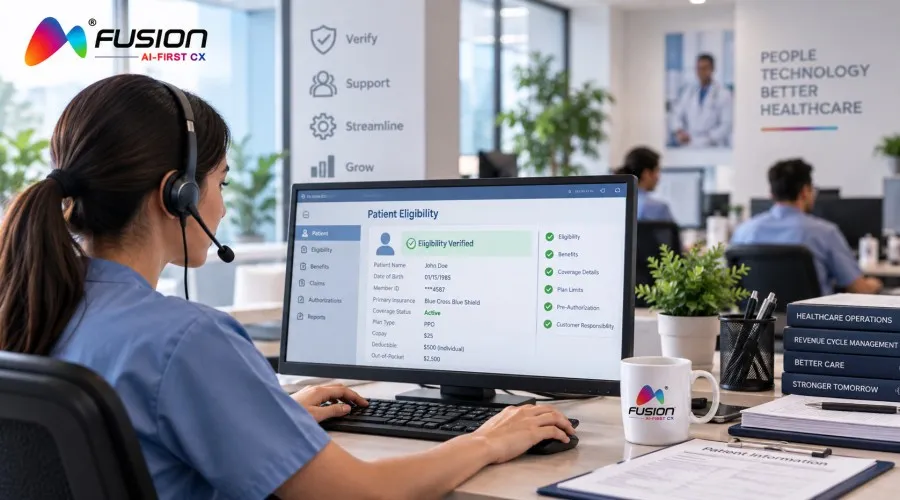
Every clean claim starts with one step done right: verifying the patient’s insurance before care is delivered. When that step fails, the consequences ripple through the entire revenue cycle. Claims get denied. Payments slow down. Patients receive surprise bills and lose trust. In fact, eligibility and registration errors are among the most common and most preventable causes of claim denials. That is why more healthcare organizations now turn to patient eligibility verification outsourcing. By handing this high-volume, detail-heavy task to a specialized partner, providers reduce denials, speed up reimbursement, and improve the patient experience. This guide explains what eligibility verification outsourcing is, how it works, and why it matters.
What Is Patient Eligibility Verification?
Patient eligibility verification is the process of confirming a patient’s insurance coverage before a service is provided. It answers a few essential questions. Is the coverage active? What does the plan cover? What are the copay, deductible, and coinsurance amounts? Does the service need prior authorization? And is there any coordination of benefits with a second payer? Getting these answers upfront prevents nasty surprises later, for both the provider and the patient.
Industry Insight: According to the CAQH Index, shifting eligibility and benefit verification from manual to electronic methods saves the U.S. healthcare industry billions of dollars each year, yet a meaningful share of verifications are still handled manually.
Why Eligibility Verification Matters
This step sits at the front door of the revenue cycle, so errors here follow the claim all the way through. An unverified or inactive policy leads to a denial. A missed prior authorization leads to a denial. An incorrect copay leads to a billing dispute. Each of these costs time and money to fix, and many are entirely preventable. Strong verification also protects the patient experience. When patients know their coverage and costs in advance, they trust the provider more and pay more reliably.
The data backs this up. Research on claim denials has consistently found that the large majority are potentially avoidable, and that front-end issues such as registration and eligibility errors rank among the leading causes. Experian Health’s State of Claims research has also reported that denials are rising, with missing or inaccurate eligibility data cited as a top driver. Preventing these errors at the front end is far cheaper than reworking a denied claim later. Industry estimates commonly place initial claim denial rates in the low double digits, and the cost to rework a single denied claim at roughly $25 or more, according to MGMA and other industry sources. Multiply that across thousands of claims, and the value of getting eligibility right becomes clear.
| Front-end denial cause | How eligibility verification prevents it |
|---|---|
| Inactive or terminated coverage | Confirms active coverage before the visit |
| Missing prior authorization | Flags authorization requirements upfront |
| Coordination-of-benefits errors | Identifies primary and secondary payers |
| Incorrect patient or insurance data | Validates and corrects details at registration |
| Non-covered service | Checks plan benefits and limitations in advance |
Expert Insight: Verify eligibility before every visit, not just for new patients. Coverage changes constantly, and a policy that was active last month may be inactive today.
What an Outsourced Eligibility Team Handles
A capable partner manages the full verification lifecycle. That includes confirming active insurance coverage, checking plan benefits and limitations, and calculating patient financial responsibility. It also covers obtaining or flagging prior authorizations, identifying coordination of benefits, updating patient records in your system, and communicating coverage details to patients. When something looks wrong, the team resolves it before the appointment, not after the claim is denied.
The Benefits of Outsourcing Eligibility Verification
The advantages show up across the revenue cycle and the patient journey.
- Fewer denials: accurate upfront verification removes one of the biggest sources of preventable denials.
- Faster reimbursement: clean claims move through faster, improving cash flow.
- Scalability: outsourced teams flex with patient volume, seasonal peaks, and growth.
- Lower cost: you avoid the overhead of recruiting, training, and retaining a large in-house team.
- Staff focus: your people spend less time on payer portals and more on patient care.
- Better patient experience: patients learn their coverage and costs early, which builds trust.
In-House vs. Outsourced Eligibility Verification
The trade-offs are clearest side by side.
| Factor | In-house | Outsourced |
|---|---|---|
| Staffing | Internal staff, hard to scale | Trained team, elastic capacity |
| Peak volume | Backlogs when demand spikes | Scales with demand |
| Accuracy & QA | Variable, sample-based | Structured QA, often AI-monitored |
| Technology | You buy and maintain it | Provider-integrated portals and tools |
| Cost structure | Salaries + overhead | Service-based pricing |
| Staff focus | Pulls staff from patient care | Frees staff for core work |
How Eligibility Verification Outsourcing Works
The process is structured and repeatable. It usually follows a clear path:
Appointment Scheduled → Collect Insurance Details → Verify With Payer → Document Benefits → Flag Prior Auth / Issues → Inform Patient → Update System
First, the team collects the patient’s insurance information at or before scheduling. Next, they verify coverage directly with the payer, through portals, clearinghouses, or calls. They then document the benefits, copay, deductible, and any authorization requirements. If a problem appears, they resolve it or flag it to your staff. Finally, they inform the patient and update your system, so registration and billing start from accurate data.
Key Metrics to Track
Measure the program on outcomes, not activity. The metrics that matter most include:
- Clean-claim rate — the share of claims that pass without edits or denials.
- Initial denial rate — how often claims are denied on first submission.
- Eligibility-related denial rate — denials traced specifically to coverage or registration errors.
- Verification turnaround time — how quickly coverage is confirmed before the visit.
- Verification accuracy — the correctness of the benefits and cost data captured.
- Cost to rework a denial — the downstream cost your program is avoiding.
Expert Insight: Track the eligibility-related denial rate specifically. It isolates the exact problem verification is meant to solve, so you can prove the program’s value in hard numbers.
The Role of the Healthcare Call Center
Verification is not only a back-office task. It also has a patient-facing side, and that is where a healthcare call center adds value. Agents confirm insurance details with patients, explain coverage and expected out-of-pocket costs in plain language, and answer questions before the visit. This proactive communication reduces confusion, cuts down on billing disputes, and makes patients feel informed rather than blindsided. Handled well, it turns a routine administrative step into a moment of trust.
Compliance and Accuracy Are Essential
Eligibility verification involves protected health information, so compliance is non-negotiable. A strong partner handles data securely, follows HIPAA requirements, and maintains complete audit trails. Accuracy is just as important, because a single wrong detail can trigger a denial. The right provider should be able to show exactly how it maintains accuracy at volume, and how it catches errors before they reach a claim. Ask how quality is measured, not just whether a quality program exists.
The AI Layer: Speed and Accuracy at Scale
Modern verification pairs skilled people with automation. At Fusion CX, technology handles the repetitive parts so agents focus on exceptions. Automated checks speed up routine verifications, while AI QMS monitors 100% of interactions and transactions for accuracy and compliance, rather than a small sample. Our Sayin.AI voice agent can handle high-volume patient confirmations, freeing staff for complex cases. The result is faster verification, fewer errors, and a lower cost per verified patient.
How to Choose an Eligibility Verification Partner
Not every provider understands healthcare. The right partner combines real RCM and verification experience, HIPAA-grade security, and technology that integrates with your practice management and EHR systems. Look for proven accuracy, elastic capacity for volume swings, transparent reporting, and a team that knows payer rules. A partner that offers both back-office verification and patient-facing support gives you consistency across the whole process.
Final Thoughts
Patient eligibility verification outsourcing turns a fragile, error-prone step into a reliable engine for clean claims and a better patient experience. Done well, it reduces denials, speeds up reimbursement, scales with demand, and frees your staff to focus on care. As margins tighten and payer rules grow more complex, getting the front end right has never mattered more. A specialized partner is often the fastest way to get there.
Fusion CX helps healthcare organizations verify patient eligibility accurately and at scale, combining trained healthcare BPO teams, a compliant healthcare call center, and an AI layer that keeps quality high and denials low. Talk to our healthcare experts to strengthen your eligibility verification and revenue cycle.