
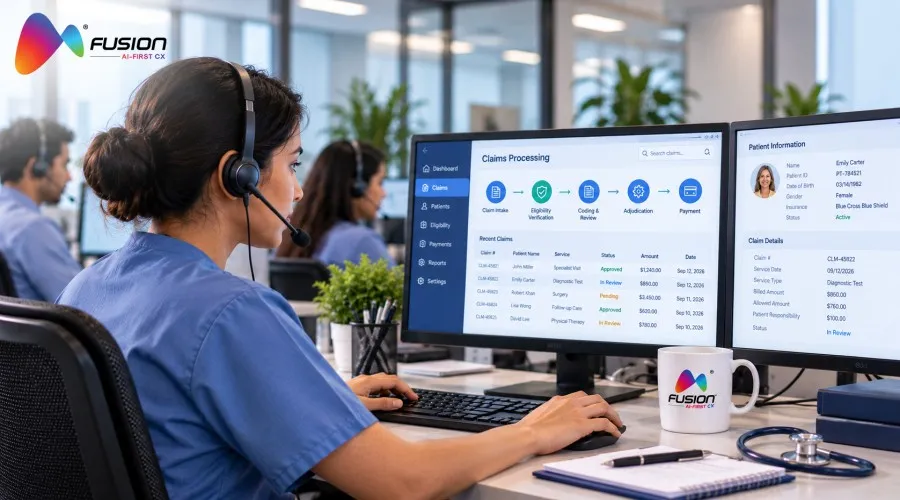
Claims are the financial engine of every healthcare organization, and they are also one of its biggest operational burdens. Denials are rising, payer rules keep changing, and administrative costs consume a large share of every healthcare dollar. When claims support is slow or error-prone, providers wait longer to get paid, members grow frustrated, and staff spend their days on rework instead of care. This is why healthcare claims support outsourcing has become a strategic move. A specialized partner reduces denials and speeds reimbursement. It also improves the experience for members and providers. This guide explains the processes, the benefits, and how to choose the right partner.
What Is Healthcare Claims Support Outsourcing?
Healthcare claims support outsourcing means partnering with an external healthcare BPO to manage the support work around claims. The work spans a wide range of tasks. That includes claim status inquiries, denial management, appeals support, and member and provider communication. The partner’s trained team works inside your systems and follows your workflows. In effect, it blends back-office claims processing with front-line customer service outsourcing. So both the paperwork and the people are handled well.
Why Claims Support Is Under Pressure
The claims environment has grown harder, not easier. Denials are climbing, and much of the cost is avoidable. Experian Health’s State of Claims survey has found that denials are rising. Many stem from preventable front-end and data issues. Reworking those denials is expensive. MGMA and other sources estimate the cost to rework one denied claim at roughly $25 or more. Administrative complexity adds to the strain, too, since it consumes a large share of U.S. healthcare spending.
Industry Insight: According to the CAQH Index, moving claims-related transactions from manual to electronic processes saves the U.S. healthcare system billions of dollars each year, yet many organizations still handle a large share manually.
The Healthcare Claims Support Process
Effective claims support follows a structured path from submission to resolution:
Claim Submitted → Status Tracking → Adjudication Support → Denial Management → Appeals → Member & Provider Communication → Resolution
In practice, the team tracks claim status and answers inquiries from members and providers. When a claim is denied, they investigate the reason, correct what can be fixed, and guide the appeal within payer and regulatory timelines. Throughout, they document everything and keep members and providers informed. The goal is simple: resolve issues quickly and prevent the next one.
What Healthcare Claims Support Outsourcing Includes
A capable partner covers the full support workload, which usually maps to these functions:
| Function | What it covers |
|---|---|
| Claim status inquiries | Answering member and provider questions on where a claim stands |
| Denial management | Identifying, correcting, and resubmitting denied claims |
| Appeals support | Guiding appeals within payer and CMS timelines |
| EOB and cost explanation | Explaining benefits and patient responsibility in plain language |
| Provider claims support | Adjudication questions, corrected claims, and remittance help |
| Back-office processing | Claim research, data entry, and reconciliation |
The Role of the Healthcare Call Center
Claims support is not only back-office work. It has a strong human side, and that is where a healthcare call center proves its value. Agents explain denials and Explanation of Benefits statements in plain language. They walk members through their options. They also give providers fast, accurate answers on claim status. Many callers are stressed or confused, so empathy matters as much as accuracy. Handled well, a claims call becomes a moment of trust rather than frustration.
Expert Insight: Track your denial rate by root cause, not just volume. Fixing the top two or three recurring causes usually prevents far more denials than working each one after the fact.
Benefits of Outsourcing Healthcare Claims Support
The advantages reach across the revenue cycle and the member experience:
- Fewer denials: specialized teams catch and correct errors before they cost you.
- Faster reimbursement: quicker resolution improves cash flow.
- Lower cost: you avoid the overhead of building and staffing a large internal team.
- Scalability: capacity flexes with claim volume and seasonal peaks.
- Compliance discipline: partners maintain HIPAA and CMS-aligned processes.
- Better experience: members and providers get clear, timely answers.
- Staff focus: your team shifts from rework to higher-value work.
In-House vs. Outsourced Claims Support
| Factor | In-house | Outsourced |
|---|---|---|
| Scalability | Limited by headcount | Flexes with volume |
| Denial expertise | Varies by team | Specialized and current |
| Quality assurance | Sample-based | Structured, often AI-monitored |
| Cost structure | Salaries + overhead | Service-based pricing |
| Focus | Pulls staff from core work | Frees internal teams |
Compliance and Accuracy Are Non-Negotiable
Claims support handles protected health information. That means strict rules from HIPAA and CMS, plus firm timelines for appeals and grievances. A strong partner secures data and keeps complete audit trails. It also meets every regulatory deadline. Accuracy matters just as much, because one wrong detail can trigger a denial. So ask exactly how a partner maintains accuracy and catches issues early.
The AI Layer: Faster Resolution, Consistent Quality
The best claims operations pair skilled people with automation. At Fusion CX, our Sayin.AI voice agent handles routine claim-status inquiries. That lets agents focus on complex denials and appeals. AI QMS monitors 100% of interactions, not just a small sample. And Semantify surfaces the patterns behind denials, so you can fix root causes. The result is faster resolution and consistent quality at a lower cost per contact.
Key KPIs to Track
Measure the program on outcomes that connect to revenue and experience:
- Clean-claim rate and initial denial rate
- Denial overturn rate on appeals
- Days in accounts receivable
- First-contact resolution and average speed of answer
- Appeal and grievance turnaround vs. CMS deadlines
- Member CSAT and provider satisfaction
- Cost per resolved claim contact
How to Choose a Healthcare Claims Support Partner
Not every provider understands healthcare claims. Look for real payer and provider claims experience, HIPAA-grade security, and technology that integrates with your systems. Confirm structured quality assurance, elastic capacity, transparent reporting, and a team fluent in denials and appeals. A partner that offers both back-office processing and member- and provider-facing support gives you consistency across the whole claims journey.
Final Thoughts
Healthcare claims support outsourcing turns a costly, error-prone burden into a reliable engine for clean claims and a better experience. Done well, it lowers denials, speeds reimbursement, scales with demand, and frees your staff to focus on care. As denials rise and payer rules grow more complex, getting claims support right is one of the highest-leverage moves a healthcare organization can make.
Fusion CX delivers healthcare claims support for payers and providers, combining trained healthcare BPO teams, a compliant healthcare call center, and an AI layer that keeps quality high and denials low. Talk to our healthcare experts to strengthen your claims support and revenue cycle.